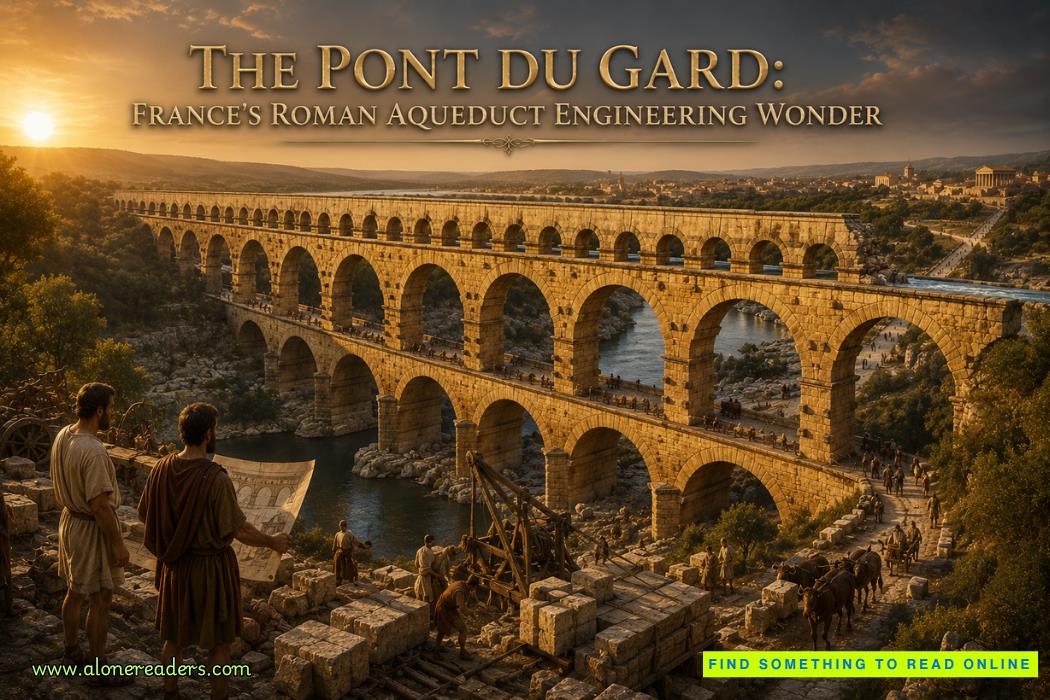
The Pont du Gard stands as one of the greatest surviving monuments of Roman engineering anywhere in the world. Rising dramatically above the Gardon River in southern France, this colossal aqueduct bridge remains a breathtaking symbol of the Roman Empire’s technical mastery, organizational power, and architectural ambition. Nearly two thousand years after its construction, the structure still dominates the landscape with astonishing elegance and durability, serving as both an engineering marvel and a reminder of how advanced Roman infrastructure had become during the first century CE. While many ancient monuments survive as ruins or fragmented remains, the Pont du Gard continues to stand almost completely intact, allowing modern observers to appreciate the extraordinary sophistication of Roman civil engineering in near-original form.
Constructed during the reign of the Roman Empire in the mid-first century CE, most likely under Emperor Claudius or Nero, the Pont du Gard formed part of a larger aqueduct system built to transport fresh water to the Roman colony of Nemausus, known today as Nîmes. The city was rapidly growing in importance and population, requiring a stable and abundant water supply for public baths, fountains, households, gardens, and sanitation systems. Roman urban life depended heavily upon reliable water infrastructure, and aqueduct construction became one of the empire’s defining technological achievements. The Pont du Gard represented the most spectacular section of a nearly 50-kilometer aqueduct route that carried water from natural springs near Uzès all the way to Nîmes.
What makes this feat especially remarkable is the extreme precision involved in maintaining the water flow. Roman engineers designed the aqueduct with an average gradient of only a few centimeters per kilometer. Despite traversing hills, valleys, forests, and rocky terrain, the water needed to move continuously using only gravity. Any error in measurement could have disrupted the entire system. The Pont du Gard itself was constructed to carry the channel high above the Gardon River valley while preserving the precise downward slope necessary for uninterrupted water transport. The result was an engineering accomplishment so accurate that modern experts continue to study it with admiration.
The structure rises approximately 49 meters high and stretches roughly 275 meters across the river valley. Its three levels of arches create a visually stunning geometric composition that combines functionality with monumental beauty. The lowest tier contains six massive arches supporting the entire structure, while the second tier contains eleven arches. The uppermost level features thirty-five smaller arches carrying the actual water channel, or specus, through which water flowed toward Nîmes. This progressive reduction in arch size and mass demonstrates an advanced understanding of load distribution and structural stability. Roman engineers were not simply building for utility; they were creating enduring monuments that reflected imperial strength and mathematical perfection.
One of the most extraordinary aspects of the Pont du Gard is that it was constructed without mortar. The massive limestone blocks were precisely cut and fitted together so accurately that their own weight and balance secured the structure. Some blocks weigh several tons and were transported from nearby quarries using sophisticated Roman lifting systems, cranes, rollers, and manpower organization. Iron clamps and strategically designed joints further reinforced the structure. The precision required for such construction was immense, especially considering that the project was completed without modern machinery, powered equipment, or computerized measurements.
The limestone used for construction came primarily from local quarries along the Gardon region. Roman stonemasons carefully shaped each block to exact specifications before lifting them into place. Evidence suggests that the builders employed wooden scaffolding and treadwheel cranes capable of raising enormous stones to impressive heights. The logistical coordination involved in moving, cutting, lifting, and positioning thousands of heavy stones demonstrates the Roman Empire’s remarkable organizational capabilities. The Pont du Gard was not merely a bridge—it was a carefully calculated hydraulic machine integrated into a vast infrastructure network.
The aqueduct supplied an estimated 20,000 to 40,000 cubic meters of water per day to Nîmes. This water supported public baths, ornamental fountains, private residences, irrigation systems, and sanitation facilities throughout the city. Roman urban civilization placed tremendous emphasis on water accessibility, cleanliness, and public bathing culture. In many ways, aqueducts represented the foundation of Roman city life. Without such systems, large urban populations would have struggled to survive. The Pont du Gard therefore served not only as an engineering structure but also as a vital artery sustaining economic growth, hygiene, and social activity within the colony.
The Romans understood hydraulic engineering with astonishing sophistication. The water channel atop the Pont du Gard was lined with waterproof mortar and carefully maintained to prevent leakage or contamination. Inspection shafts allowed maintenance workers to access the channel periodically and remove mineral buildup caused by calcium-rich water. Over time, thick limestone deposits accumulated inside the channel, but these deposits also provide modern archaeologists with valuable information about water flow patterns and maintenance schedules used during Roman occupation.
Another remarkable feature of the Pont du Gard is its ability to withstand centuries of natural and human threats. Floods, wars, erosion, neglect, and changing political regimes all threatened the structure at various points in history. Yet the aqueduct survived due to the incredible quality of its engineering and construction techniques. During the Middle Ages, the bridge even served as a toll crossing for travelers and merchants. Modifications were made to accommodate carts and foot traffic, including the removal of some stonework along the lower level. Although these changes slightly damaged the original design, they ironically contributed to the structure’s continued maintenance and preservation.
Throughout medieval and early modern periods, many Roman monuments across Europe were dismantled for building materials. The Pont du Gard narrowly escaped complete destruction multiple times. Local authorities and rulers eventually recognized its historical and architectural significance, leading to preservation efforts beginning in the eighteenth century. French engineers conducted restorations to stabilize weakened sections and prevent collapse. By the nineteenth century, the bridge had become a celebrated symbol of France’s classical heritage and an important destination for artists, scholars, and travelers.
The structure gained international admiration during the rise of archaeology and historical preservation movements in Europe. Architects, historians, and engineers viewed the Pont du Gard as evidence of Rome’s unparalleled mastery of civil engineering. It became a physical textbook of ancient construction techniques. Even modern engineers continue to marvel at the precision of its measurements and the durability of its design. The fact that the bridge remained standing for nearly two millennia despite floods and seismic activity illustrates how effectively Roman engineers understood force distribution, material properties, and structural geometry.
Aesthetic beauty also plays a central role in the monument’s enduring fame. Unlike many functional infrastructure projects, the Pont du Gard possesses a striking architectural harmony that elevates it into the realm of monumental art. The repeating arches create rhythmic symmetry against the surrounding landscape, while the warm golden limestone reflects sunlight beautifully throughout the day. The bridge appears simultaneously powerful and elegant, embodying the Roman belief that engineering and beauty should coexist. This combination of functionality and visual grandeur remains one of the defining characteristics of Roman architecture.
The surrounding environment contributes greatly to the monument’s atmosphere. Located amid the rugged Mediterranean landscape of southern France, the aqueduct rises above clear river waters, rocky cliffs, and dense vegetation. Seasonal changes alter the scenery dramatically, with summer sunlight intensifying the limestone’s golden tones while winter mists create an almost mystical silhouette around the arches. The setting reinforces the impression that the structure belongs naturally within the landscape despite its immense scale and artificial construction.
Archaeological research around the Pont du Gard has revealed extensive information about Roman labor systems and construction organization. Workers likely included skilled Roman engineers, local laborers, slaves, stonemasons, surveyors, and military personnel. Roman infrastructure projects required enormous administrative planning, including material procurement, worker coordination, food supply logistics, and transportation management. Surveyors used sophisticated instruments such as the chorobates and groma to measure distances and gradients with remarkable accuracy. These tools allowed engineers to maintain the aqueduct’s delicate slope across vast terrain.
The aqueduct system eventually fell into disuse after the decline of Roman authority in the region. As political instability spread and maintenance ceased, mineral deposits and structural deterioration gradually reduced water flow. By approximately the sixth century CE, the aqueduct no longer functioned effectively as a water supply system. Nevertheless, the bridge itself endured due to its immense structural strength. Its transformation from infrastructure into historical monument reflects the broader transition from Roman civilization to medieval Europe.
Today, the Pont du Gard is recognized as a UNESCO World Heritage Site and remains one of France’s most visited ancient monuments. Millions of visitors travel to southern France each year to witness the bridge’s scale and craftsmanship firsthand. Modern preservation efforts carefully balance tourism with structural protection, ensuring that the monument remains stable for future generations. Educational exhibitions and archaeological studies continue to deepen public understanding of Roman engineering techniques and the broader importance of aqueduct systems in ancient society.
Modern analysis using laser scanning, structural modeling, and geological studies has revealed just how advanced Roman engineering truly was. Researchers have discovered that the bridge’s dimensions were carefully optimized to minimize stress while maximizing durability. The use of varying arch spans, precise stone placement, and adaptive construction techniques demonstrates a level of engineering intelligence far beyond what many once assumed about the ancient world. The Pont du Gard continues to challenge modern misconceptions about technological progress and ancient capabilities.
The monument also symbolizes the Roman Empire’s broader philosophy of infrastructure-driven governance. Roads, bridges, aqueducts, harbors, and public buildings allowed Rome to integrate vast territories into a functioning imperial system. Water infrastructure in particular reflected Roman priorities regarding urbanization, public health, and civic life. The Pont du Gard therefore represents more than a local engineering success; it embodies the empire’s larger vision of order, connectivity, and technological control over nature.
The aqueduct’s enduring influence extends into modern engineering education and architectural inspiration. Engineers study Roman arch construction to better understand force transfer and long-term durability. Architects admire the balance between structural necessity and visual proportion achieved by Roman designers. Even contemporary bridge construction still employs many principles fundamentally similar to those demonstrated by the Pont du Gard nearly two thousand years ago.
Perhaps the most astonishing aspect of the Pont du Gard is the realization that it was built during a time without electricity, combustion engines, reinforced concrete, or digital calculations. Every measurement, stone cut, and structural adjustment depended upon human skill, mathematical understanding, and practical experience. Yet the finished structure achieved a level of precision and resilience that continues to impress modern experts. The monument stands as undeniable proof that ancient civilizations possessed engineering capabilities of extraordinary sophistication.
Walking beneath its towering arches today, visitors encounter not merely an old bridge but a surviving masterpiece of human ingenuity. The immense stone blocks, graceful curves, and perfectly balanced proportions create a powerful sense of continuity with the ancient world. The Pont du Gard remains a monument to ambition, precision, and technical brilliance—a structure that transformed the landscape of Roman Gaul and demonstrated the extraordinary reach of Roman engineering knowledge. Nearly two millennia after its construction, it still fulfills its original purpose in another form: carrying the achievements of the ancient world across time itself.




 The Hundred Days Offensive: How the Allies Defeated Germany in World War I
 The Second Battle of the Marne: The Turning Point of World War I in 1918
 The Spring Offensive of 1918: Germany's Final Gamble to Win World War I
 The Treaty of Brest-Litovsk: How Russia Left World War I
 The Russian Revolution and World War I: How War Brought Down the Tsar
 The Zimmermann Telegram Explained: Germany's Secret Offer to Mexico in World War I