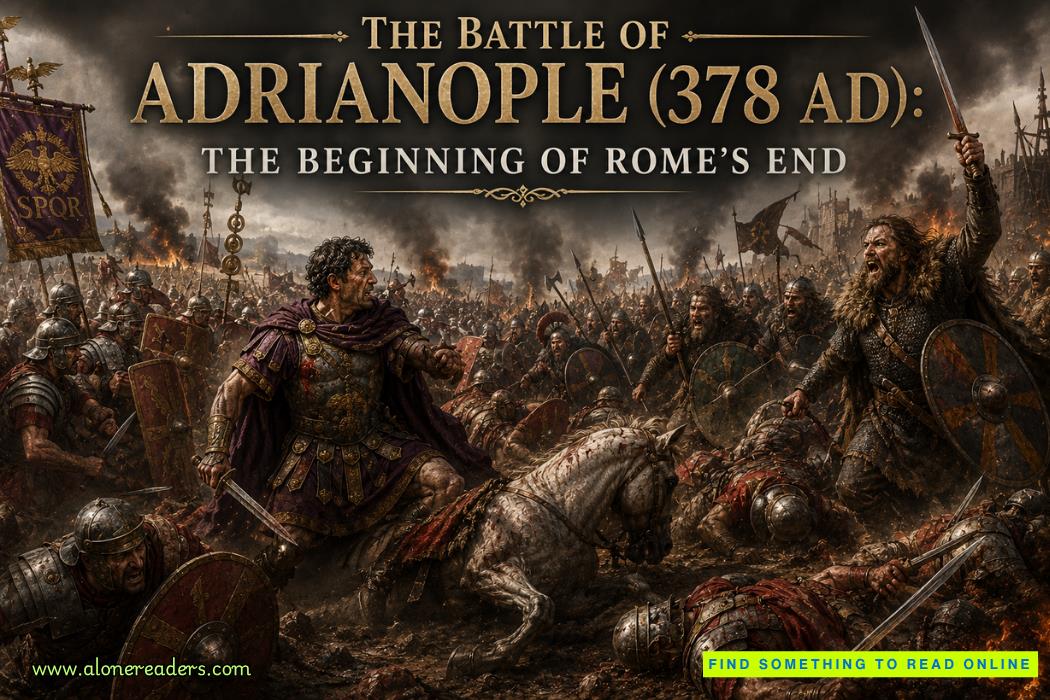
The Battle of Adrianople in 378 AD stands as one of the most catastrophic defeats in Roman military history, not merely for its immediate consequences, but for the long shadow it cast over the future of the Roman Empire. This was not just a lost battle—it was a moment when the illusion of Roman invincibility shattered, revealing deep structural weaknesses that would ultimately contribute to the fall of the Western Roman Empire less than a century later.
By the late fourth century, the Roman Empire was already undergoing profound transformation. Though still vast and powerful, it was no longer the unified, expansionist force of earlier centuries. Instead, it had become increasingly divided, both administratively and culturally, into Eastern and Western halves. Emperor Valens ruled the Eastern Roman Empire, while his nephew Gratian governed the West. While this division was meant to improve governance, it also led to fragmented responses to crises, a factor that would prove disastrous at Adrianople.
The roots of the battle lie in a crisis triggered not by Roman enemies, but by a mass migration of Gothic tribes fleeing a greater terror. Around 376 AD, the Huns, a nomadic and highly aggressive group from Central Asia, began pushing westward into Gothic territories north of the Danube River. Faced with annihilation, large numbers of Goths—particularly the Thervingi—sought refuge within Roman borders. They petitioned Emperor Valens for asylum, offering to settle peacefully and even serve as soldiers in the Roman army.
Valens agreed, seeing an opportunity to strengthen his forces with fresh recruits. However, what could have been a mutually beneficial arrangement quickly deteriorated due to corruption, mismanagement, and exploitation by Roman officials. The Goths were poorly supplied, mistreated, and even starved. Roman commanders extorted them, selling food at exorbitant prices and allegedly even trading dog meat for Gothic children as slaves. This inhumane treatment transformed desperate refugees into angry rebels.
The situation escalated into open revolt. Gothic forces, under leaders such as Fritigern, began raiding Roman territories in Thrace. Roman attempts to suppress the uprising were ineffective, partly due to underestimating the Goths and partly due to poor coordination. Over the next two years, the Goths proved to be a formidable force, defeating smaller Roman units and gathering strength.
By 378 AD, Emperor Valens decided to take decisive action. Rather than waiting for reinforcements from the Western Emperor Gratian, who was marching to assist him, Valens chose to engage the Goths alone. This decision has been widely criticized by historians as a fatal miscalculation driven by pride and impatience. Valens reportedly feared that sharing victory with Gratian would diminish his own prestige.
On August 9, 378 AD, near the city of Adrianople (modern-day Edirne in Turkey), the Roman army confronted the Gothic forces. The Roman army was substantial, possibly numbering between 15,000 to 20,000 troops, including heavy infantry and cavalry. However, they were exhausted from a long march under the summer heat and lacked proper reconnaissance of the enemy’s full strength.
The Goths had formed a defensive position using a wagon laager—a circular barricade made of wagons—to protect their non-combatants. While part of their cavalry was away foraging, Fritigern cleverly delayed the Roman attack through negotiations, buying time for his cavalry to return. This tactical maneuver would prove decisive.
The battle began chaotically. Roman units advanced without full coordination, and some engaged prematurely. The Roman cavalry on the flanks was quickly overwhelmed once the Gothic cavalry returned to the field. What followed was a devastating encirclement of the Roman infantry, which found itself trapped, disorganized, and unable to maneuver effectively.
The heat, dust, and confusion turned the battlefield into a nightmare. Roman soldiers, packed tightly together, struggled to fight effectively. Communication broke down, and units were isolated. The disciplined formations that had once made Roman legions nearly invincible collapsed under pressure. The Goths, fighting with ferocity and momentum, exploited every weakness.
Emperor Valens himself was present on the battlefield, a rare occurrence for Roman emperors by this period. As the situation deteriorated, he refused to retreat, possibly hoping to rally his troops or avoid the shame of flight. His exact fate remains uncertain—some accounts suggest he was wounded and taken to a nearby farmhouse, which was later burned by the Goths, killing him inside. Others claim he died in the chaos of the battlefield. Regardless, the death of a reigning Roman emperor in battle was a shocking and destabilizing event.
The Roman army was effectively annihilated. Estimates suggest that up to two-thirds of the Eastern field army perished. Many experienced officers and elite troops were lost, creating a vacuum that could not easily be filled. This was not just a tactical defeat—it was a strategic disaster with long-term consequences.
The immediate aftermath of Adrianople exposed the vulnerability of the Roman Empire. The Goths were not immediately able to capture heavily fortified cities like Constantinople, but they roamed freely across the Balkans, looting and destabilizing the region. The Roman military, weakened and demoralized, struggled to contain them.
More importantly, the battle forced a fundamental shift in Roman policy. In 382 AD, the Roman government reached a settlement with the Goths, allowing them to settle within the empire as foederati—allied but autonomous groups who retained their own leaders and were not fully integrated into Roman society. This marked a significant departure from earlier practices of assimilation and control.
While this arrangement provided short-term stability, it also set a dangerous precedent. The presence of large, semi-independent barbarian groups within the empire would later contribute to internal instability and power struggles. Over time, these groups would become kingmakers, rebels, and eventually rulers within Roman territory.
Adrianople also revealed deeper systemic issues within the Roman Empire. The quality of leadership had declined, and internal politics often took precedence over strategic necessity. The reliance on barbarian recruits, while initially practical, reflected a weakening of traditional Roman military structures. Economic pressures, administrative corruption, and social divisions further compounded these problems.
In many ways, the battle symbolized the transition from a classical Roman world to a new era dominated by shifting alliances, migrations, and hybrid cultures. The clear lines between “Roman” and “barbarian” began to blur, reshaping the political and cultural landscape of Europe.
The psychological impact of Adrianople cannot be overstated. For centuries, Rome had projected an image of dominance and control. Even in defeat, it had often managed to recover and reassert its authority. But Adrianople was different. It demonstrated that Rome could be beaten decisively by external forces, and that its military superiority was no longer guaranteed.
This perception had ripple effects across the empire and beyond. Other groups, including the Vandals, Suebi, and Alans, would later cross into Roman territories, contributing to the gradual disintegration of the Western Roman Empire. The sack of Rome in 410 AD by the Visigoths—descendants of those involved in Adrianople—was a direct consequence of these evolving dynamics.
Although the Eastern Roman Empire would survive and eventually transform into what we now call the Byzantine Empire, the Western Roman Empire faced increasing pressure from both internal decay and external invasions. By 476 AD, when the last Western Roman emperor was deposed, the process set in motion at Adrianople had reached its conclusion.
It would be overly simplistic to claim that the Battle of Adrianople alone caused the fall of Rome. However, it undeniably marked a turning point. It exposed critical vulnerabilities, accelerated existing trends, and forced changes that would reshape the empire in irreversible ways.
In historical hindsight, Adrianople represents the moment when the balance of power began to shift decisively. It was not the end of Rome, but it was the beginning of the end—a stark reminder that even the greatest empires are not immune to collapse when internal weaknesses meet external pressures.
For modern readers and historians, the battle offers enduring lessons about leadership, governance, and the consequences of neglecting systemic issues. The Roman Empire did not fall overnight; it eroded over time, with Adrianople serving as one of the most visible and dramatic signs of that decline.
The story of Adrianople is not just about a battlefield in Thrace—it is about the fragility of power, the cost of arrogance, and the complex interplay of human decisions that shape the course of history.




 The Hundred Days Offensive: How the Allies Defeated Germany in World War I
 The Second Battle of the Marne: The Turning Point of World War I in 1918
 The Spring Offensive of 1918: Germany's Final Gamble to Win World War I
 The Treaty of Brest-Litovsk: How Russia Left World War I
 The Russian Revolution and World War I: How War Brought Down the Tsar
 The Zimmermann Telegram Explained: Germany's Secret Offer to Mexico in World War I