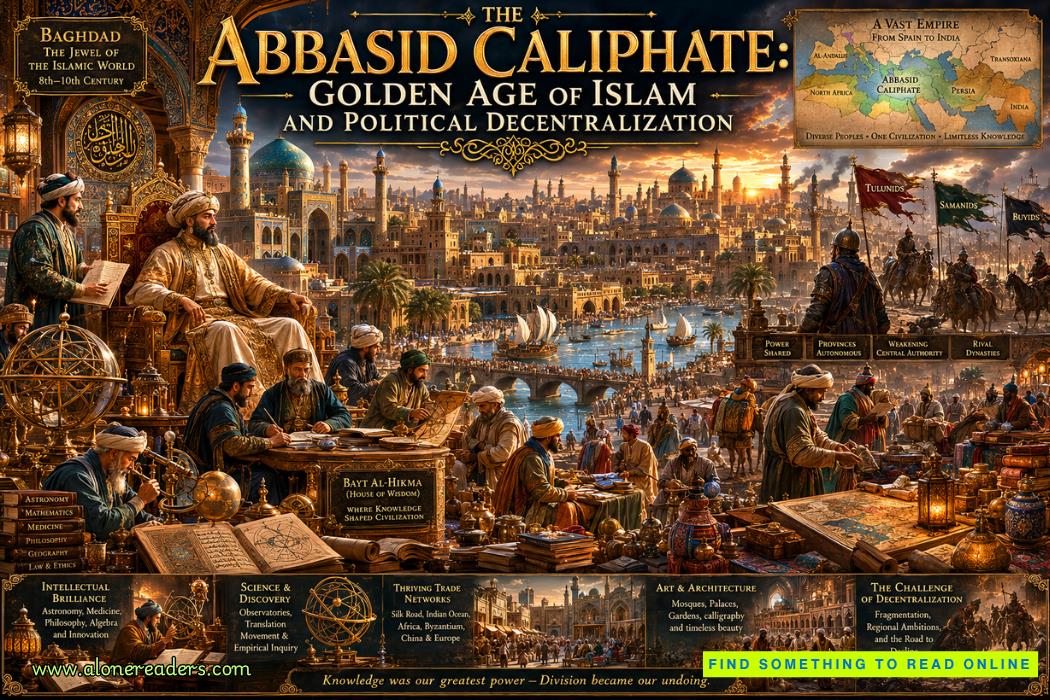
Few dynasties in world history have left a legacy as profound and far-reaching as the Abbasid Caliphate. For more than five centuries, the Abbasids presided over an empire that became the intellectual, cultural, scientific, and economic center of the medieval world. Their reign witnessed extraordinary advances in mathematics, astronomy, medicine, literature, engineering, philosophy, and commerce. During their golden age, the Abbasid capital of Baghdad emerged as one of the largest and most sophisticated cities on Earth, attracting scholars, merchants, diplomats, and travelers from across three continents.
Yet the story of the Abbasids is not merely one of achievement and prosperity. It is also a story of gradual political fragmentation, decentralization of authority, military dependence, regional autonomy, and eventual collapse. While the caliphate reached remarkable heights of cultural influence, its political power steadily weakened over time. Provincial governors became increasingly independent, military commanders gained enormous influence, and rival dynasties emerged throughout the Islamic world. The Abbasid experience demonstrates how an empire can remain culturally dominant even while losing political control.
The rise and fall of the Abbasid Caliphate remains one of the most important chapters in the history of the Middle East and the broader Islamic world.
The Abbasid dynasty emerged during a period of widespread dissatisfaction with the preceding Umayyad Caliphate. The Umayyads had created a vast empire stretching from the Atlantic Ocean to Central Asia, but many groups within the Islamic world felt excluded from political power. Non-Arab Muslims, particularly Persians and other converts, often believed they were treated as second-class members of society despite sharing the same faith.
The Abbasids skillfully exploited these grievances. Claiming descent from Abbas ibn Abd al-Muttalib, an uncle of the Prophet Muhammad, they presented themselves as leaders capable of restoring justice and unity. Their movement gained strong support in the eastern province of Khurasan, where diverse populations sought greater political representation.
In 750 CE, Abbasid forces defeated the Umayyads in a decisive struggle that transformed the Islamic world. The victory effectively ended Umayyad rule across most of the empire and established the Abbasid dynasty as the new ruling power.
One of the Abbasids' most significant decisions was the relocation of the political center from Damascus to Baghdad. Founded in 762 CE by Caliph Al-Mansur, Baghdad was strategically positioned near major trade routes connecting Asia, Africa, and Europe.
The city was carefully planned and designed as a symbol of imperial authority. Known initially as the "Round City," Baghdad featured concentric defensive walls, administrative centers, palaces, mosques, and residential districts arranged according to an organized urban vision.
Baghdad rapidly grew into one of the largest cities in the world. Its location enabled merchants to transport goods from China, India, Central Asia, East Africa, and Europe. Precious metals, silk, spices, textiles, books, and scientific knowledge flowed into the city, creating immense prosperity.
The establishment of Baghdad marked the beginning of a new era. Unlike the Umayyads, whose administration was heavily influenced by Arab traditions, the Abbasids embraced a more cosmopolitan model of governance. Persian administrative practices, Greek intellectual traditions, Indian scientific knowledge, and Arab cultural foundations combined to create a remarkably dynamic civilization.
The early Abbasid caliphs proved highly effective administrators. Leaders such as Al-Mansur, Harun al-Rashid, and Al-Ma'mun strengthened the state's institutions, expanded commerce, improved tax collection, and maintained stability across vast territories.
Under their leadership, the empire controlled lands stretching from North Africa to Central Asia. Major cities flourished as centers of trade, manufacturing, scholarship, and administration.
The Abbasids also developed sophisticated bureaucratic systems. Government departments managed taxation, military affairs, public works, correspondence, and intelligence gathering. Professional administrators helped maintain cohesion across enormous distances.
This administrative sophistication became one of the key foundations of Abbasid success. Rather than relying solely on military conquest, the dynasty invested heavily in governance, infrastructure, and economic integration.
The period commonly known as the Islamic Golden Age reached its peak under Abbasid rule. This era witnessed an unprecedented flowering of intellectual activity that transformed global knowledge.
Perhaps the most famous institution associated with this period was the House of Wisdom in Baghdad. This scholarly center became a hub for translation, research, education, and scientific investigation. Scholars collected and translated works from Greek, Persian, Indian, and other traditions.
The translation movement preserved countless ancient texts that might otherwise have been lost. Philosophical works by ancient thinkers, mathematical treatises, medical writings, and astronomical observations were translated, studied, and expanded upon.
The Abbasid world became a place where intellectual curiosity was actively encouraged. Scholars worked across disciplines, often combining insights from multiple traditions to create entirely new fields of study.
The scientific achievements of the Abbasid era fundamentally shaped the development of world civilization.
Mathematics experienced remarkable progress during this period. Scholars developed algebra into a sophisticated discipline and refined numerical systems that would eventually spread throughout Europe.
Astronomy also flourished. Observatories conducted detailed observations of celestial bodies, improved astronomical tables, and enhanced understanding of planetary movements. These advances improved navigation, calendar calculations, and scientific knowledge.
Medicine reached extraordinary levels of sophistication. Physicians established hospitals, wrote comprehensive medical encyclopedias, developed surgical techniques, and emphasized clinical observation. Medical institutions in Abbasid cities often provided free treatment and served as centers for professional training.
Engineering innovations improved irrigation systems, water management, mechanical devices, and industrial production. These technologies increased agricultural productivity and supported urban growth.
The Abbasid period also witnessed remarkable literary achievements. Poetry, historical writing, philosophy, geography, and storytelling flourished across the empire. Works produced during this era influenced generations of scholars throughout the Islamic world and beyond.
Economic prosperity played a crucial role in sustaining Abbasid achievements. The caliphate occupied a strategic position at the crossroads of major international trade routes.
Merchants connected China with the Mediterranean, India with the Middle East, and Africa with Eurasia. Trade networks transported luxury goods, raw materials, agricultural products, and manufactured items across vast distances.
Urban centers prospered from commercial activity. Markets became hubs of economic exchange and cultural interaction. Wealth generated through trade funded public infrastructure, educational institutions, scientific research, and artistic patronage.
Agriculture also benefited from technological innovation. Improved irrigation systems and the introduction of new crops increased productivity. Farmers cultivated diverse agricultural products, supporting population growth and urban expansion.
The Abbasid economy became one of the most sophisticated and interconnected economic systems of the medieval world.
Despite these extraordinary achievements, signs of political decentralization began appearing relatively early in Abbasid history.
The empire's enormous size created significant administrative challenges. Communication across thousands of kilometers remained slow, making direct control difficult. Provincial governors often exercised considerable autonomy simply because of distance from the capital.
Over time, regional leaders accumulated wealth, military resources, and political influence. While they nominally acknowledged Abbasid authority, many increasingly governed their territories independently.
This process marked the beginning of one of the most important developments in Abbasid history: the gradual separation of cultural authority from political power.
The caliphs remained symbols of legitimacy and religious leadership, but their direct control over provincial territories steadily diminished.
Several powerful regional dynasties emerged during this period. Although they frequently recognized the caliph's spiritual authority, they often managed their own military forces, taxation systems, and local administrations.
This decentralization did not immediately destroy the empire. In many cases, local rulers continued to support commerce, scholarship, and cultural development. However, it weakened the political unity that had characterized the early Abbasid state.
Military developments further accelerated fragmentation. The Abbasids increasingly relied on professional soldiers recruited from various regions.
These troops provided military effectiveness but created new political risks. Commanders often became influential power brokers capable of shaping succession disputes and government policy.
As military leaders gained influence, caliphs sometimes became dependent on their support. This dependence reduced the authority of the central government and strengthened competing centers of power.
By the tenth century, military elites and regional rulers frequently exercised greater practical authority than the caliph himself.
The rise of powerful military dynasties further transformed the political landscape. Groups such as the Buyids and later the Seljuks entered Baghdad and effectively controlled the government while allowing the Abbasid caliphs to retain symbolic status.
This arrangement illustrates the unique nature of Abbasid decline.
Unlike many empires that collapsed suddenly through conquest, the Abbasid Caliphate experienced a long process of political erosion. The institution of the caliphate survived, but real power increasingly resided elsewhere.
Baghdad remained a center of learning and culture even as political authority slipped away from the caliphs.
The distinction between cultural influence and political power became especially apparent during this period. Scholars continued producing important works, trade remained active, and intellectual life flourished despite governmental weakness.
Nevertheless, decentralization carried significant costs. Fragmented political authority complicated military coordination and reduced the empire's ability to respond effectively to external threats.
As regional powers pursued their own interests, collective defense became more difficult. Rivalries among local rulers sometimes undermined broader strategic objectives.
The Crusades demonstrated some of these challenges. Although Muslim forces ultimately achieved important successes, political fragmentation initially hindered coordinated responses.
Even more significant was the rise of new powers in Central Asia. Expanding nomadic empires transformed the geopolitical environment surrounding the Islamic world.
The final catastrophe arrived in 1258 when Mongol forces under Hulagu Khan advanced toward Baghdad.
The Mongols had already conquered vast territories across Asia and the Middle East. Their military campaigns devastated numerous states and reshaped entire regions.
When Baghdad fell, one of the greatest cities of the medieval world suffered immense destruction. Libraries, palaces, educational institutions, and infrastructure were heavily damaged. The city's population experienced tremendous suffering.
The last reigning Abbasid caliph in Baghdad was killed, bringing an end to the dynasty's political rule in its historic capital.
The fall of Baghdad in 1258 is often regarded as one of the most significant turning points in medieval history. It marked the conclusion of an era during which the Abbasids had served as the leading political and cultural force in much of the Islamic world.
Yet the Abbasid legacy did not disappear with the Mongol conquest.
The dynasty's contributions to science, medicine, mathematics, literature, philosophy, architecture, and governance continued influencing societies across the globe. Many classical texts preserved by Abbasid scholars later helped stimulate intellectual developments in Europe and other regions.
The administrative systems developed under Abbasid rule influenced later Islamic states. Their model of cosmopolitan governance demonstrated how diverse cultures could be integrated within a single political framework.
Most importantly, the Abbasids created an environment in which knowledge, scholarship, and innovation flourished on an extraordinary scale.
Their greatest achievement was not merely the construction of an empire but the creation of a civilization whose intellectual influence extended far beyond its political lifespan.
The history of the Abbasid Caliphate illustrates a recurring pattern in world history. Military success and political expansion can create powerful states, but sustaining centralized authority over vast territories presents enduring challenges. Economic prosperity, cultural achievement, and scientific advancement can coexist with political fragmentation, at least for a time. Ultimately, however, decentralization weakens the institutions necessary for collective defense and long-term stability.
The Abbasids transformed the Islamic world into a center of global learning and commerce. Their golden age produced breakthroughs that shaped human civilization for centuries. Yet the same empire that fostered extraordinary intellectual achievement gradually lost political cohesion as regional powers asserted autonomy and military elites gained influence. The result was a remarkable civilization whose cultural brilliance outlasted its political dominance, ensuring that the Abbasid name would remain synonymous with one of history's greatest golden ages.
At a Glance: The Abbasid Caliphate
| Category | Details |
|---|---|
| Dynasty | Abbasid Caliphate |
| Founded | 750 CE |
| Founder | Abu al-Abbas al-Saffah |
| Capital | Baghdad |
| Peak Period | 8th–9th Centuries |
| Greatest Achievement | Islamic Golden Age and House of Wisdom |
| Economic Strength | International trade linking Asia, Africa, and Europe |
| Scientific Contributions | Mathematics, astronomy, medicine, engineering, philosophy |
| Main Challenge | Political decentralization and regional autonomy |
| Decline Factors | Weak central authority, military dominance, provincial independence |
| Final Collapse | Mongol conquest of Baghdad in 1258 CE |
| Historical Legacy | Preservation and advancement of global knowledge, major influence on later civilizations |





 The Hundred Days Offensive: How the Allies Defeated Germany in World War I
 The Second Battle of the Marne: The Turning Point of World War I in 1918
 The Spring Offensive of 1918: Germany's Final Gamble to Win World War I
 The Treaty of Brest-Litovsk: How Russia Left World War I
 The Russian Revolution and World War I: How War Brought Down the Tsar
 The Zimmermann Telegram Explained: Germany's Secret Offer to Mexico in World War I