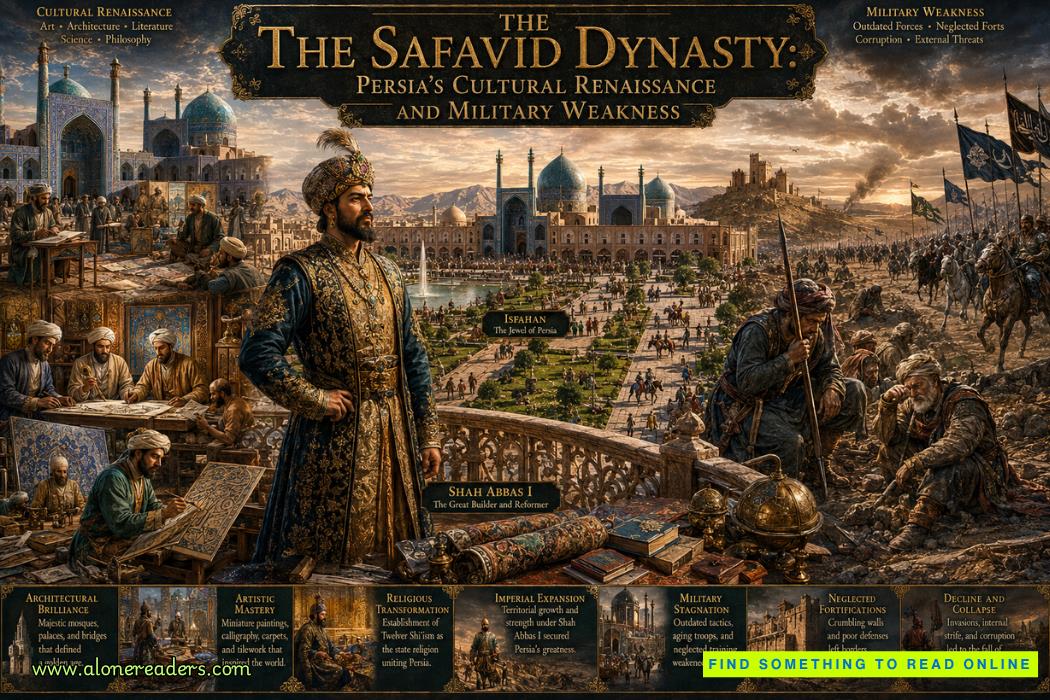
Among the great dynasties that shaped the history of the Middle East, few left a legacy as profound and enduring as the Safavid Dynasty. Emerging from relative obscurity at the beginning of the sixteenth century, the Safavids transformed Persia from a fragmented region contested by rival powers into a centralized empire with a distinct identity. Their rule not only established the political foundations of modern Iran but also initiated one of the most remarkable periods of artistic, architectural, and cultural achievement in Persian history.
Yet the Safavid story is also one of contradiction. While the dynasty produced magnificent cities, flourishing trade networks, and extraordinary works of art, it failed to maintain a military system capable of adapting to changing geopolitical realities. The same empire that dazzled travelers with its wealth and sophistication gradually weakened under ineffective rulers, economic pressures, and military stagnation. By the early eighteenth century, the dynasty that had once rivaled the greatest powers of its age collapsed with surprising speed.
The rise and fall of the Safavid Dynasty demonstrates how cultural brilliance alone cannot sustain an empire. Political stability, military innovation, and effective leadership remain essential to preserving power across generations.
The origins of the Safavid Dynasty can be traced to a religious order established in northwestern Persia during the thirteenth century. The order was founded by a charismatic spiritual leader whose descendants gradually transformed the movement from a mystical religious brotherhood into a powerful political force. Over time, the followers of the order became increasingly militant and loyal to the Safavid family.
By the late fifteenth century, Persia was deeply fragmented. The region had suffered from centuries of invasions, internal conflicts, and political instability. Various tribal confederations controlled different territories, while neighboring powers sought influence throughout the region. This fragmentation created an opportunity for an ambitious leader to unite the country.
That leader emerged in the form of the young Shah Ismail I. Despite his youth, Ismail possessed extraordinary charisma and military talent. In 1501, after a series of successful campaigns, he captured the city of Tabriz and declared himself ruler of Persia. This event marked the official beginning of the Safavid Dynasty.
The significance of Ismail's victory extended far beyond territorial conquest. He established a centralized state and initiated one of the most consequential religious transformations in Middle Eastern history. He declared Twelver Shiism the official religion of the empire and began a systematic effort to spread it throughout his domains.
This decision fundamentally altered the religious landscape of the region. Persia became distinct from its predominantly Sunni neighbors, particularly the powerful Ottoman Empire. The religious identity established during the Safavid period remains one of the defining characteristics of modern Iran.
The early Safavid Empire expanded rapidly. Ismail's armies conquered vast territories stretching across Persia and into surrounding regions. For a time, the Safavids appeared unstoppable.
However, the empire's rapid growth revealed significant weaknesses. Much of the military relied on tribal warriors whose loyalty often centered on personal relationships rather than state institutions. This system could achieve remarkable victories but lacked long-term stability.
The limitations became evident in 1514 during the Battle of Chaldiran. The Safavids faced the Ottoman Empire, one of the most powerful military forces in the world. Ottoman troops utilized advanced artillery and firearms, while Safavid forces relied heavily on traditional cavalry tactics.
The result was a devastating defeat. The battle exposed a critical reality: military technology was changing, and traditional methods alone could no longer guarantee success.
Although the Safavid state survived, Chaldiran served as an early warning that military modernization would be essential for the empire's future.
Despite this setback, the dynasty continued to strengthen. The true architect of Safavid greatness emerged several decades later in the form of Shah Abbas I, widely regarded as the dynasty's greatest ruler.
Ascending the throne in 1588, Shah Abbas inherited an empire threatened by internal unrest and external enemies. The Ottomans pressed from the west, while other rivals challenged Safavid authority in the east. Tribal factions competed for influence within the state.
Abbas responded with a comprehensive program of reform. He recognized that the empire's survival depended upon reducing tribal power and strengthening central authority.
One of his most important achievements was the creation of a new military structure. Instead of relying exclusively on tribal warriors, Abbas developed a standing army loyal directly to the crown. He recruited soldiers from diverse backgrounds and incorporated firearms and artillery into military operations.
These reforms dramatically improved the effectiveness of the Safavid military. Abbas successfully recovered lost territories and restored the empire's prestige.
His victories transformed the Safavid Empire into one of the dominant powers of the early modern world.
Yet Shah Abbas's legacy extends far beyond military success. His reign represented a golden age of Persian culture, architecture, commerce, and administration.
The city of Isfahan became the centerpiece of this cultural renaissance. Abbas moved the imperial capital there and launched one of the most ambitious urban development programs in history.
Travelers arriving in Isfahan encountered a city unlike any other. Grand avenues, elegant bridges, expansive public squares, and magnificent mosques reflected the wealth and sophistication of the empire.
The central square became one of the largest urban spaces in the world. Surrounding structures displayed extraordinary architectural harmony and artistic refinement.
The mosques of Isfahan showcased intricate tilework, geometric patterns, calligraphy, and engineering achievements that continue to inspire admiration centuries later.
Architecture became a statement of imperial confidence.
The Safavid rulers understood that monumental construction could symbolize political legitimacy and cultural superiority.
Persian art flourished during this period. Miniature painting reached new heights of technical excellence and creativity. Artists produced richly detailed manuscripts depicting court life, historical events, and literary themes.
Persian carpets also achieved international fame. Safavid workshops created some of the finest textiles ever produced. Their intricate designs, vibrant colors, and exceptional craftsmanship made them highly sought after throughout Asia and Europe.
Many of the world's most valuable historic carpets originate from the Safavid period.
The dynasty also encouraged intellectual and scholarly pursuits. Philosophers, theologians, poets, and scientists found patronage at court.
Educational institutions expanded, and cultural exchange increased through growing trade connections.
Commerce played a crucial role in Safavid prosperity. Positioned between Europe, Central Asia, India, and the Middle East, Persia occupied a strategic location along major trade routes.
Silk became one of the empire's most important exports. Merchants from numerous countries traveled to Safavid cities seeking access to Persian goods.
Trade relationships with European powers expanded significantly. Foreign merchants established commercial connections that generated revenue and strengthened diplomatic ties.
This economic vitality supported the empire's cultural achievements and administrative development.
For a time, the Safavid state appeared remarkably stable.
Yet beneath the surface, structural problems persisted.
The success of Shah Abbas created a paradox. His centralization reforms strengthened the monarchy but concentrated authority heavily in the hands of the ruler. Future stability depended upon capable successors maintaining effective governance.
Unfortunately, many later rulers lacked the talent, energy, and vision of Abbas.
After his death in 1629, a gradual decline began.
Several successors spent more time within palace walls than on matters of state. Court intrigue expanded while administrative efficiency diminished.
Over time, the government became increasingly disconnected from provincial realities.
The military also began to deteriorate.
Although Abbas had modernized the armed forces, later rulers failed to maintain the same commitment to reform. Training standards declined. Corruption weakened military institutions. Innovation slowed.
Meanwhile, rival powers continued evolving.
The Ottoman Empire remained a formidable opponent. New regional challengers emerged. Military technologies advanced across Eurasia.
The Safavid military increasingly struggled to keep pace.
Economic difficulties compounded these problems.
Global trade patterns shifted during the seventeenth century. Maritime routes reduced the importance of some traditional overland trade networks.
Competition affected Persian commerce, while administrative inefficiencies reduced state revenues.
Heavy taxation often burdened local populations. Economic pressures contributed to dissatisfaction and weakened support for the government.
Religious policies also created challenges.
The promotion of Shiism had helped unify the empire, but excessive religious rigidity sometimes alienated segments of the population.
Balancing religious authority with political pragmatism became increasingly difficult.
As central power weakened, regional leaders gained greater autonomy.
Provincial officials often pursued their own interests rather than those of the state.
The empire's ability to respond effectively to crises declined.
The final blow came during the early eighteenth century.
In eastern regions, tribal groups increasingly challenged Safavid authority. One such movement eventually launched a major invasion.
The empire's weakened military proved incapable of mounting an effective defense.
In 1722, invading forces advanced toward the capital.
The subsequent siege exposed the full extent of Safavid decline.
Once a symbol of imperial glory, Isfahan suffered from starvation, chaos, and political paralysis.
After months of resistance, the city surrendered.
The fall of the capital effectively ended Safavid rule.
The collapse was not merely a military defeat; it represented the failure of institutions that had gradually lost their effectiveness over generations.
Although later leaders attempted to restore stability, the Safavid Dynasty never recovered.
Its political authority disappeared, but its cultural legacy endured.
The dynasty's impact on Persian identity remains immense. The establishment of Shiism as the dominant faith fundamentally shaped the development of modern Iran.
Safavid architecture continues to define some of the most iconic urban landscapes in the Middle East.
The artistic traditions cultivated during the dynasty influenced generations of painters, craftsmen, and architects.
Persian carpets produced under Safavid patronage remain celebrated masterpieces of decorative art.
Even the concept of a unified Persian state owes much to Safavid achievements.
The dynasty demonstrated that cultural power can elevate a nation to extraordinary heights. It transformed Persia into a center of artistic excellence and intellectual creativity admired throughout the world.
At the same time, the Safavid experience illustrates the dangers of complacency. Military innovation, administrative competence, and effective leadership cannot be neglected without consequences.
The empire's rulers built magnificent mosques but failed to maintain equally strong institutions. They fostered cultural brilliance yet struggled to preserve military effectiveness. They created a lasting national identity but allowed political structures to weaken.
The result was a dramatic contrast between cultural renaissance and strategic decline.
Few dynasties better exemplify the complex relationship between artistic achievement and political power. The Safavid Empire remains one of history's most fascinating examples of how a civilization can reach extraordinary heights of cultural greatness while simultaneously laying the foundations of its own downfall.
At a Glance: The Safavid Dynasty
| Category | Details |
|---|---|
| Dynasty | Safavid Dynasty |
| Founded | 1501 |
| Founder | Shah Ismail I |
| Capital | Isfahan (during its golden age) |
| Greatest Ruler | Shah Abbas I |
| Official Religion | Twelver Shiism |
| Golden Age | Late 16th to early 17th century |
| Major Achievements | Centralized Persian state, cultural renaissance, architectural masterpieces, expansion of trade |
| Famous Products | Persian carpets, silk, miniature paintings |
| Main Strength | Strong cultural identity and administrative centralization |
| Main Weakness | Military stagnation and weak successors |
| Key Turning Point | Battle of Battle of Chaldiran (1514) |
| Collapse | 1722 after the fall of Isfahan |
| Historical Legacy | Shaped modern Iranian identity, religion, architecture, and culture |



 The Hundred Days Offensive: How the Allies Defeated Germany in World War I
 The Second Battle of the Marne: The Turning Point of World War I in 1918
 The Spring Offensive of 1918: Germany's Final Gamble to Win World War I
 The Treaty of Brest-Litovsk: How Russia Left World War I
 The Russian Revolution and World War I: How War Brought Down the Tsar
 The Zimmermann Telegram Explained: Germany's Secret Offer to Mexico in World War I