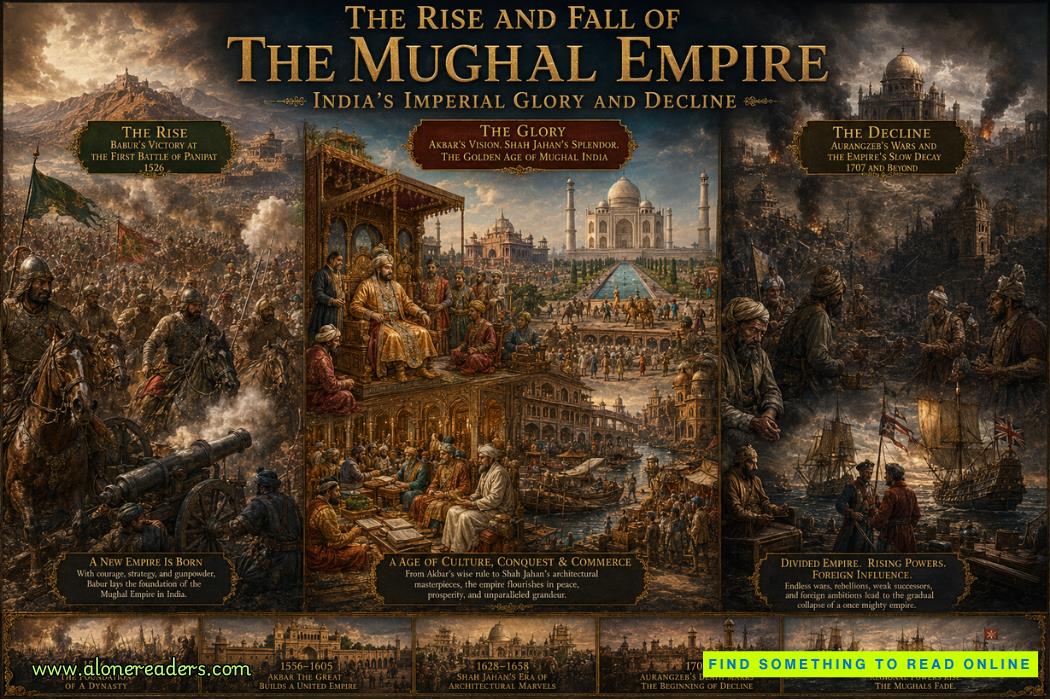
The story of the Mughal Empire is one of the most remarkable chapters in world history. For more than three centuries, the Mughal rulers dominated much of the Indian subcontinent, creating one of the wealthiest, most culturally vibrant, and politically influential empires of the early modern world. At its height, the empire controlled vast territories stretching across northern, central, and parts of southern India, governed tens of millions of people, and generated enormous wealth through agriculture, trade, and manufacturing.
The Mughal Empire left behind a legacy of magnificent architecture, sophisticated administration, artistic achievements, and cultural synthesis that continues to shape South Asia today. Yet despite its immense power and prestige, the empire gradually weakened and eventually collapsed under the combined weight of political instability, military overextension, economic pressures, and foreign intervention.
The rise and fall of the Mughal Empire demonstrates how even the most powerful dynasties can ascend rapidly through military brilliance and effective governance, only to decline when structural weaknesses emerge and external challenges intensify.
The origins of the Mughal Empire can be traced to Zahir-ud-Din Muhammad Babur, a Central Asian prince who claimed descent from both the conqueror Timur and the Mongol ruler Genghis Khan. Babur spent much of his early life struggling to maintain control over small territories in Central Asia. After repeated setbacks, he turned his attention toward northern India, a region fragmented among competing kingdoms and sultanates.
The decisive moment came in 1526 during the First Battle of Panipat. Babur's army was significantly smaller than that of the ruling Sultan of Delhi, but he possessed a crucial advantage: the effective use of field artillery and disciplined military tactics. His forces defeated the larger army and seized control of Delhi and Agra. This victory marked the beginning of Mughal rule in India.
Although Babur's reign lasted only four years after his conquest, he established the foundations of a new imperial state. His military innovations, administrative initiatives, and determination to secure his territories enabled the dynasty to survive its fragile beginnings.
Following Babur's death, his son Humayun inherited the throne. Humayun faced numerous challenges from rival rulers and internal opponents. His reign was marked by instability, and at one point he lost much of his empire to the Afghan ruler Sher Shah Suri. Forced into exile, Humayun sought refuge abroad before eventually returning to reclaim his territories.
While Humayun's reign is often viewed as a period of difficulty, it played an important role in preserving the dynasty. His eventual restoration ensured that the Mughal state survived long enough for the emergence of one of history's most celebrated rulers.
That ruler was Akbar the Great, who ascended the throne in 1556 at a young age. Akbar transformed the Mughal state from a vulnerable kingdom into a powerful empire capable of dominating much of the Indian subcontinent.
Akbar's military campaigns expanded Mughal territory significantly. Through conquest, diplomacy, and strategic alliances, he incorporated numerous kingdoms and regions into the empire. Unlike many conquerors, however, Akbar understood that lasting power required more than military success.
One of Akbar's greatest achievements was the development of a highly efficient administrative system. He reorganized provincial government, established a sophisticated revenue collection structure, and created a bureaucracy that helped maintain imperial authority across vast territories. These reforms increased state revenues and improved governance.
Akbar also recognized the importance of accommodating the diverse populations under his rule. The empire contained people from numerous ethnic, linguistic, and religious backgrounds. Rather than imposing rigid uniformity, Akbar pursued policies of inclusion and cooperation. He recruited talented individuals from different communities into government service and cultivated relationships with influential regional rulers.
This pragmatic approach contributed significantly to political stability. It reduced resistance, encouraged loyalty, and strengthened the empire's legitimacy among various groups.
Under Akbar, the Mughal Empire became not only a military power but also a thriving center of culture, commerce, and intellectual activity. Trade expanded, cities grew, and agricultural production increased. The foundations were laid for a period of extraordinary prosperity.
Following Akbar's death in 1605, the empire continued to flourish under his successors. Jahangir maintained much of the administrative framework established by his father while supporting artistic and cultural development. The Mughal court became famous for its patronage of painters, poets, and craftsmen.
The reign of Shah Jahan is often regarded as the pinnacle of Mughal grandeur. During this period, the empire reached extraordinary levels of wealth and prestige. Imperial revenues were immense, trade networks connected India to global markets, and the court displayed unparalleled luxury.
Shah Jahan is best remembered for sponsoring some of the most magnificent architectural projects in history. The most famous of these is the Taj Mahal, a masterpiece of design, engineering, and artistic craftsmanship. Constructed as a mausoleum for his wife, it remains one of the most recognizable monuments on Earth.
The Mughal architectural style combined influences from Persian, Central Asian, and Indian traditions. Monumental forts, mosques, palaces, gardens, and public buildings demonstrated both imperial power and artistic sophistication. These structures symbolized the empire's confidence and stability during its golden age.
By the mid-seventeenth century, the Mughal Empire was among the wealthiest states in the world. European merchants arriving in India encountered prosperous cities, thriving textile industries, and sophisticated commercial systems. Indian cotton textiles, luxury goods, spices, and manufactured products were highly sought after in international markets.
The empire's prosperity was supported by a vast agricultural economy. Revenue collected from fertile farmland financed military campaigns, public works, and administrative institutions. Population growth and expanding trade further strengthened the state's economic foundation.
Yet beneath this impressive surface, challenges were beginning to emerge.
The accession of Aurangzeb in 1658 marked a turning point in Mughal history. Aurangzeb was a capable administrator and determined ruler who sought to expand imperial authority even further. Under his leadership, the empire reached its greatest territorial extent.
However, expansion came at a significant cost.
Aurangzeb launched lengthy military campaigns in southern India that lasted for decades. These wars consumed enormous financial resources and tied down large numbers of troops. Although some territorial gains were achieved, the campaigns placed increasing pressure on the empire's administrative and economic systems.
The sheer size of the empire created additional difficulties. Governing such vast territories required effective communication, loyal officials, and continuous military presence. As the empire expanded, maintaining control became increasingly expensive and complicated.
Regional leaders began asserting greater independence. Some local rulers resented imperial interference, while others took advantage of opportunities created by overstretched Mughal forces. Rebellions and resistance movements became more common.
The empire also faced growing fiscal problems. Military expenditures continued to rise while administrative costs increased. Revenue collection became less efficient in certain regions, and corruption weakened the effectiveness of local governance.
Although Aurangzeb remained a powerful ruler, his policies contributed to long-term instability. The empire's resources were stretched to their limits, leaving future rulers with mounting challenges.
When Aurangzeb died in 1707, the Mughal Empire remained vast, but its foundations had become fragile. His death triggered succession struggles among competing princes, a recurring problem in Mughal politics.
Unlike systems with clearly defined rules of inheritance, Mughal succession often involved violent contests among royal family members. These conflicts weakened central authority and distracted the government from addressing broader challenges.
During the eighteenth century, regional powers gained increasing autonomy. Former imperial governors established independent states, while ambitious military leaders carved out territories for themselves. The central government gradually lost control over distant provinces.
The Marathas emerged as one of the most significant challengers to Mughal dominance. Their expanding influence reduced imperial authority across large portions of India. Other regional powers also asserted independence, contributing to the fragmentation of the empire.
At the same time, foreign invasions exposed the empire's declining military effectiveness. In 1739, the Persian ruler Nader Shah invaded northern India and captured Delhi. The invasion shocked contemporaries and demonstrated the weakness of Mughal defenses.
The sack of Delhi caused immense destruction and resulted in the loss of enormous wealth. Treasures accumulated over generations were carried away, damaging both the empire's finances and prestige.
Subsequent invasions further weakened the state. Repeated military setbacks undermined confidence in imperial leadership and accelerated political fragmentation.
Economic problems compounded these difficulties. Political instability disrupted trade networks and agricultural production in many regions. As central authority weakened, local officials often pursued their own interests rather than supporting imperial objectives.
The empire's declining revenues limited its ability to maintain armies, pay officials, and fund administrative functions. Financial weakness increasingly translated into military weakness, creating a cycle of decline that proved difficult to reverse.
Meanwhile, European trading companies were expanding their influence along India's coasts. Initially focused on commerce, these organizations gradually became involved in regional politics and military affairs.
Among them, the British East India Company proved particularly successful. By exploiting rivalries among Indian states and building its own military capabilities, the company transformed itself from a commercial enterprise into a political power.
The weakening of Mughal authority created opportunities for external intervention. As regional rulers competed for influence, European powers increasingly inserted themselves into local conflicts.
The decisive shift occurred during the second half of the eighteenth century. The Mughal emperor remained a symbolic figure, but real power increasingly belonged to regional states and foreign actors.
By the early nineteenth century, the empire existed largely in name only. The emperor retained limited authority in Delhi while British influence expanded across the subcontinent.
The final chapter came during the Indian Rebellion of 1857. Although the aging Mughal emperor became a symbolic figurehead for some rebels, the uprising ultimately failed. In its aftermath, the British formally abolished the Mughal monarchy.
The last emperor was removed from power and exiled, bringing more than three centuries of Mughal rule to an end.
Despite its collapse, the Mughal Empire's legacy remains profound. Its administrative innovations influenced later governments. Its architectural achievements continue to attract admiration from around the world. Its cultural contributions shaped literature, art, cuisine, language, and social traditions across South Asia.
The rise of the Mughal Empire demonstrates how military innovation, effective administration, economic prosperity, and political flexibility can transform a regional kingdom into a global power. Its decline illustrates the dangers of overexpansion, fiscal strain, succession conflicts, weakening institutions, and failure to adapt to changing geopolitical realities.
Few dynasties have left such a lasting mark on history. For generations, the Mughal Empire stood as a symbol of imperial grandeur, cultural brilliance, and political achievement. Yet its eventual collapse serves as a reminder that even the most magnificent empires are not immune to the forces of change, internal weakness, and external challenge.
At a Glance: Summary Box
| Category | Details |
|---|---|
| Dynasty | Mughal Empire |
| Founder | Babur |
| Established | 1526 |
| Ended | 1857 |
| Peak Territorial Extent | Under Aurangzeb in the late seventeenth century |
| Golden Age Rulers | Akbar, Jahangir, Shah Jahan |
| Greatest Monument | Taj Mahal |
| Key Strengths | Military innovation, strong administration, agricultural wealth, trade, cultural patronage |
| Major Challenges | Overexpansion, costly wars, succession conflicts, regional rebellions |
| Major Rivals | Marathas, regional kingdoms, foreign invaders |
| Critical Turning Point | Death of Aurangzeb in 1707 |
| Final Blow | British expansion and the aftermath of the Indian Rebellion of 1857 |
| Historical Legacy | Architecture, governance, art, culture, and enduring influence across South Asia |



 The Hundred Days Offensive: How the Allies Defeated Germany in World War I
 The Second Battle of the Marne: The Turning Point of World War I in 1918
 The Spring Offensive of 1918: Germany's Final Gamble to Win World War I
 The Treaty of Brest-Litovsk: How Russia Left World War I
 The Russian Revolution and World War I: How War Brought Down the Tsar
 The Zimmermann Telegram Explained: Germany's Secret Offer to Mexico in World War I










