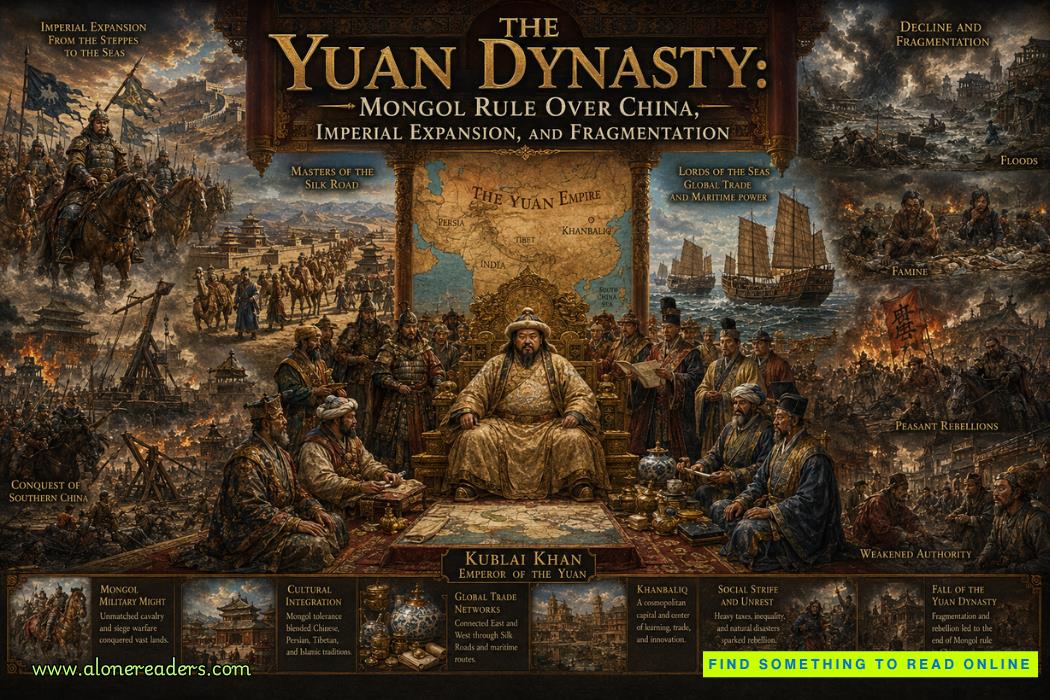
The Yuan Dynasty occupies a unique place in Chinese history. It was the first dynasty to rule all of China while being founded and governed by a foreign conqueror. Established by the Mongols under Kublai Khan, the Yuan Dynasty represented the eastern branch of the vast Mongol Empire that had emerged from the conquests of Genghis Khan. For nearly a century, Mongol rulers controlled one of the world's largest and most populous civilizations, overseeing a period of remarkable cultural exchange, commercial growth, and international connectivity. Yet despite its impressive achievements, the dynasty struggled to reconcile the traditions of nomadic rule with the realities of governing a sophisticated agricultural empire. Ultimately, internal tensions, economic difficulties, environmental disasters, and widespread rebellion shattered Mongol authority, paving the way for the rise of the Ming Dynasty.
The story of the Yuan Dynasty begins with the extraordinary rise of the Mongols in the early thirteenth century. Under the leadership of Genghis Khan, Mongol tribes that had long been divided across the steppes of Central Asia were united into a powerful military force. Through discipline, mobility, and innovative military tactics, Mongol armies rapidly conquered vast territories stretching from eastern Asia to Eastern Europe. After Genghis Khan's death in 1227, his successors continued expanding the empire, including campaigns against the Jin Dynasty in northern China and the Southern Song Dynasty in the south.
China at the time was politically divided. The Jin Dynasty controlled much of northern China, while the Southern Song ruled the prosperous south. The Mongols gradually defeated the Jin and turned their attention toward the Song. This conflict became one of the longest and most challenging campaigns in Mongol history. Unlike the open grasslands and smaller kingdoms conquered elsewhere, southern China possessed massive cities, fortified positions, advanced military technology, and abundant resources.
A turning point came with the rise of Kublai Khan, a grandson of Genghis Khan. Kublai recognized that conquering China required more than military power. He increasingly adopted Chinese administrative practices, employed Chinese advisers, and sought to present himself as a legitimate ruler rather than merely a foreign conqueror. In 1271, he formally proclaimed the Yuan Dynasty and declared himself emperor. This act symbolized the transformation of the Mongol conquest state into a Chinese-style imperial dynasty.
The final defeat of the Southern Song occurred in 1279 after years of intense warfare. The Yuan Dynasty now controlled all of China, creating an empire that stretched from the Pacific Ocean to Central Asia through connections with the wider Mongol world. For the first time in centuries, China was politically unified under a single government.
The rise of the Yuan Dynasty brought profound changes. Kublai Khan established his capital at Khanbaliq, located near modern Beijing. The city became one of the world's largest urban centers and a symbol of imperial authority. Massive construction projects transformed the capital into a magnificent administrative and ceremonial center. Roads, canals, warehouses, and communication networks were expanded to support the needs of the empire.
One of the Yuan Dynasty's greatest strengths was its position within the broader Mongol Empire. The vast territories under Mongol influence created unprecedented opportunities for trade and cultural exchange. Merchants could travel across enormous distances with greater security than had previously been possible. The Silk Road experienced renewed activity as goods, ideas, technologies, and people moved between East Asia, Central Asia, the Middle East, and Europe.
Foreign visitors arrived in China in greater numbers than ever before. Among the most famous was the Venetian traveler Marco Polo, whose descriptions introduced many Europeans to the wealth and sophistication of Yuan China. Although historians debate certain details of his accounts, they illustrate the international significance of the dynasty.
The Yuan government actively encouraged commerce. Merchants received protections and privileges that elevated their status compared with many previous Chinese dynasties. Trade flourished in silk, porcelain, tea, spices, metals, and luxury goods. Maritime commerce expanded as Chinese ports connected with trading networks across Southeast Asia, India, and the Persian Gulf.
The dynasty also promoted technological and scientific exchanges. Knowledge traveled alongside merchants and diplomats. Innovations in astronomy, medicine, engineering, and cartography circulated throughout Eurasia. The movement of people across the Mongol world created a level of interconnectedness rarely seen in earlier centuries.
Despite these achievements, the Yuan Dynasty faced fundamental challenges from the beginning. The Mongol rulers were foreign conquerors governing a population vastly larger than themselves. Most Chinese subjects did not view the Mongols as natural rulers. To maintain control, the Yuan government developed a hierarchical social structure that placed Mongols at the top. Other foreign groups from Central and Western Asia often occupied intermediate positions, while northern Chinese and southern Chinese generally held lower status.
This system generated resentment. Many educated Chinese elites found themselves excluded from positions of influence. Traditional institutions that had long provided pathways into government service were weakened or altered. Although some Chinese officials continued serving the state, tensions persisted between Mongol rulers and segments of the Chinese population.
The Yuan rulers also struggled to balance competing identities. They sought to preserve Mongol traditions while simultaneously governing through Chinese institutions. This created contradictions within the administration. Mongol nobles often favored traditional steppe customs, while bureaucrats argued for greater reliance on established Chinese methods of governance. These competing priorities sometimes produced inefficiency and political conflict.
Military expansion beyond China further strained imperial resources. Kublai Khan launched ambitious campaigns against neighboring regions, including Vietnam, Burma, Java, and Japan. Some initial successes were achieved, but several expeditions ended in costly failures.
The attempted invasions of Japan became especially famous. Large Mongol-led fleets crossed the sea in 1274 and again in 1281. Both invasions failed, partly because of fierce Japanese resistance and partly because devastating storms destroyed significant portions of the invading fleets. These disasters consumed enormous resources and damaged the prestige of the Yuan government.
As the fourteenth century progressed, new problems emerged. Population growth increased pressure on agricultural production. Maintaining massive military forces and an extensive bureaucracy required substantial revenue. The government frequently turned to paper currency to finance expenditures.
Initially, paper money facilitated trade and administration. However, excessive issuance eventually contributed to inflation and declining confidence in the currency. Economic instability affected merchants, farmers, and urban residents alike. The government's financial difficulties became increasingly difficult to manage.
Environmental challenges compounded these economic problems. Major floods, droughts, and other natural disasters affected agricultural production in many regions. The Yellow River changed course several times, causing extensive destruction. Crop failures led to food shortages, displacement, and social unrest.
In traditional Chinese political thought, natural disasters were often interpreted as signs that a ruling dynasty had lost the Mandate of Heaven. As hardship spread, many people began questioning the legitimacy of Mongol rule. Religious movements and secret societies gained followers among populations suffering from poverty and insecurity.
The Yuan court itself became increasingly unstable. After the death of Kublai Khan in 1294, succession disputes and factional struggles weakened central authority. Later emperors often lacked the political skill, military strength, or administrative capacity needed to govern such a vast empire effectively.
Court politics became dominated by rival groups seeking influence over imperial decisions. Corruption expanded in many areas of government. Local officials sometimes exploited populations already burdened by taxes and economic hardship. The gap between the imperial center and provincial regions widened steadily.
By the mid-fourteenth century, the dynasty faced a crisis on multiple fronts. Economic decline, administrative corruption, environmental disasters, and political fragmentation combined to undermine public confidence. These conditions created fertile ground for rebellion.
Among the most important uprisings was the Red Turban movement. Drawing support from peasants, religious groups, and disaffected communities, the rebels challenged Yuan authority across large portions of China. What began as localized unrest gradually evolved into a broader struggle against Mongol rule.
The Yuan government attempted to suppress these revolts through military force, but its capacity was increasingly limited. Provincial commanders often pursued their own interests rather than coordinating with the central government. In many regions, effective control slipped away from the imperial court.
One of the leaders who emerged during this period was Zhu Yuanzhang. Born into a poor peasant family, he joined rebel forces and gradually rose to prominence through military skill and political leadership. Unlike many rivals, Zhu successfully consolidated power and built a disciplined administrative structure.
As rebel victories multiplied, Mongol control collapsed. Cities and provinces that had once formed the backbone of Yuan authority fell to anti-Mongol forces. The dynasty's remaining resources proved insufficient to reverse the trend.
In 1368, Zhu Yuanzhang captured the Yuan capital and proclaimed the establishment of the Ming Dynasty. The last Yuan emperor fled north into Mongolia. Although Mongol rulers continued maintaining a separate regime in the steppe regions, their control over China had ended.
The fragmentation of the Yuan Dynasty illustrates the difficulties of sustaining a conquest empire over the long term. The Mongols had achieved one of history's most remarkable military expansions, yet military success alone could not guarantee lasting political stability. Governing China required effective administration, economic management, social integration, and legitimacy among the population.
Nevertheless, the Yuan Dynasty left a significant legacy. It permanently altered China's political geography by reinforcing the importance of Beijing as a center of power. The dynasty expanded international trade networks and strengthened connections between East Asia and the wider Eurasian world. Cultural exchanges facilitated the movement of technologies, artistic influences, religious ideas, and scientific knowledge across continents.
The Yuan period also demonstrated the possibilities and limitations of multicultural imperial rule. Mongols, Chinese, Persians, Central Asians, and many other peoples interacted within a single political framework. This diversity enriched the empire but also generated tensions that rulers struggled to manage.
Historians continue to debate the overall significance of the Yuan Dynasty. Some emphasize the disruption caused by conquest and foreign domination. Others highlight the extraordinary level of global connectivity that emerged under Mongol rule. Both perspectives reveal important aspects of the dynasty's history.
What remains clear is that the Yuan Dynasty represented a pivotal chapter in the evolution of China and Eurasia. Its rise reflected the unprecedented power of the Mongol Empire, while its collapse revealed the challenges of maintaining authority across diverse populations and vast territories. The dynasty's fragmentation ultimately opened the way for the Ming Dynasty, but its influence continued shaping Chinese politics, commerce, and international relations long after Mongol rule had ended.
At a Glance: The Yuan Dynasty
| Category | Details |
|---|---|
| Dynasty Name | Yuan Dynasty |
| Founded | 1271 |
| Founder | Kublai Khan |
| Capital | Khanbaliq (modern Beijing) |
| Origin | Mongol Empire |
| Territory | Entire China plus connections to the wider Mongol world |
| Golden Age | Reign of Kublai Khan and early Yuan period |
| Major Strengths | Military power, trade expansion, Silk Road revival, international connectivity |
| Major Challenges | Ethnic tensions, administrative conflicts, costly wars, economic instability |
| Key Decline Factors | Inflation, natural disasters, corruption, rebellions, political fragmentation |
| Major Rebellion | Red Turban Rebellion |
| End of Dynasty | 1368 |
| Successor Dynasty | Ming Dynasty |
| Historical Legacy | First foreign dynasty to rule all of China, strengthened Eurasian trade and cultural exchange |



 The Hundred Days Offensive: How the Allies Defeated Germany in World War I
 The Second Battle of the Marne: The Turning Point of World War I in 1918
 The Spring Offensive of 1918: Germany's Final Gamble to Win World War I
 The Treaty of Brest-Litovsk: How Russia Left World War I
 The Russian Revolution and World War I: How War Brought Down the Tsar
 The Zimmermann Telegram Explained: Germany's Secret Offer to Mexico in World War I










