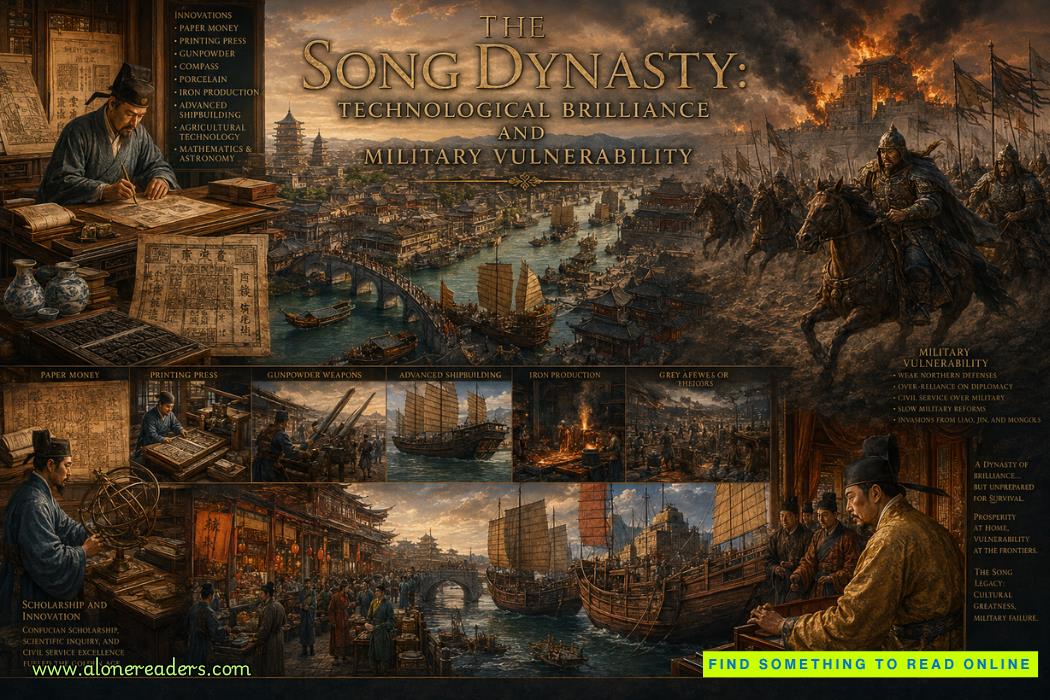
The Song Dynasty remains one of the most remarkable periods in Chinese history because it represented an era of extraordinary intellectual, economic, and technological achievement while simultaneously exposing the dangers of military weakness in a hostile geopolitical environment. Lasting from 960 to 1279, the dynasty transformed China into one of the most advanced societies on Earth. During this period, China experienced explosive urban growth, commercial expansion, scientific innovation, artistic refinement, and administrative sophistication. Yet despite its brilliance, the Song Dynasty struggled to defend itself against powerful northern rivals and ultimately collapsed under the pressure of Mongol conquest. The dynasty’s history demonstrates how a civilization can achieve unmatched cultural greatness while remaining strategically vulnerable.
The origins of the Song Dynasty emerged from the chaos that followed the collapse of the Tang Dynasty in 907. After the Tang disintegrated, China fragmented into the turbulent era known as the Five Dynasties and Ten Kingdoms Period. Regional warlords competed for power, governments rose and fell rapidly, and military commanders dominated politics. This instability devastated large parts of northern China and weakened central authority. By the middle of the tenth century, many Chinese elites desired reunification, order, and restoration of imperial stability.
The founder of the Song Dynasty was Zhao Kuangyin, a military commander who seized power in 960 and became Emperor Taizu of Song. Unlike many rulers who relied on permanent military domination, Taizu understood the dangers posed by powerful generals. The collapse of previous dynasties had often been caused by military governors who accumulated too much influence. Consequently, one of the first priorities of the new dynasty was to reduce military autonomy and strengthen civilian administration.
This decision profoundly shaped the future of the Song Dynasty. The emperors intentionally elevated scholar-officials and Confucian bureaucrats over military commanders. The imperial examination system expanded dramatically, allowing educated men to compete for government positions based on merit rather than aristocratic birth. This created one of the most sophisticated bureaucratic governments in the medieval world. Educated officials administered taxation, law, engineering, trade regulation, and agricultural projects with remarkable efficiency.
The Song rulers believed that civil governance, economic prosperity, and intellectual development would create long-term stability. In many ways, they succeeded. Under the Song, China entered a period of astonishing prosperity that historians often describe as an early form of commercial revolution. Massive population growth occurred as agricultural productivity improved. New strains of fast-ripening rice imported from Southeast Asia allowed farmers to harvest multiple crops per year. Irrigation systems expanded, and farming manuals spread advanced agricultural techniques throughout the empire.
As food production increased, cities grew rapidly. The Song capital of Kaifeng became one of the world’s largest urban centers, filled with merchants, artisans, scholars, entertainers, and government officials. Later, after northern territories were lost, the Southern Song established its capital at Hangzhou, which became another enormous commercial metropolis admired by foreign visitors for its beauty and sophistication.
The economy of Song China was highly monetized and commercially dynamic. Markets flourished across the empire, connected by rivers, canals, and maritime trade routes. Merchants transported tea, silk, porcelain, iron goods, spices, and luxury products across Asia. The Grand Canal played a critical role in linking northern and southern China, enabling efficient transport of grain and commercial goods.
One of the most revolutionary innovations of the Song era was the widespread use of paper money. Earlier dynasties had experimented with paper currency, but the Song government institutionalized it on a large scale. This development reflected the complexity and scale of the Song economy. Merchants could conduct long-distance trade more efficiently without transporting heavy metal coins. The existence of government-backed banknotes revealed the sophistication of Song financial administration.
Technological progress during the Song Dynasty was extraordinary. Many historians argue that Song China was centuries ahead of much of the contemporary world in science and engineering. The dynasty witnessed major advances in metallurgy, navigation, printing, mathematics, astronomy, hydraulics, and weaponry.
The iron industry expanded dramatically during this period. Song foundries produced enormous quantities of iron and steel for tools, weapons, agricultural equipment, and construction. Coal usage increased significantly, allowing industrial-scale production previously unseen in world history. Some historians even compare aspects of the Song economy to an early industrial revolution.
Printing technology revolutionized education and intellectual life. Woodblock printing had existed earlier, but the Song expanded its use extensively. Books became more accessible, literacy rates increased among educated classes, and knowledge spread more rapidly across society. The invention of movable type printing by Bi Sheng represented another major technological breakthrough. Although woodblock printing remained dominant for many purposes, movable type demonstrated the innovative spirit of the age.
Gunpowder technology also advanced significantly during the Song Dynasty. Chinese scientists and military engineers experimented with explosive weapons, flamethrowers, fire arrows, bombs, and primitive firearms. Ironically, despite inventing many early gunpowder weapons, the Song still struggled militarily against aggressive nomadic powers.
Maritime technology flourished as well. Song shipbuilders constructed large ocean-going vessels equipped with watertight compartments and advanced rudders. Chinese merchants sailed throughout Southeast Asia and the Indian Ocean, participating in a vast network of international trade. The magnetic compass became increasingly important for navigation, strengthening China’s maritime capabilities and commercial reach.
The intellectual culture of the Song Dynasty was equally influential. Neo-Confucianism emerged as the dominant philosophical system of the era. Thinkers such as Zhu Xi reinterpreted classical Confucian teachings, blending them with metaphysical ideas and moral philosophy. Neo-Confucianism emphasized discipline, ethical self-cultivation, family hierarchy, and social harmony. These ideas profoundly shaped Chinese society for centuries and later spread to Korea, Japan, and Vietnam.
Song art and literature also achieved exceptional refinement. Landscape painting became one of the defining artistic traditions of Chinese civilization. Artists portrayed mountains, rivers, forests, and mist-filled valleys with extraordinary detail and emotional depth. These paintings reflected philosophical ideas about humanity’s relationship with nature and the cosmos. Poetry, ceramics, and calligraphy flourished as well, with Song porcelain becoming especially admired for its elegance and craftsmanship.
Despite this brilliance, the Song Dynasty faced severe military challenges from the very beginning. Northern China bordered powerful steppe and semi-steppe peoples who possessed highly mobile cavalry armies. These rival states often excelled in warfare and posed constant threats to sedentary Chinese empires.
One of the earliest major rivals was the Liao Dynasty, established by the Khitan people. The Song lacked the cavalry strength necessary to decisively defeat the Liao and eventually agreed to a treaty involving tribute payments. Although this arrangement maintained temporary peace, it revealed the military limitations of the Song state.
The dynasty’s strategic problems worsened with the rise of the Jin Dynasty, founded by the Jurchens. Initially, the Song allied with the Jin against the Liao, hoping to recover lost northern territories. However, this alliance proved disastrous. After defeating the Liao, the Jin turned against the Song themselves.
In 1127, the Jin captured Kaifeng during the catastrophic Jingkang Incident. The emperor and many members of the imperial family were taken prisoner. Northern China fell under Jin control, forcing the surviving Song court to flee south. This marked the transition from the Northern Song to the Southern Song period.
Although the Southern Song survived for another century and a half, the dynasty never fully recovered its former territorial power. The loss of northern China was economically and psychologically devastating. Nevertheless, the Southern Song adapted remarkably well. The south possessed fertile agricultural lands, thriving commercial cities, and strong maritime trade networks. Economically, the Southern Song remained wealthy and innovative.
The Southern Song military also improved in several respects. The navy became especially important because rivers and coastal defenses provided strategic advantages against northern invaders. Song naval forces used paddle-wheel ships, gunpowder bombs, and advanced engineering techniques. In some battles, Song forces demonstrated impressive tactical innovation.
However, the dynasty still suffered from structural weaknesses. The ruling elite remained deeply suspicious of military commanders. Civil officials often exercised authority over generals, limiting military flexibility and initiative. The government also struggled with financial burdens caused by maintaining massive defensive armies.
Corruption, factional disputes, and bureaucratic inefficiency increasingly affected the state. Court politics became divided between officials advocating military resistance and those favoring diplomatic compromise. These internal conflicts weakened strategic coherence during moments of crisis.
The greatest threat emerged in the thirteenth century with the rise of the Mongol Empire under Genghis Khan and his successors. The Mongols created the largest contiguous land empire in history through unmatched military organization, mobility, and discipline. Their cavalry armies devastated kingdoms across Asia and Eastern Europe.
Initially, the Song benefited from Mongol attacks against the Jin Dynasty. Yet once the Jin were destroyed, the Mongols focused their full attention on the Southern Song. The resulting conflict became one of the longest and most difficult military campaigns the Mongols ever fought.
The Southern Song resisted fiercely. Strong fortifications, river defenses, naval warfare, and economic resources allowed the dynasty to survive for decades against overwhelming odds. Some Song commanders displayed extraordinary determination and tactical skill. Gunpowder weapons played an increasingly important role during these wars, with explosive bombs and fire lances used in defensive operations.
Nevertheless, the Mongols possessed advantages that gradually proved decisive. They adapted their strategies, incorporated engineers and siege specialists from conquered regions, and built their own naval capabilities. The Mongols also exploited divisions within the Song leadership and systematically destroyed defensive positions.
One of the most significant events occurred in 1276 when the Mongols captured the Song capital of Hangzhou. Although resistance continued under loyalist forces in the south, the dynasty’s collapse became inevitable. The final destruction came in 1279 during the Battle of Yamen, a massive naval confrontation in which Song loyalists were decisively defeated.
According to historical accounts, loyal officials chose death over surrender. The last child emperor reportedly died when an official carrying him jumped into the sea rather than submit to Mongol rule. This dramatic end symbolized the fall of one of China’s most brilliant dynasties.
After the conquest, the Mongols established the Yuan Dynasty under Kublai Khan. China became part of a vast Eurasian empire connecting East Asia, Central Asia, Persia, and parts of Eastern Europe. Although the Yuan preserved many aspects of Chinese administration, the transition marked the end of native Song rule.
The legacy of the Song Dynasty remains enormous. Many historians regard it as one of the high points of Chinese civilization. Its economic systems, technological innovations, intellectual achievements, and artistic traditions influenced generations far beyond China itself.
The dynasty demonstrated the power of education, administration, and commercial development in creating a prosperous society. It showed how technological progress and urbanization could transform an empire into a sophisticated economic powerhouse centuries before similar developments emerged elsewhere.
At the same time, the Song experience revealed the dangers of strategic imbalance. The dynasty prioritized civilian governance and cultural refinement to such an extent that military effectiveness suffered. While Song leaders feared internal military coups, their efforts to control the army weakened the empire’s ability to confront external enemies.
This contradiction lies at the heart of Song history. The dynasty was intellectually powerful but strategically fragile. It produced innovations that transformed world civilization while struggling to secure its own borders. It mastered commerce, engineering, literature, and administration but faced repeated humiliation from militarized rivals.
Modern historians often debate whether the Song should be viewed primarily as a failed military state or as one of history’s greatest cultural civilizations. In reality, it was both. Its military failures cannot erase its astonishing achievements, and its technological brilliance cannot hide the geopolitical realities that led to its destruction.
The Song Dynasty ultimately stands as a reminder that economic and cultural greatness alone do not guarantee survival. Civilizations must balance prosperity with security, innovation with defense, and intellectual advancement with strategic resilience. The dynasty’s rise and fall continue to fascinate scholars because they reveal how a society can simultaneously reach extraordinary heights of human achievement while remaining vulnerable to collapse.
At a Glance — The Song Dynasty
| Category | Details |
|---|---|
| Time Period | 960–1279 |
| Founder | Emperor Taizu (Zhao Kuangyin) |
| Capitals | Kaifeng and later Hangzhou |
| Major Strengths | Technology, trade, bureaucracy, education, urban growth |
| Key Innovations | Paper money, movable type printing, compass navigation, gunpowder weapons |
| Economic Importance | One of the world’s most advanced commercial economies |
| Intellectual Legacy | Rise of Neo-Confucianism |
| Major Enemies | Liao, Jin, and Mongol Empires |
| Greatest Weakness | Military vulnerability and weak cavalry power |
| Major Turning Point | Jingkang Incident in 1127 |
| Final Collapse | Defeated by the Mongols in 1279 |
| Historical Legacy | Technological and cultural golden age of medieval China |



 The Hundred Days Offensive: How the Allies Defeated Germany in World War I
 The Second Battle of the Marne: The Turning Point of World War I in 1918
 The Spring Offensive of 1918: Germany's Final Gamble to Win World War I
 The Treaty of Brest-Litovsk: How Russia Left World War I
 The Russian Revolution and World War I: How War Brought Down the Tsar
 The Zimmermann Telegram Explained: Germany's Secret Offer to Mexico in World War I