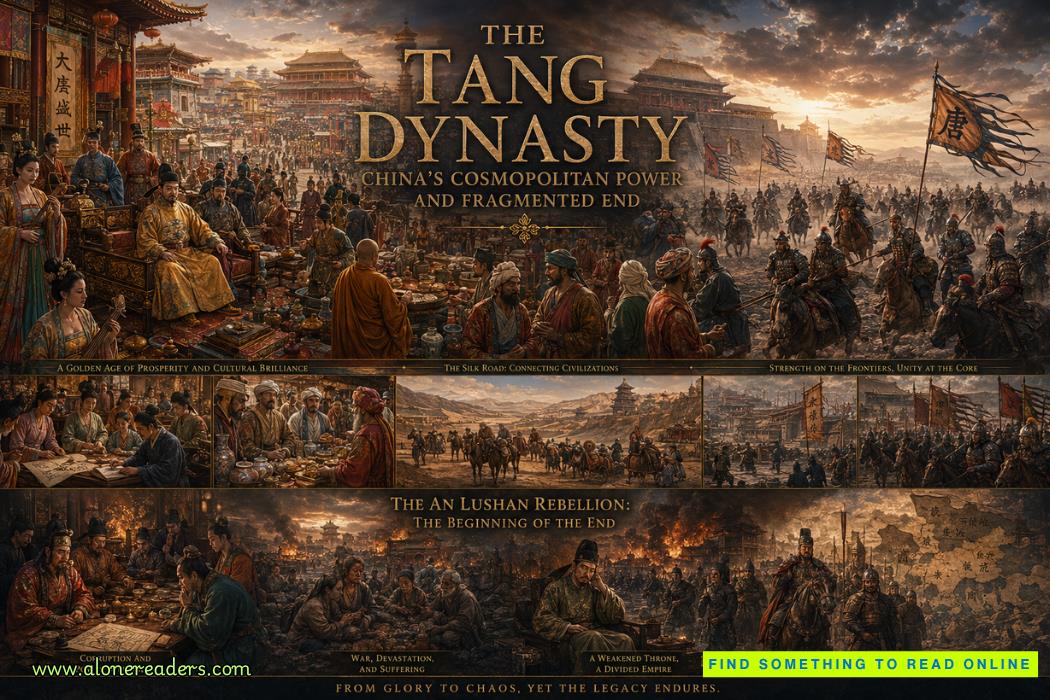
The Tang Dynasty remains one of the most celebrated periods in Chinese history, remembered as an era of extraordinary cultural brilliance, military expansion, international trade, and cosmopolitan sophistication. Lasting from 618 to 907, the Tang Empire transformed China into one of the wealthiest and most influential civilizations on Earth. During its height, the Tang court governed a vast territory stretching deep into Central Asia, maintained diplomatic relations with distant kingdoms, and presided over a society that attracted merchants, scholars, monks, artists, and travelers from across Eurasia. The dynasty’s capital, Chang’an, became one of the largest and most diverse cities in the medieval world, a center where Chinese traditions mixed with Persian, Turkic, Indian, Korean, Japanese, and Arab influences.
Yet despite its immense achievements, the Tang Dynasty eventually collapsed into fragmentation, rebellion, corruption, and regional warfare. The same openness and military power that helped build the empire also created vulnerabilities that weakened central authority over time. Internal court struggles, growing military autonomy, economic strain, peasant suffering, and catastrophic rebellions gradually destroyed the foundations of Tang rule. By the early tenth century, the once-glorious empire had broken apart into competing states, ending one of China’s greatest dynastic eras.
The rise of the Tang Dynasty began in the aftermath of the collapse of the Sui Dynasty, whose ambitious infrastructure projects and disastrous military campaigns exhausted the population. The Sui emperors had reunified China after centuries of division, but their harsh taxation and forced labor policies generated widespread rebellion. Amid this chaos emerged Li Yuan, a powerful aristocrat and military commander who seized the capital in 618 and established the Tang Dynasty as Emperor Gaozu.
The Tang state quickly consolidated power under Gaozu and his more famous successor, Emperor Taizong. Taizong became one of the most respected rulers in Chinese history because of his administrative skill, military leadership, and willingness to listen to capable advisors. Under his reign, the empire expanded dramatically, defeating rival states and nomadic powers while stabilizing internal governance. The Tang political system combined strong centralized authority with a sophisticated bureaucracy that rewarded talent and education. This helped create an efficient government capable of administering a massive empire.
One of the most important features of Tang governance was the expansion of the imperial examination system. Although earlier dynasties had experimented with civil service examinations, the Tang rulers institutionalized the process more effectively. Officials increasingly gained power through examinations based on Confucian classics rather than solely through aristocratic birth. This system encouraged education, literary culture, and administrative competence across the empire. The Tang examination system would later influence governance models throughout East Asia for centuries.
Military success also played a crucial role in Tang expansion. Tang cavalry armies were highly effective against nomadic rivals in Central Asia and along the northern frontiers. The dynasty defeated the Eastern Turks and established influence over key Silk Road territories. Chinese power extended westward into oasis cities and trade routes that connected China to Persia, the Islamic world, and the Byzantine Empire. Control over these routes enriched the empire while increasing diplomatic influence.
The Silk Road flourished under Tang rule. Caravans carried silk, porcelain, tea, spices, horses, precious metals, glassware, and religious ideas across Eurasia. Foreign merchants established communities inside Tang cities, while travelers from distant regions documented the wealth and sophistication of China. Chang’an became a symbol of imperial prosperity and cultural diversity. The city contained massive markets, Buddhist temples, foreign religious centers, entertainment districts, gardens, and administrative compounds. Merchants from Central Asia and Persia walked the same streets as Chinese scholars and Korean diplomats.
The cosmopolitan character of Tang society distinguished it from many earlier Chinese dynasties. Foreign music, dance, fashion, and cuisine became fashionable among elites. Persian influences appeared in art and decorative styles. Buddhism expanded enormously during this era, supported by imperial patronage and international exchange. Monks traveled between India and China translating sacred texts and spreading religious philosophy. Daoism and Confucianism also flourished, creating a vibrant intellectual environment.
Tang China also experienced remarkable achievements in literature and the arts. The dynasty is often considered the golden age of Chinese poetry. Famous poets such as Li Bai and Du Fu produced works that explored nature, war, friendship, politics, loneliness, and social suffering with extraordinary emotional depth. Their poetry remains influential even today. Tang poetry became one of the highest forms of cultural expression in Chinese civilization.
Painting, ceramics, sculpture, and calligraphy also advanced significantly. Tang artists emphasized realism, movement, and emotional expression. Ceramic production expanded with improved glazing techniques and trade demand. Buddhist art flourished in cave temples and monasteries throughout the empire. The wealth generated by commerce and imperial patronage allowed cultural institutions to thrive on a scale rarely seen before.
Economically, the Tang Dynasty benefited from agricultural expansion, population growth, and extensive trade networks. Improvements in irrigation and farming increased food production, supporting larger cities and armies. Government land distribution policies initially helped maintain relative stability by allocating land to peasant households. Taxes collected from agricultural production funded the military and bureaucracy.
Women in Tang society generally enjoyed greater freedoms compared to some later dynasties. Elite women could participate more openly in social activities, ride horses, play sports, and influence court politics. The most famous example was Empress Wu Zetian, the only woman in Chinese history to rule officially as emperor. Rising from the imperial court, Wu consolidated power through political alliances and intelligence networks before establishing her own Zhou Dynasty during an interruption in Tang rule. Though controversial, she proved to be an effective administrator who strengthened the examination system and supported Buddhism.
Despite these successes, structural weaknesses gradually emerged within the Tang state. The empire’s vast size created enormous military and administrative pressures. Maintaining frontier defenses required large standing armies commanded by regional military governors known as jiedushi. Over time, these governors accumulated significant military autonomy and economic resources. While initially useful for border security, they eventually became semi-independent power centers.
Court politics also became increasingly unstable. Eunuchs gained growing influence within the imperial palace and often manipulated succession disputes. Rival factions among aristocrats, officials, and military leaders weakened the coherence of the central government. Corruption expanded as officials sought wealth and political survival within a highly competitive environment.
The turning point in Tang history came during the reign of Emperor Xuanzong. Early in his rule, Xuanzong presided over one of the dynasty’s greatest periods of prosperity and cultural achievement. However, as he aged, court politics deteriorated. His relationship with the concubine Yang Guifei and the growing influence of her relatives generated resentment and instability. At the same time, powerful frontier generals gained increasing control over military forces.
Among these generals was An Lushan, a commander of mixed Sogdian and Turkic background who controlled major northern armies. In 755, An Lushan launched a massive rebellion against the Tang government, beginning one of the most devastating conflicts in Chinese history. The An Lushan Rebellion shattered the foundations of Tang power and permanently weakened the empire.
Rebel armies captured major cities, including Chang’an and Luoyang, forcing the emperor to flee. Millions of people died through warfare, famine, disease, and displacement. Agricultural production collapsed in many regions, while entire communities were destroyed. Although Tang forces eventually suppressed the rebellion with assistance from foreign allies and regional armies, the dynasty never fully recovered.
The rebellion exposed the dangers of excessive military decentralization. Regional commanders who helped defeat the rebels retained substantial autonomy afterward. The central government became increasingly dependent on provincial military leaders who often ignored imperial authority. Tax revenues declined while military expenses increased dramatically. Peasant populations suffered under heavier taxation and insecurity.
Following the rebellion, the Tang court entered a prolonged period of decline. Eunuchs gained even greater power over imperial succession and military affairs. Several emperors became weak or politically isolated figures controlled by palace factions. Provincial governors frequently acted independently, creating fragmented regional power structures across the empire.
Economic inequality also intensified. Wealthy landowners expanded their estates while many peasants lost land and became impoverished tenants. Government land distribution systems weakened, reducing state revenue and increasing rural instability. Natural disasters and famines further aggravated social tensions.
Religious and cultural changes reflected broader anxieties within the empire. Although Buddhism had flourished earlier, some officials began viewing foreign religions and influences with suspicion. In the ninth century, Emperor Wuzong initiated major persecutions against Buddhist institutions, confiscating monastery wealth and reducing religious influence. These campaigns reflected both economic motives and growing cultural conservatism within the court.
External threats further strained the empire. Tibetan forces challenged Tang control in western regions, while other nomadic groups attacked frontier territories. The dynasty gradually lost influence over Central Asian trade routes that had once enriched the empire. Maritime trade remained important, but the geopolitical dominance of early Tang China diminished significantly.
The final decades of the Tang Dynasty were marked by escalating rebellion and political fragmentation. One of the most destructive uprisings was the Huang Chao Rebellion in the late ninth century. Huang Chao, originally involved in salt smuggling, led massive peasant armies against the government after widespread famine and economic suffering. Rebel forces captured major cities and devastated large regions of China.
Although Tang loyalists eventually defeated Huang Chao, the rebellion accelerated the collapse of imperial authority. Regional military leaders gained even more power during the conflict. One of these commanders, Zhu Wen, gradually emerged as the dominant figure in northern China. In 907, he forced the last Tang emperor to abdicate, officially ending the dynasty.
The collapse of the Tang Dynasty ushered in the chaotic Five Dynasties and Ten Kingdoms period, an era of political fragmentation and regional warfare. China would remain divided until the rise of the Song Dynasty later in the tenth century.
Despite its collapse, the legacy of the Tang Dynasty remained profound. Tang China became a model of imperial governance, cultural sophistication, and cosmopolitan exchange throughout East Asia. Japanese envoys and scholars studied Tang institutions, architecture, writing systems, and Buddhism extensively. Korean kingdoms adopted many Tang administrative and cultural practices. Chinese literature, poetry, and artistic traditions from the Tang era continued influencing later generations across Asia.
The dynasty also left a lasting impression on global history through its role in Silk Road commerce and cultural interaction. Tang China connected East and West during a crucial period of medieval globalization. Goods, technologies, religions, artistic styles, and scientific ideas moved across Eurasia through networks strengthened by Tang stability and economic power.
Yet the dynasty’s downfall also provided enduring historical lessons. The Tang experience demonstrated the dangers of military decentralization, court corruption, economic inequality, and overextension. Its decline showed how even the most powerful empires can fragment when central authority weakens and regional forces gain autonomy. The Tang rulers built one of the world’s greatest civilizations, but sustaining such a vast and diverse empire proved extraordinarily difficult over time.
Modern historians continue to view the Tang Dynasty as one of the defining high points of Chinese civilization. Its combination of military strength, economic prosperity, artistic brilliance, international openness, and intellectual achievement created a cultural legacy unmatched by many contemporary empires. At the same time, its violent collapse revealed the fragility hidden beneath imperial grandeur.
The Tang Dynasty’s story remains both inspiring and cautionary. It was an empire that embraced global exchange centuries before modern globalization, fostered extraordinary creativity, and projected immense political power across Asia. But it was also an empire vulnerable to internal division, elite corruption, social inequality, and military fragmentation. Its rise reflected the possibilities of strong governance and cultural openness, while its collapse revealed the consequences of instability and concentrated power.
In many ways, the Tang Dynasty represented the height of medieval Chinese civilization. Its cities dazzled foreign visitors, its poets transformed literature, its armies dominated trade routes, and its scholars shaped intellectual traditions that endured for centuries. Even after its fall, the memory of Tang greatness continued influencing Chinese identity and historical imagination long afterward.
At a Glance – The Tang Dynasty
| Category | Details |
|---|---|
| Dynasty Period | 618–907 |
| Founder | Emperor Gaozu (Li Yuan) |
| Greatest Early Ruler | Emperor Taizong |
| Capital | Chang’an |
| Golden Age Features | Silk Road trade, poetry, art, cosmopolitan culture |
| Major Achievements | Expansion into Central Asia, examination system growth, cultural flourishing |
| Famous Figures | Li Bai, Du Fu, Wu Zetian, Emperor Xuanzong |
| Major Turning Point | An Lushan Rebellion (755–763) |
| Key Weaknesses | Military decentralization, eunuch power, corruption |
| Final Collapse | 907 under pressure from regional warlords |
| Historical Legacy | Golden age of Chinese culture and international influence |



 The Hundred Days Offensive: How the Allies Defeated Germany in World War I
 The Second Battle of the Marne: The Turning Point of World War I in 1918
 The Spring Offensive of 1918: Germany's Final Gamble to Win World War I
 The Treaty of Brest-Litovsk: How Russia Left World War I
 The Russian Revolution and World War I: How War Brought Down the Tsar
 The Zimmermann Telegram Explained: Germany's Secret Offer to Mexico in World War I