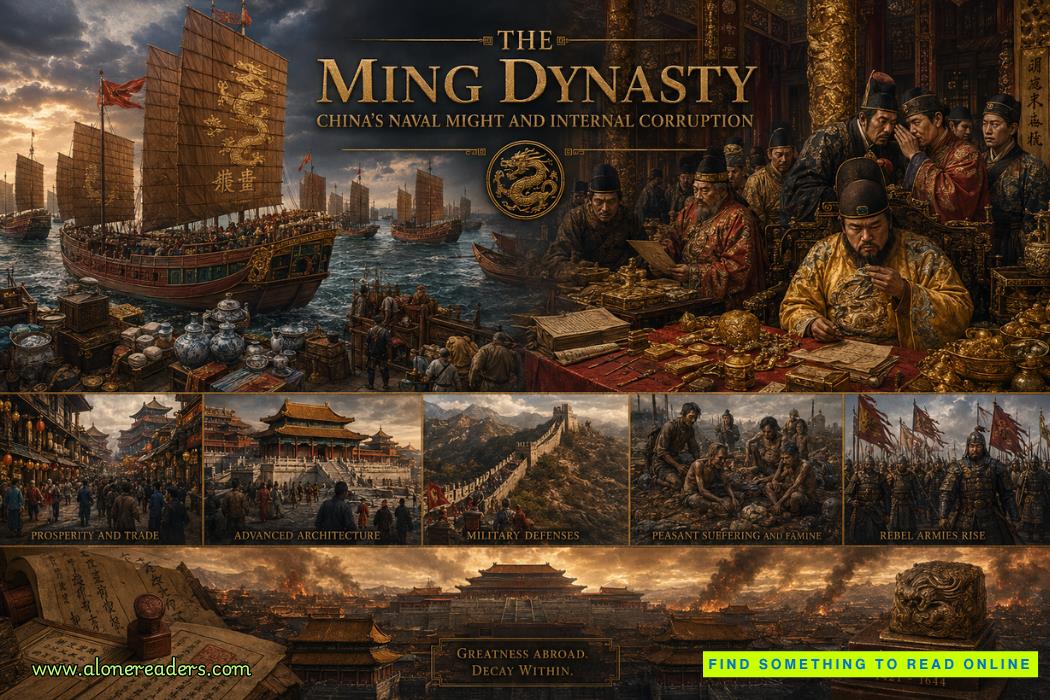
The Ming Dynasty remains one of the most influential and fascinating imperial periods in Chinese history. Founded in 1368 after the collapse of the Mongol-led Yuan Dynasty, the Ming era represented a dramatic restoration of Han Chinese rule and identity. For nearly three centuries, the Ming emperors presided over an empire that became one of the wealthiest, most technologically advanced, and most culturally sophisticated civilizations on Earth. Its massive cities, disciplined bureaucracy, naval expeditions, and flourishing trade networks projected Chinese influence across Asia and beyond. Yet behind this image of strength lay dangerous internal weaknesses. Corruption, factional struggles, economic instability, peasant suffering, and political decay gradually hollowed out the empire from within. By the seventeenth century, the once-mighty dynasty collapsed under the combined pressures of rebellion, invasion, and institutional paralysis.
The rise of the Ming Dynasty began with a peasant-born revolutionary named Zhu Yuanzhang, later known as the Hongwu Emperor. His early life reflected the harsh conditions of late Yuan China. Famine, disease, and economic collapse devastated rural communities while Mongol rulers faced widespread resentment from the Han Chinese majority. Zhu Yuanzhang lost much of his family to starvation and disease before joining a rebel movement associated with the Red Turbans, a religious and political uprising against Mongol rule. Through military skill, political intelligence, and relentless determination, he gradually defeated rival factions and captured the Yuan capital.
When Zhu Yuanzhang established the Ming Dynasty in 1368, he sought not merely to replace one ruling family with another but to completely reconstruct imperial governance. The Hongwu Emperor viewed corruption and elite privilege as existential threats to state stability. He implemented severe laws, centralized authority, and expanded agricultural production to rebuild the war-torn economy. Vast irrigation systems were restored, abandoned farmland was redistributed, and millions of peasants were resettled to revive food production. Taxes were reduced in many areas to encourage economic recovery.
The Ming state also created one of the most sophisticated bureaucratic systems in world history. Civil service examinations based on Confucian scholarship became central to administration. Talented individuals from across the empire could theoretically rise into government service through examination success rather than noble birth alone. This system strengthened imperial control and promoted intellectual unity. Confucian ideology emphasized hierarchy, discipline, morality, and loyalty to the emperor, reinforcing the political structure of the empire.
Under the early Ming rulers, China entered a period of immense prosperity and demographic expansion. Agricultural output increased significantly through improved farming techniques and expanded cultivation. Cities grew rapidly as domestic trade flourished. Chinese artisans produced highly prized silk, porcelain, lacquerware, and metalwork that attracted international demand. Ming porcelain, especially the famous blue-and-white ceramics, became symbols of luxury across Asia, the Middle East, and Europe.
The Ming capital itself reflected imperial ambition and organizational power. Beijing, especially after becoming the primary capital under the Yongle Emperor, transformed into a monumental center of administration and culture. The construction of the Forbidden City demonstrated extraordinary engineering capabilities and imperial wealth. Massive walls, grand palaces, ceremonial halls, and carefully designed urban planning symbolized centralized authority and cosmic order.
One of the most remarkable aspects of the Ming golden age was China’s extraordinary naval expansion during the early fifteenth century. Under the Yongle Emperor, the dynasty launched enormous maritime expeditions commanded by the Muslim eunuch admiral Zheng He. These voyages represented one of the greatest naval enterprises in pre-modern history.
Zheng He’s treasure fleets were astonishing in scale. Some accounts describe fleets consisting of hundreds of ships and tens of thousands of sailors, soldiers, merchants, translators, and officials. The enormous treasure ships dwarfed many contemporary vessels elsewhere in the world. The Ming navy projected Chinese influence across Southeast Asia, India, the Arabian Peninsula, and East Africa decades before European maritime empires began global expansion.
The goals of these voyages were political, diplomatic, and economic rather than purely colonial. Zheng He carried imperial gifts, established tributary relationships, demonstrated Chinese military strength, and expanded trade connections. Foreign rulers sent ambassadors back to China bearing tribute, exotic animals, precious goods, and diplomatic recognition. The voyages reinforced the idea that China stood at the center of a vast international order.
The naval expeditions also demonstrated advanced Chinese technological and logistical capabilities. Chinese shipbuilders mastered large-scale vessel construction, navigation, compartmentalized hull design, and maritime coordination. Ming China possessed sophisticated knowledge of astronomy, cartography, and oceanic travel. At its height, the Ming maritime system represented perhaps the most advanced naval power on Earth.
Yet this naval supremacy did not last. After the death of the Yongle Emperor and his successors, powerful factions within the imperial court began questioning the value of overseas expeditions. Conservative Confucian officials argued that maritime expansion wasted resources, strengthened eunuch influence, and distracted from domestic priorities. China increasingly turned inward.
The cancellation of Zheng He’s voyages marked one of the great turning points in world history. Shipyards declined, maritime records were neglected or destroyed, and restrictions on overseas trade increased. While European powers later expanded aggressively into global maritime exploration, Ming China gradually retreated from oceanic dominance. Historians continue debating how differently world history might have unfolded had China maintained its naval expansion.
Internally, the Ming Dynasty increasingly struggled with political corruption and institutional dysfunction. Ironically, the very bureaucracy designed to ensure stability gradually became a source of decay. Court politics became dominated by rival factions competing for influence over weak or disengaged emperors. Scholar-officials, military commanders, eunuchs, and aristocratic elites fought constant power struggles that weakened governance.
One of the most destructive developments was the growing influence of palace eunuchs. Originally intended to serve as trusted imperial servants isolated from family-based political ambitions, eunuchs gradually accumulated enormous power. Certain emperors relied heavily on eunuchs because they distrusted scholar-officials and ministers. Over time, eunuch factions established intelligence networks, manipulated court appointments, controlled access to the emperor, and amassed vast personal wealth.
The corruption associated with powerful eunuchs became notorious. Officials accepted bribes, embezzled state funds, manipulated taxes, and exploited peasants. Government positions increasingly depended not only on examination merit but also on factional connections and political favoritism. Honest officials often faced persecution when challenging corrupt interests.
The late Ming court became infamous for political paralysis. Emperors sometimes withdrew from active governance for years, allowing competing factions to dominate decision-making. The Wanli Emperor, for example, eventually became deeply frustrated with bureaucratic conflict and largely abandoned direct participation in government affairs. Important administrative functions stalled while corruption expanded throughout the empire.
Economic problems further destabilized the dynasty. Although Ming China remained wealthy overall, its financial system became increasingly fragile. Population growth placed enormous pressure on land and resources. Rural inequality worsened as wealthy landowners accumulated large estates while peasants struggled with debt, taxes, and declining living standards.
Silver became central to the Ming economy due to tax reforms requiring payments in silver rather than grain or labor. Initially, this system stimulated commercial activity and linked China to global trade networks. Large quantities of silver entered China through trade with Japan and later Spanish-controlled American mines via Manila. However, dependence on silver created vulnerability to global market disruptions.
When silver supplies fluctuated during the seventeenth century, the consequences were devastating. Deflation increased tax burdens on peasants, economic activity slowed, and widespread hardship spread through rural communities. At the same time, natural disasters intensified suffering. Droughts, floods, famines, and epidemics struck various regions of China, creating massive social instability.
Climate change associated with the Little Ice Age worsened agricultural production during the late Ming period. Crop failures became more frequent, leading to starvation and migration. Desperate peasants increasingly turned to banditry and rebellion. The Ming government often proved incapable of responding effectively because corruption and fiscal weakness undermined relief efforts.
As conditions deteriorated, large-scale rebellions erupted across northern China. Among the most important rebel leaders was Li Zicheng, a former postal worker who capitalized on widespread anger against the government. His movement attracted starving peasants, unemployed soldiers, and disillusioned citizens who viewed the Ming administration as hopelessly corrupt and ineffective.
The Ming military, once formidable, had also declined severely by this time. Corruption weakened discipline, funds intended for soldiers were stolen, and military readiness deteriorated. Frontier defenses became increasingly unreliable. Although the Great Wall remained an impressive defensive structure, internal instability mattered more than physical fortifications. Empires often collapse not because enemies become overwhelmingly strong, but because internal institutions become fatally weak.
In 1644, Li Zicheng’s rebel forces captured Beijing. The Chongzhen Emperor, the final Ming ruler, reportedly hanged himself on a hill near the Forbidden City rather than face capture. This moment symbolized the dramatic collapse of one of China’s greatest dynasties.
However, the story did not end there. Shortly after the fall of Beijing, Ming general Wu Sangui opened the gates of the Great Wall to the Manchus, a rising power from northeast Asia. Seeking assistance against the rebels, Wu unintentionally enabled the Manchu conquest of China. The Manchus defeated Li Zicheng and established the Qing Dynasty, which would rule China until the early twentieth century.
The fall of the Ming Dynasty illustrates a recurring pattern throughout history. Powerful empires often achieve extraordinary success through military organization, economic productivity, technological advancement, and effective governance. Yet over time, internal corruption, bureaucratic stagnation, inequality, and political fragmentation erode these strengths. The Ming collapse was not caused by a single invasion or disaster but by the cumulative weakening of institutions over generations.
Despite its eventual downfall, the Ming Dynasty left a profound historical legacy. Ming cultural achievements deeply shaped Chinese civilization. Literature, painting, ceramics, architecture, philosophy, and urban culture flourished during this period. The Forbidden City remains one of the most iconic architectural complexes in the world. Ming legal systems and bureaucratic practices influenced later Chinese governance for centuries.
The dynasty also demonstrated the remarkable potential of pre-modern Chinese maritime power. Zheng He’s voyages revealed that China possessed the technological capability and organizational capacity to become a dominant global naval civilization long before European colonial empires emerged. The Ming retreat from maritime expansion remains one of the most debated strategic decisions in global history.
Modern historians increasingly view the Ming Dynasty not simply as a story of rise and collapse but as a complex era of transformation. It represented the restoration of native Chinese rule after foreign domination, the expansion of global trade networks, the growth of sophisticated urban economies, and the evolution of one of history’s most advanced bureaucratic states. At the same time, it exposed the dangers of concentrated political power, factionalism, institutional corruption, and economic inequality.
The Ming experience also offers broader lessons about state resilience. Strong institutions require accountability, adaptability, and public trust. Economic prosperity alone cannot preserve stability if governments become disconnected from ordinary people. Military strength and technological sophistication can be undermined when corruption destroys administrative effectiveness. The dynasty’s enormous naval fleets and monumental architecture could not compensate for the erosion of internal cohesion.
Today, the Ming Dynasty continues to fascinate historians, political thinkers, and the public because it combines extraordinary achievement with dramatic decline. It was an empire capable of projecting immense power across oceans while simultaneously struggling with corruption inside palace walls. It built magnificent cities and fleets yet failed to maintain institutional stability. Its story remains one of the clearest historical examples of how greatness and vulnerability can coexist within the same civilization.
At a Glance: The Ming Dynasty
| Category | Details |
|---|---|
| Founded | 1368 |
| Founder | Zhu Yuanzhang (Hongwu Emperor) |
| Capital | Beijing |
| Dynasty Duration | 1368–1644 |
| Major Achievement | Restoration of Han Chinese rule |
| Naval Power | Zheng He’s treasure fleet expeditions |
| Economic Strength | Silk, porcelain, agriculture, global trade |
| Cultural Legacy | Forbidden City, Ming porcelain, literature |
| Main Weaknesses | Corruption, eunuch dominance, factionalism |
| Economic Problems | Silver shortages, taxation crisis, inequality |
| Environmental Issues | Famines, floods, Little Ice Age effects |
| Final Collapse | Peasant rebellions and Manchu invasion |
| Successor Dynasty | Qing Dynasty |
| Historical Importance | One of China’s greatest imperial eras combining technological brilliance, maritime power, and political decline |



 The Hundred Days Offensive: How the Allies Defeated Germany in World War I
 The Second Battle of the Marne: The Turning Point of World War I in 1918
 The Spring Offensive of 1918: Germany's Final Gamble to Win World War I
 The Treaty of Brest-Litovsk: How Russia Left World War I
 The Russian Revolution and World War I: How War Brought Down the Tsar
 The Zimmermann Telegram Explained: Germany's Secret Offer to Mexico in World War I










