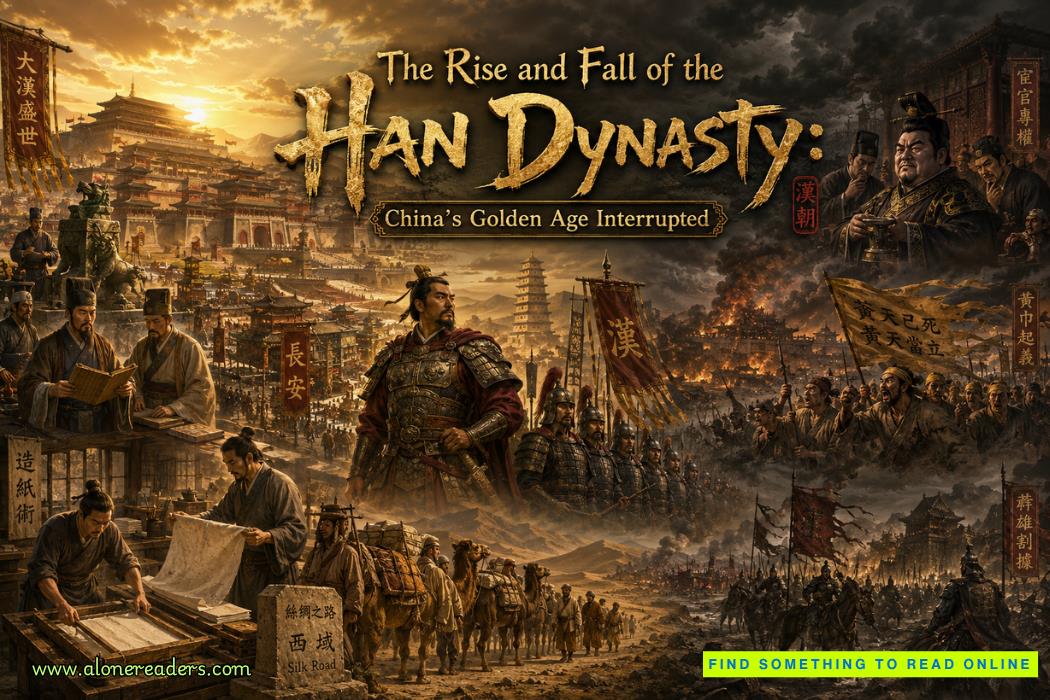
The Han Dynasty occupies a unique place in world history because it was not merely a successful imperial government but the civilization that permanently shaped the cultural and political identity of China. Even today, the majority ethnic population of China identifies itself as the Han people, a direct reflection of the dynasty’s enormous historical influence. Few ruling houses in human history have left such a deep and lasting imprint on national identity. Emerging from the chaos that followed the brutal collapse of the Qin Dynasty, the Han transformed a fragile empire into one of the ancient world’s most sophisticated and powerful states. It oversaw military expansion, economic growth, technological innovation, philosophical consolidation, and the opening of international trade routes that linked East Asia with Central Asia and beyond. Yet despite centuries of success, the dynasty eventually fractured under the combined weight of corruption, economic inequality, political instability, and rebellion. Its story is one of extraordinary achievement interrupted by internal decay.
The rise of the Han Dynasty began in the aftermath of the Qin Dynasty’s rapid collapse in 206 BCE. The Qin had unified China for the first time under Qin Shi Huang, but its harsh Legalist policies, massive labor projects, oppressive taxation, and authoritarian governance generated widespread resentment. After Qin Shi Huang’s death, rebellions erupted across the empire. Among the many rebel leaders who emerged during this period, Liu Bang eventually proved the most capable politically and militarily. Unlike many aristocratic rivals, Liu Bang came from a relatively humble background. He understood the frustrations of ordinary people and cultivated support among soldiers, peasants, and administrators alike.
Following years of civil war known as the Chu–Han Contention, Liu Bang defeated his main rival Xiang Yu and established the Han Dynasty in 202 BCE, taking the imperial title Emperor Gaozu. The foundation of the Han marked a significant shift in governance. While the Qin had ruled through fear and rigid control, the early Han emperors adopted a more pragmatic approach. They retained the centralized administrative framework created by the Qin but softened its harsher elements. Taxes were reduced, labor obligations were moderated, and agricultural recovery became a major priority. This balance between centralized authority and practical governance became one of the key reasons for Han stability.
The early Han rulers recognized that military conquest alone could not sustain an empire. They needed legitimacy, economic recovery, and administrative continuity. Agriculture formed the foundation of the imperial economy, and the government actively encouraged farming by distributing land, reducing burdens on peasants, and stabilizing rural society. As agricultural production improved, population growth accelerated, cities expanded, and commerce revived. Grain surpluses allowed the state to maintain armies, construct infrastructure, and fund bureaucratic institutions.
The Han also gradually moved away from strict Legalism and increasingly embraced Confucian philosophy as the ideological foundation of the state. Confucianism emphasized moral leadership, filial piety, social harmony, education, and bureaucratic responsibility. Under Emperor Wu, one of the dynasty’s greatest rulers, Confucianism became deeply integrated into government institutions. Scholars trained in classical texts gained increasing influence at court, and education became an important pathway into public service. This fusion of imperial authority with Confucian ideals helped create one of the most enduring political traditions in Chinese history.
The reign of Emperor Wu, who ruled from 141 BCE to 87 BCE, represented the high point of Han expansion and imperial ambition. Determined to strengthen China’s position, Emperor Wu launched extensive military campaigns against the Xiongnu confederation, powerful nomadic groups that threatened northern borders. These campaigns were expensive and often difficult, but they significantly weakened the Xiongnu and expanded Han influence deep into Central Asia.
The expansion westward had profound global consequences because it facilitated the development of the Silk Road. This vast network of trade routes connected China with Central Asia, Persia, India, and eventually the Mediterranean world. Chinese silk became one of the most valuable luxury goods in Eurasian commerce. In return, China received horses, precious stones, glassware, spices, and new cultural influences. The Silk Road was not simply a commercial system; it was a channel for diplomacy, religion, technology, and cultural exchange. Buddhism, which would later become highly influential in China, entered through these interconnected routes.
The Han period also witnessed remarkable administrative sophistication. The empire was divided into commanderies and counties overseen by appointed officials. Bureaucratic records, taxation systems, census operations, and legal procedures became increasingly organized. The state maintained granaries to stabilize food supplies during famines and used monopolies on essential commodities like salt and iron to generate revenue. These measures reflected an advanced understanding of governance and economic management for the ancient world.
Technological and intellectual achievements flourished during the Han era. Papermaking, traditionally associated with Cai Lun during the Eastern Han period, revolutionized communication and record-keeping. Advances occurred in metallurgy, hydraulic engineering, astronomy, mathematics, and medicine. Scholars compiled historical works, including Sima Qian’s monumental Records of the Grand Historian, one of the greatest historical texts ever produced in antiquity. Han scientists developed sophisticated seismographs and improved agricultural tools that increased productivity. The dynasty’s achievements were not confined to military power; they represented a broad civilizational transformation.
Yet beneath the surface of prosperity, structural weaknesses gradually emerged. One major problem involved land ownership. Over time, wealthy aristocratic families accumulated enormous estates while many peasants lost their land due to debt, taxation, or economic hardship. As land concentration increased, inequality deepened across the empire. Wealthy landlords often avoided taxes through political influence, shifting the burden onto poorer peasants. This weakened government revenue while simultaneously increasing social resentment.
Court politics also became increasingly unstable. Emperors often ascended the throne at young ages, allowing regents, eunuchs, and powerful court factions to dominate imperial decision-making. Rivalries between scholar-officials and palace eunuchs became especially destructive during the later Han period. Eunuchs gained influence through their proximity to emperors and frequently manipulated appointments, suppressed rivals, and enriched themselves through corruption. In response, Confucian officials attempted to challenge eunuch power, leading to repeated political purges and factional struggles.
The dynasty experienced a major interruption during the brief Xin Dynasty established by Wang Mang in 9 CE. Wang Mang, a powerful regent connected to the imperial family, seized the throne and attempted sweeping reforms designed to address economic inequality and restore idealized ancient practices. He tried to redistribute land, regulate slavery, and restructure the economy. However, his reforms proved deeply unpopular among elites and difficult to enforce. Natural disasters, flooding of the Yellow River, famine, and widespread rebellion further destabilized his regime.
In 23 CE, Wang Mang was overthrown, and the Han Dynasty was restored under Emperor Guangwu, marking the beginning of the Eastern Han period. Although the restoration revived imperial authority, the new dynasty faced ongoing challenges. The capital moved eastward to Luoyang, and while economic recovery occurred, the political structure was increasingly fragile. Regional elites gained greater autonomy, military commanders became more powerful, and the central government struggled to maintain control across vast territories.
Natural disasters worsened the situation. Floods, droughts, locust infestations, and famine devastated agricultural communities. In ancient China, such disasters were often interpreted as signs that the ruling dynasty had lost the Mandate of Heaven, the traditional belief that heaven granted legitimacy to morally just rulers. As suffering intensified, confidence in imperial leadership weakened. Religious movements promising salvation and divine renewal began attracting massive followings among desperate peasants.
The most famous of these uprisings was the Yellow Turban Rebellion of 184 CE. Led by Zhang Jue and inspired by Daoist religious beliefs, the rebels called for the overthrow of the Han government and the establishment of a new era of equality and peace. Their slogan reflected widespread despair: “The Blue Heaven is dead; the Yellow Heaven will rise.” The rebellion spread rapidly across northern China, involving hundreds of thousands of followers.
Although Han forces eventually suppressed the rebellion, the cost was catastrophic. To defeat the rebels, the government relied heavily on regional military commanders and local warlords. These figures gained independent armies, political influence, and territorial control. The rebellion did not destroy the dynasty immediately, but it shattered the central government’s monopoly on military power. Once regional commanders realized their own strength, many stopped obeying imperial authority altogether.
Following the rebellion, the Han court descended into even greater chaos. Eunuchs and military factions fought openly for influence. In 189 CE, the warlord Dong Zhuo seized control of the capital and dominated the emperor through military intimidation. His brutality accelerated the empire’s fragmentation. Regional governors and military leaders formed coalitions, but instead of restoring imperial unity, they increasingly pursued their own ambitions.
China soon descended into prolonged civil war. Rival warlords such as Cao Cao, Liu Bei, and Sun Quan carved out competing territories across the empire. The Han emperor became little more than a symbolic figure manipulated by stronger political actors. Finally, in 220 CE, Cao Pi, son of the powerful warlord Cao Cao, forced the last Han emperor to abdicate. This formally ended the Han Dynasty and initiated the period known as the Three Kingdoms.
The fall of the Han Dynasty was not caused by a single event but by the convergence of multiple crises over generations. Economic inequality undermined rural stability. Corruption weakened public trust. Court factionalism paralyzed governance. Natural disasters intensified suffering. Rebellions destabilized the countryside. Military decentralization empowered warlords who no longer depended on imperial authority. The same vast empire that once symbolized order and prosperity gradually fragmented under the pressure of its own internal contradictions.
Despite its collapse, the Han Dynasty’s legacy remained extraordinarily influential. Later Chinese dynasties repeatedly looked back to the Han as a model of effective governance and cultural achievement. Confucian bureaucratic systems developed during the Han continued shaping Chinese administration for nearly two thousand years. The Silk Road established patterns of international exchange that transformed Eurasian history. Chinese historical identity itself became closely associated with the Han name.
The dynasty also left an enduring intellectual and cultural legacy. Historical writing, statecraft theory, educational traditions, legal practices, and philosophical discourse all evolved significantly during the Han period. Artistic developments in ceramics, sculpture, tomb architecture, and literature reflected a civilization growing increasingly confident in its identity and sophistication. Even military organization and frontier policy influenced later imperial governments across East Asia.
Perhaps the most remarkable aspect of the Han Dynasty is that it demonstrated how durable imperial systems could emerge from chaos through administrative innovation and ideological cohesion. The dynasty survived interruptions, rebellions, and enormous territorial challenges for over four centuries because it combined practical governance with a compelling cultural vision. Yet its eventual collapse also illustrates a recurring pattern in imperial history: great empires are often destroyed less by foreign invasion than by internal fragmentation, corruption, and inequality.
The Han Dynasty’s story remains deeply relevant because it reveals both the strengths and vulnerabilities of centralized power. Its rulers built roads, expanded trade, promoted education, strengthened administration, and unified vast populations under a shared political framework. But over time, the concentration of wealth, erosion of institutional integrity, and militarization of regional politics gradually hollowed out the state from within.
In the broader history of world civilizations, the Han Dynasty stands alongside Rome, Persia, and Mauryan India as one of antiquity’s defining empires. It transformed East Asia politically, economically, and culturally while helping connect distant regions through trade and diplomacy. Its achievements created the foundations of imperial China, while its collapse demonstrated the fragile balance required to maintain such an enormous state over centuries.
The rise and fall of the Han Dynasty was therefore not simply the story of one ruling family. It was the story of how a civilization achieved a golden age through organization, innovation, and cultural integration — and how that golden age was ultimately interrupted by the very human forces of greed, rivalry, instability, and ambition.
| Topic | Details |
|---|---|
| Dynasty Name | Han Dynasty |
| Time Period | 202 BCE – 220 CE |
| Founder | Emperor Gaozu (Liu Bang) |
| Capital Cities | Chang’an and later Luoyang |
| Greatest Expansion | Under Emperor Wu |
| Major Achievement | Creation of a stable imperial bureaucracy and Silk Road expansion |
| Official Philosophy | Confucianism |
| Key Innovations | Papermaking, improved administration, astronomy, historical records |
| Major Threats | Xiongnu invasions, court corruption, economic inequality |
| Famous Rebellion | Yellow Turban Rebellion (184 CE) |
| Cause of Decline | Corruption, land inequality, rebellions, warlordism |
| Final Outcome | Collapse into the Three Kingdoms period |
| Historical Legacy | Foundation of Chinese imperial identity and Han Chinese culture |



 The Hundred Days Offensive: How the Allies Defeated Germany in World War I
 The Second Battle of the Marne: The Turning Point of World War I in 1918
 The Spring Offensive of 1918: Germany's Final Gamble to Win World War I
 The Treaty of Brest-Litovsk: How Russia Left World War I
 The Russian Revolution and World War I: How War Brought Down the Tsar
 The Zimmermann Telegram Explained: Germany's Secret Offer to Mexico in World War I










