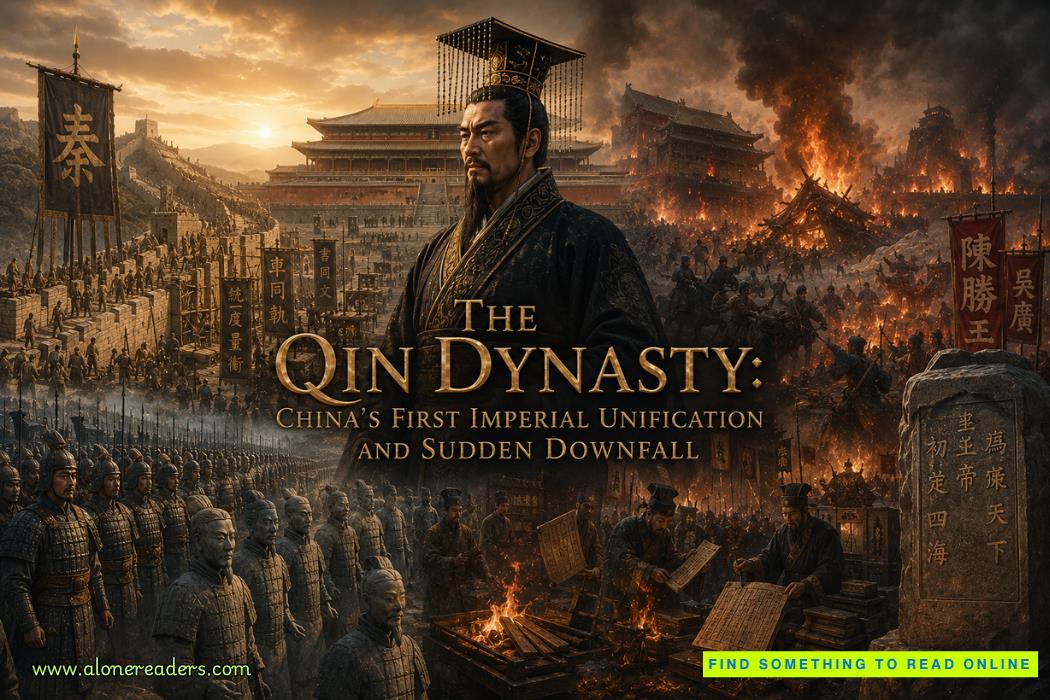
The history of imperial China cannot be understood without examining the short yet transformative existence of the Qin Dynasty. Although it lasted for only fifteen years, from 221 BCE to 206 BCE, the Qin Dynasty fundamentally reshaped Chinese civilization in ways that survived for more than two millennia. It was the first regime to unify the fragmented states of ancient China under a centralized imperial system, creating political structures, administrative systems, legal frameworks, and cultural standards that became the foundation of later Chinese empires. Yet the same dynasty that accomplished this monumental unification also collapsed with astonishing speed. Its fall revealed the dangers of excessive authoritarianism, brutal governance, and political paranoia. The Qin Dynasty therefore stands as one of history’s most important examples of how extraordinary state-building achievements can coexist with catastrophic internal weaknesses.
Before the rise of Qin power, China was divided among numerous competing kingdoms during the Warring States Period, one of the bloodiest and most politically complex eras in ancient East Asian history. For centuries, powerful states such as Chu, Zhao, Wei, Han, Yan, Qi, and Qin fought endlessly for supremacy. Warfare during this era became increasingly sophisticated and devastating. Massive conscript armies numbering in the hundreds of thousands clashed across vast territories. Iron weapons, cavalry tactics, fortified cities, and bureaucratic military systems transformed warfare into a brutal contest of total state mobilization.
Among these states, Qin initially appeared geographically isolated and culturally less refined than its eastern rivals. Located in western China, the Qin state had long been considered somewhat peripheral by other Chinese kingdoms. However, this relative isolation became an advantage. Qin rulers aggressively implemented reforms that strengthened the state far more effectively than many of their competitors. The most influential architect of Qin’s transformation was Shang Yang, a Legalist reformer who served during the fourth century BCE.
Shang Yang’s reforms radically altered Qin society. Aristocratic privileges were weakened, while military merit became the basis for advancement. Farmers were rewarded for agricultural productivity, and strict legal codes imposed harsh punishments for disobedience. The reforms emphasized discipline, obedience, efficiency, and centralized authority. Legalism, the governing philosophy behind these policies, rejected the Confucian belief that morality and virtue should guide rulers. Instead, Legalists argued that human beings were fundamentally selfish and could only be controlled through strict laws, rewards, and punishments.
These reforms transformed Qin into a highly militarized and centralized state capable of sustaining enormous armies and maintaining internal stability. Over time, Qin developed superior administrative efficiency, economic productivity, and military organization. Its armies became feared throughout China for their discipline and ruthlessness. Gradually, the balance of power shifted in Qin’s favor.
The man who would complete the unification of China was Ying Zheng, later known as Qin Shi Huang, meaning “First Emperor of Qin.” Ascending the throne as a young ruler, he inherited a state already strengthened by decades of reform and expansion. Under his leadership, Qin launched systematic campaigns against rival kingdoms. One after another, the remaining states fell. Han was conquered first, followed by Zhao, Wei, Chu, Yan, and finally Qi in 221 BCE.
For the first time in Chinese history, a single ruler controlled the core territories of ancient China. This achievement was not merely a military victory; it represented the birth of imperial China itself. Qin Shi Huang did not call himself king. Instead, he created the entirely new title of Huangdi, or emperor, signaling that his authority surpassed that of all previous rulers.
The Qin Dynasty’s unification of China was one of the most revolutionary political transformations in world history. It ended centuries of fragmentation and established the principle that China should exist as a single centralized empire rather than a collection of competing kingdoms. This concept would shape Chinese political identity for the next two thousand years.
After unification, Qin Shi Huang undertook massive reforms designed to consolidate imperial authority. One of his most significant achievements was the abolition of the old feudal system. Rather than allowing hereditary nobles to govern regional territories independently, the emperor divided the empire into commanderies and districts administered directly by appointed officials loyal to the central government. This administrative centralization became a defining feature of later Chinese dynasties.
The Qin government also standardized weights, measures, currency, and even axle widths for carts. Standardization improved trade, taxation, communication, and military logistics across the empire. Most importantly, the dynasty standardized the written Chinese script, allowing officials and scholars from different regions to communicate effectively despite linguistic differences. This linguistic standardization became one of the most enduring foundations of Chinese cultural unity.
Massive infrastructure projects further strengthened imperial control. Roads and canals connected distant regions, allowing armies and officials to move rapidly across the empire. One of the most famous projects associated with the Qin Dynasty was the early construction of what later became known as the Great Wall of China. Existing northern defensive walls built by previous states were linked together to defend against nomadic groups from the northern steppes.
These achievements came at tremendous human cost. The Qin state relied heavily on forced labor. Hundreds of thousands of peasants, prisoners, and conscripted workers were compelled to participate in construction projects under brutal conditions. Countless laborers died from exhaustion, starvation, disease, and harsh punishment. The enormous demands placed upon the population generated deep resentment.
Qin Shi Huang’s obsession with control extended beyond administration and infrastructure. He sought ideological domination as well. Influenced heavily by Legalist philosophy, the emperor viewed intellectual dissent as a threat to state stability. Confucian scholars, who criticized the regime’s harshness and defended older moral traditions, became particular targets.
One of the most infamous episodes of the Qin Dynasty was the burning of books and burying of scholars. Historical records describe how many philosophical and historical texts were destroyed in an effort to suppress competing schools of thought. Scholars accused of criticizing the regime were allegedly executed or buried alive. Although historians debate the exact scale of these events, the episode became a lasting symbol of authoritarian censorship and intellectual repression.
The emperor’s rule increasingly reflected paranoia and absolutism. Qin Shi Huang became obsessed with immortality and feared assassination and death. He traveled extensively throughout the empire under heavy security, often concealing his location even from close officials. Alchemists and court advisors searched desperately for elixirs that could prolong his life. Ironically, some substances consumed in these attempts may have contained mercury, potentially worsening his health and mental condition.
The emperor’s grandest personal project was his enormous mausoleum near modern Xi’an, guarded by the famous Terracotta Army. Thousands of life-sized clay soldiers, horses, chariots, and officers were buried to protect him in the afterlife. The scale of the project demonstrated both the immense resources available to the Qin state and the extreme concentration of imperial power.
Despite its achievements, the Qin Dynasty contained severe structural weaknesses beneath its appearance of strength. The empire depended almost entirely on fear, coercion, and the personal authority of Qin Shi Huang. Loyalty to the dynasty itself remained fragile. Many conquered populations still identified with their former kingdoms and deeply resented Qin rule.
The Legalist system created efficiency, but it also created inflexibility and cruelty. Harsh punishments were imposed for even minor offenses. Entire families could be punished for individual crimes. Peasants faced crushing taxation, forced military service, and compulsory labor obligations. Local officials often enforced laws ruthlessly to avoid punishment themselves.
Moreover, the dynasty lacked a stable succession system. Qin Shi Huang failed to establish a secure political framework capable of surviving his death. This vulnerability became immediately apparent in 210 BCE when the emperor died unexpectedly during a journey through eastern China.
The aftermath of his death exposed the dangerous instability at the heart of the regime. Court officials and eunuchs concealed the emperor’s death temporarily to avoid panic and manipulate succession politics. A conspiracy led by the eunuch Zhao Gao and Prime Minister Li Si altered the emperor’s will, forcing the legitimate heir, Crown Prince Fusu, to commit suicide. Instead, the weaker and more controllable son, Huhai, became emperor under the title Qin Er Shi.
This political manipulation proved disastrous. Qin Er Shi lacked his father’s authority, competence, and military reputation. Zhao Gao effectively controlled the government behind the scenes, eliminating rivals through intimidation and execution. Political chaos spread rapidly throughout the court.
At the same time, widespread rebellions erupted across the empire. The most famous early rebellion began when two low-ranking officers, Chen Sheng and Wu Guang, faced execution for arriving late to their military assignment due to flooding. Rather than accept certain death under Qin law, they rebelled. Their uprising inspired broader revolts among peasants, former nobles, soldiers, and regional leaders.
The rebellion spread with astonishing speed because resentment against Qin rule was already deeply entrenched. Former aristocratic families from conquered states saw an opportunity to regain power. Peasants suffering under forced labor and taxation joined revolutionary armies. Local officials abandoned the collapsing regime.
Among the rebel leaders who emerged during this chaos was Liu Bang, a former minor official who would later found the Han Dynasty. Another major figure was Xiang Yu, a powerful military commander from the former state of Chu. Together, rebel forces systematically dismantled Qin authority.
As rebellions intensified, internal court politics became even more unstable. Zhao Gao manipulated the emperor further and eliminated political opponents through fear and deception. Eventually, Qin Er Shi himself was forced to commit suicide. The dynasty descended into complete disorder.
In 206 BCE, rebel forces captured the Qin capital of Xianyang. The last Qin ruler surrendered, bringing the dynasty to an end only fifteen years after the empire’s unification.
The rapid collapse of the Qin Dynasty demonstrated a critical historical lesson: military conquest and centralized power alone are insufficient to sustain a durable empire. The Qin rulers succeeded brilliantly in creating a unified state but failed to create political legitimacy, social trust, or institutional flexibility. Their government relied excessively on coercion while neglecting the importance of public stability and elite cooperation.
Yet despite its sudden downfall, the Qin Dynasty’s long-term historical impact was extraordinary. The succeeding Han Dynasty retained many Qin institutions while softening the harsher aspects of Legalist rule with Confucian ideology. The centralized bureaucratic state created by Qin became the standard model for later Chinese governments. Standardized writing, currency, administration, and infrastructure survived long after the dynasty itself vanished.
Even the name “China” may derive linguistically from “Qin,” reflecting the dynasty’s profound influence on how the civilization became known internationally. Although the Qin Dynasty fell quickly, it permanently transformed the political and cultural structure of East Asia.
The dynasty’s legacy remains deeply complex. On one hand, Qin Shi Huang is remembered as a visionary unifier who ended centuries of warfare and created the foundations of imperial China. On the other hand, he is remembered as a tyrant whose harsh governance caused immense suffering and instability. Chinese historical tradition has long viewed the Qin Dynasty as both magnificent and cautionary — an example of how absolute power can achieve greatness while simultaneously sowing the seeds of destruction.
The Qin experience also highlights a recurring pattern visible throughout world history. States capable of extraordinary expansion often rely on intense centralization, militarization, and authoritarian control during their rise. These same characteristics can later undermine stability when rulers fail to adapt institutions to changing political realities. The Qin Dynasty’s dramatic rise and collapse therefore transcends Chinese history alone; it represents a universal historical lesson about power, governance, legitimacy, and the fragile balance between state authority and social endurance.
| Category | Details |
|---|---|
| Dynasty | Qin Dynasty |
| Time Period | 221 BCE – 206 BCE |
| Founder | Qin Shi Huang |
| Capital | Xianyang |
| Historical Importance | First imperial unification of China |
| Governing Philosophy | Legalism |
| Major Achievements | Political unification, standardized script, currency, roads, and administration |
| Major Construction Projects | Early Great Wall sections, roads, canals, Terracotta Army |
| Key Weaknesses | Harsh laws, forced labor, political repression, unstable succession |
| Cause of Collapse | Rebellions, court conspiracies, public resentment, weak leadership after Qin Shi Huang |
| Successor Dynasty | Han Dynasty |
| Lasting Legacy | Foundation of centralized imperial China for over 2,000 years |



 The Hundred Days Offensive: How the Allies Defeated Germany in World War I
 The Second Battle of the Marne: The Turning Point of World War I in 1918
 The Spring Offensive of 1918: Germany's Final Gamble to Win World War I
 The Treaty of Brest-Litovsk: How Russia Left World War I
 The Russian Revolution and World War I: How War Brought Down the Tsar
 The Zimmermann Telegram Explained: Germany's Secret Offer to Mexico in World War I










