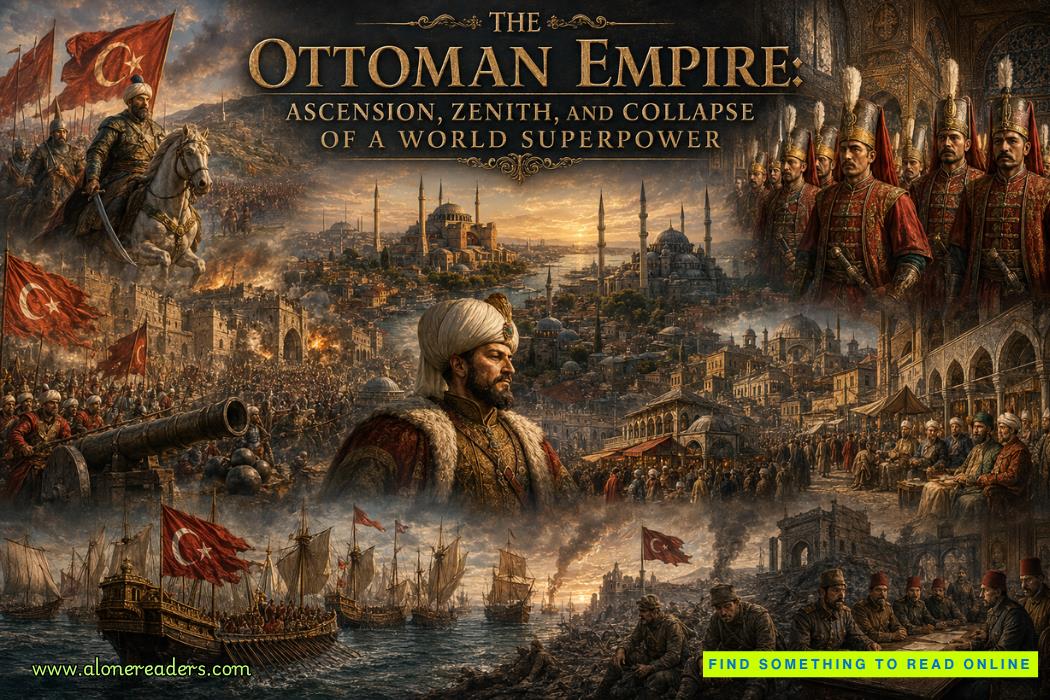
The Ottoman Empire stands among the most extraordinary political entities in human history. For more than six centuries, it dominated strategic trade routes, conquered some of the world’s greatest cities, ruled over diverse populations across three continents, and shaped the political, cultural, military, and religious landscape of Europe, the Middle East, and North Africa. At its height, the empire stretched from the gates of Vienna to the Persian Gulf, from the Crimean Peninsula to the deserts of Arabia, controlling lands that had once belonged to the Byzantine Empire, the Arab caliphates, and several Balkan kingdoms. Few empires in history endured for such an immense period while continuously adapting to changing global conditions. Yet despite its longevity and immense power, the Ottoman Empire eventually entered a prolonged era of decline that culminated in its collapse after the First World War. Its story is not merely one of conquest and defeat, but a vast historical narrative involving statecraft, religion, military innovation, trade, diplomacy, reform, nationalism, and imperial transformation.
The origins of the Ottoman Empire can be traced to the late thirteenth century in northwestern Anatolia, a region fragmented after the weakening of the Seljuk Sultanate of Rum and the devastating Mongol invasions. In this chaotic political environment, numerous small Turkish principalities known as beyliks emerged. Among these frontier states was a relatively minor principality led by Osman I, from whom the empire derived its name. Osman’s territory bordered the weakening Byzantine Empire, creating opportunities for expansion through frontier warfare. The early Ottomans were ghazi warriors, Muslim frontier fighters motivated by both religious zeal and the pursuit of wealth, land, and prestige. This combination of ideology and pragmatism became one of the defining characteristics of Ottoman expansion.
What distinguished the Ottomans from neighboring Anatolian beyliks was their remarkable organizational flexibility and strategic geography. Positioned near Byzantine territories in western Anatolia, they could focus their military campaigns against weakened Christian lands rather than competing directly with stronger Muslim rivals in eastern Anatolia. As Byzantine authority deteriorated, Ottoman forces captured town after town, gradually establishing control over important trade routes and fertile territories. The conquest of Bursa in 1326 became a turning point because it provided the Ottomans with their first major urban center and administrative capital. Bursa transformed the Ottoman state from a frontier principality into an emerging regional power.
The empire’s expansion accelerated dramatically under Orhan and Murad I. Ottoman armies crossed into Europe through the Dardanelles during the mid-fourteenth century, exploiting political instability within the Balkans. Balkan kingdoms were deeply divided, weakened by internal rivalries, succession disputes, and feudal fragmentation. The Ottomans skillfully manipulated these divisions through diplomacy, alliances, marriage arrangements, and military pressure. Their victory at the Battle of Kosovo in 1389 marked a decisive step toward Ottoman domination of southeastern Europe. This battle became deeply embedded in Serbian historical memory, symbolizing both resistance and tragedy.
One of the Ottoman Empire’s greatest strengths during its rise was its sophisticated military system. Unlike many medieval states dependent on feudal levies, the Ottomans gradually created a centralized and professional military structure. The most famous component of this system was the Janissary corps. Recruited primarily through the devshirme system, Christian boys from the Balkans were converted to Islam, rigorously trained, and transformed into elite soldiers and administrators loyal directly to the sultan. The Janissaries became one of the most disciplined standing infantry forces in the world. Their use of firearms and strict organization gave the Ottomans a major military advantage over many rivals.
The Ottoman state also developed highly effective administrative mechanisms. Conquered territories were integrated through a provincial system governed by appointed officials. Land grants known as timars allowed cavalry soldiers to collect taxes in exchange for military service, reducing the financial burden on the central government while maintaining military readiness. Religious diversity was managed through the millet system, which allowed non-Muslim communities such as Orthodox Christians, Armenians, and Jews to govern many of their internal affairs under their own religious leaders. While these communities remained subordinate within the Islamic imperial hierarchy, the system provided a degree of stability and coexistence uncommon in many contemporary states.
The conquest of Constantinople in 1453 by Sultan Mehmed II represented the defining moment in Ottoman ascension. Constantinople, capital of the Byzantine Empire and one of the most important cities in the world, had long symbolized imperial prestige and Christian civilization. Its massive walls had resisted countless invasions for centuries. Mehmed II employed enormous cannons, naval maneuvers, siege engineering, and relentless assaults to finally breach the city’s defenses. The fall of Constantinople shocked Europe and marked the end of the Byzantine Empire. It also transformed the Ottomans into a global imperial power.
Mehmed II immediately understood the strategic and symbolic significance of the city. Renamed Istanbul in Ottoman usage over time, it became the empire’s capital and one of the greatest urban centers on Earth. The Ottomans rebuilt the city extensively, restoring trade, repopulating neighborhoods, constructing mosques, markets, baths, palaces, and administrative institutions. Constantinople became the heart of an empire connecting Europe and Asia, controlling crucial trade routes between the Mediterranean and the Black Sea.
The sixteenth century marked the empire’s zenith under rulers such as Selim I and Suleiman the Magnificent. Selim I dramatically expanded Ottoman territory into the Middle East by defeating the Safavid Empire and conquering the Mamluk Sultanate of Egypt. These victories brought the holy cities of Mecca and Medina under Ottoman control and elevated the Ottoman sultans as leaders of much of the Sunni Islamic world. Control of Egypt also gave the empire immense economic wealth due to its strategic location along major trade networks.
Under Suleiman the Magnificent, the Ottoman Empire reached unparalleled heights of military power, administrative sophistication, and cultural achievement. Suleiman expanded Ottoman authority deep into Hungary, besieged Vienna, dominated large portions of the Mediterranean, and challenged both the Habsburgs and Safavids simultaneously. During his reign, the empire became a true superpower capable of influencing events across Europe, North Africa, and the Middle East.
Yet Suleiman’s greatness extended beyond military conquest. He was also known as “Kanuni,” meaning “The Lawgiver,” because of his extensive legal reforms. Ottoman governance under Suleiman blended Islamic law with imperial regulations designed to administer a vast multicultural empire. His reign witnessed flourishing architecture, literature, science, calligraphy, and urban development. The architect Mimar Sinan constructed magnificent mosques and public buildings that transformed the skylines of Ottoman cities. The Süleymaniye Mosque in Istanbul remains one of the masterpieces of Islamic architecture.
Economically, the empire benefited enormously from its geographical position. Ottoman territories sat astride major commercial routes connecting Europe, Asia, and Africa. Caravans, maritime trade, spices, silk, textiles, grain, coffee, and precious metals flowed through imperial markets. Istanbul became one of the largest and wealthiest cities in the world. Ottoman naval power under admirals such as Hayreddin Barbarossa dominated large parts of the Mediterranean, enabling the empire to project influence far beyond its core territories.
However, the same empire that achieved such greatness gradually began experiencing structural problems. The decline of the Ottoman Empire was not sudden but rather a slow and uneven process extending across centuries. Historians increasingly reject simplistic narratives of inevitable decay and instead emphasize a combination of internal weaknesses and external pressures.
One major challenge emerged from changes in global trade patterns. European maritime exploration shifted international commerce away from traditional overland routes controlled by the Ottomans. Portuguese and later Dutch and British sea routes around Africa reduced the strategic importance of Ottoman-controlled trade corridors. Meanwhile, European economies underwent significant technological, financial, and industrial transformations that gradually outpaced Ottoman economic structures.
Military stagnation also became increasingly problematic. While the Janissaries had once been an elite force, over time they evolved into a politically powerful and resistant institution. They opposed reforms that threatened their privileges and often interfered in imperial politics. Technological and tactical innovations in European warfare advanced rapidly during the seventeenth and eighteenth centuries, while Ottoman military modernization proceeded more slowly. Repeated defeats against Austria and Russia exposed growing military weaknesses.
The failed Ottoman siege of Vienna in 1683 symbolized a major turning point. The defeat not only halted Ottoman expansion into Central Europe but initiated a series of territorial losses. The Treaty of Karlowitz in 1699 forced the empire to surrender significant European territories for the first time. From this point onward, the Ottomans increasingly fought defensive wars aimed at preserving rather than expanding their empire.
Internal political instability compounded these challenges. Succession struggles, palace intrigues, corruption, provincial rebellions, and weak leadership undermined central authority. In many provinces, local elites accumulated substantial autonomy, reducing imperial cohesion. Economic inflation, partly caused by the influx of New World silver into global markets, destabilized the Ottoman financial system. Tax burdens increased, social unrest intensified, and rural populations often suffered from insecurity and exploitation.
The rise of nationalism during the nineteenth century posed perhaps the greatest existential threat to the empire. Ottoman territories contained numerous ethnic and religious groups including Greeks, Serbs, Bulgarians, Armenians, Arabs, Kurds, Albanians, and others. Influenced by European nationalist ideas, many of these groups sought independence or autonomy. Greece successfully achieved independence in the 1820s after a brutal conflict that attracted widespread European support. Similar nationalist movements spread throughout the Balkans during the nineteenth century.
European powers increasingly interfered in Ottoman affairs under the pretext of protecting Christian minorities or preserving regional stability. The empire became known as the “Sick Man of Europe,” a phrase reflecting European perceptions of Ottoman weakness. Russia, Britain, France, and Austria-Hungary competed for influence over Ottoman territories, often exploiting the empire’s vulnerabilities for strategic advantage.
Despite mounting difficulties, the Ottomans repeatedly attempted major reforms. The Tanzimat reforms of the nineteenth century sought to modernize administration, law, taxation, military organization, and education. Ottoman leaders hoped these reforms would strengthen the empire by creating a more centralized and modern state. Railways, telegraphs, modern schools, and new legal institutions were introduced. Yet reforms often faced resistance from conservative factions while failing to fully resolve underlying structural problems.
The reign of Sultan Abdulhamid II illustrated the tensions of late Ottoman governance. Initially associated with constitutional reforms, Abdulhamid later suspended parliament and ruled autocratically. He emphasized pan-Islamism as a unifying ideology while also expanding infrastructure and education. However, opposition movements continued growing, particularly among reformist intellectuals and military officers.
In 1908, the Young Turk Revolution restored the constitution and attempted to revitalize the empire through modernization and centralization. Yet the empire faced escalating crises. The Balkan Wars of 1912–1913 resulted in catastrophic territorial losses in Europe and produced massive refugee movements. Ottoman authority in North Africa had already weakened dramatically, with territories falling under European colonial control.
The final catastrophe arrived with the First World War. The Ottoman Empire allied itself with Germany and the Central Powers, hoping to reverse its decline and recover lost influence. Ottoman forces fought across multiple fronts including Gallipoli, Mesopotamia, the Caucasus, and Arabia. Although the empire achieved some remarkable military successes, especially at Gallipoli, the war exhausted its remaining resources.
The wartime period also witnessed one of the darkest chapters in Ottoman history: the mass deportations and deaths of Armenians during 1915–1916. These events remain deeply contested politically but are recognized by many historians and governments as genocide. The collapse of imperial authority, ethnic tensions, wartime paranoia, and nationalist extremism contributed to immense human suffering across the empire.
Following defeat in 1918, the Ottoman Empire effectively disintegrated. Allied occupation forces entered Istanbul, Arab territories were partitioned, and nationalist movements accelerated. Under the leadership of Mustafa Kemal Atatürk, Turkish nationalists resisted foreign occupation and established the foundations of modern Turkey. In 1922, the Ottoman sultanate was formally abolished, ending more than six centuries of imperial rule.
The Ottoman Empire’s legacy remains immense and deeply complex. It shaped the borders, cultures, cuisines, languages, religions, and political traditions of vast regions stretching from southeastern Europe to the Middle East and North Africa. Ottoman architecture continues to define the skylines of cities such as Istanbul, Sarajevo, and Jerusalem. Its administrative traditions influenced successor states long after the empire’s collapse. The empire also served as a bridge between civilizations, facilitating cultural exchange across continents for centuries.
At the same time, the empire’s history remains contested. Different peoples remember Ottoman rule in dramatically different ways — as an era of stability and coexistence, or as a period of domination and repression. Modern debates surrounding nationalism, religion, secularism, imperialism, and identity throughout the Balkans and Middle East still bear the imprint of Ottoman history.
The rise and fall of the Ottoman Empire illustrates how geography, military innovation, political adaptability, economic networks, and cultural integration can create extraordinary imperial power. Yet it also demonstrates how even the mightiest empires can struggle against technological transformation, nationalist fragmentation, global economic shifts, and institutional stagnation. For over six hundred years, the Ottomans stood at the crossroads of continents and civilizations. Their empire was not merely a regional kingdom but one of history’s defining superpowers — an empire whose influence still echoes across the modern world.
| Category | Details |
|---|---|
| Founded | Late 13th century |
| Founder | Osman I |
| Capital | Constantinople/Istanbul |
| Peak Period | 16th century under Suleiman the Magnificent |
| Territories Controlled | Southeastern Europe, Anatolia, Middle East, North Africa |
| Major Strengths | Military organization, Janissaries, trade routes, centralized administration |
| Greatest Achievement | Conquest of Constantinople in 1453 |
| Key Golden Age Figure | Suleiman the Magnificent |
| Major Rivals | Habsburg Empire, Safavid Empire, Russia |
| Causes of Decline | Military stagnation, nationalism, economic shifts, European intervention |
| Final Collapse | After World War I |
| Official End | Abolition of the Sultanate in 1922 |
| Successor State | Republic of Turkey |




 The Hundred Days Offensive: How the Allies Defeated Germany in World War I
 The Second Battle of the Marne: The Turning Point of World War I in 1918
 The Spring Offensive of 1918: Germany's Final Gamble to Win World War I
 The Treaty of Brest-Litovsk: How Russia Left World War I
 The Russian Revolution and World War I: How War Brought Down the Tsar
 The Zimmermann Telegram Explained: Germany's Secret Offer to Mexico in World War I










