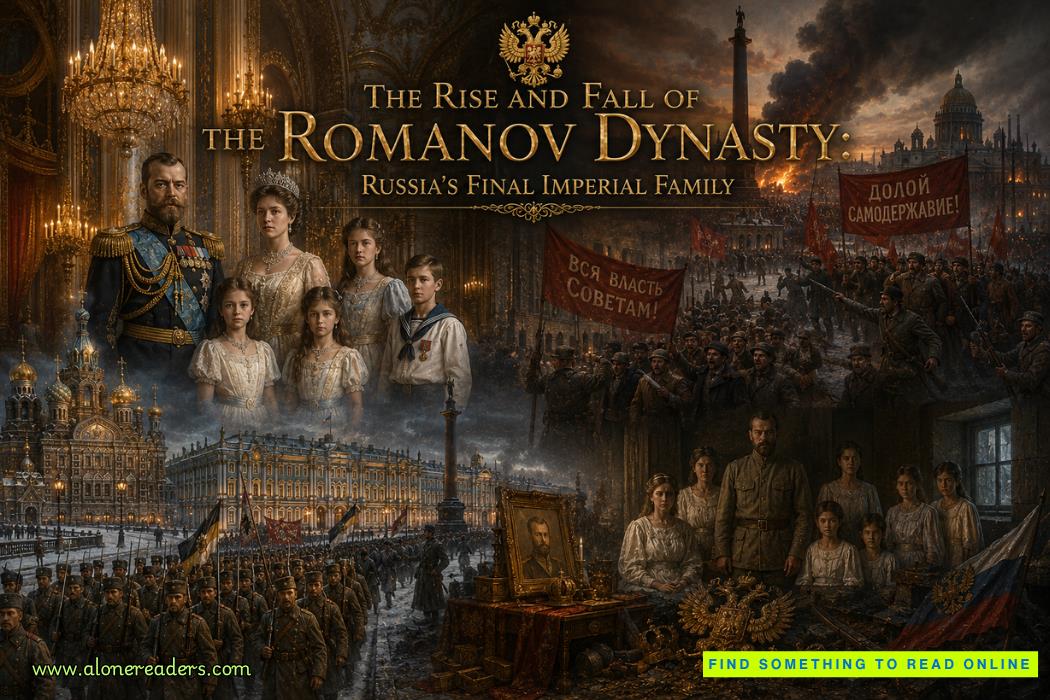
The story of the Romanov Dynasty is one of the most dramatic political narratives in world history. For more than three centuries, the Romanovs ruled the vast Russian Empire, transforming a fractured and unstable kingdom into one of the largest empires ever created. Their reign witnessed territorial expansion across Europe and Asia, the rise of Saint Petersburg as an imperial capital, immense military victories, cultural brilliance, industrial modernization, and the emergence of Russia as a dominant geopolitical power. Yet the dynasty’s final years descended into catastrophe. Economic inequality, political repression, military disaster, and revolutionary anger eventually destroyed the Romanov monarchy and swept away centuries of imperial tradition in a violent revolution that reshaped the twentieth century.
The Romanov Dynasty officially began in 1613 when Michael Romanov was elected Tsar by the Zemsky Sobor after Russia emerged from the devastating “Time of Troubles.” This chaotic period had nearly destroyed the Russian state. Foreign invasions, civil conflict, famine, and competing claims to the throne had plunged the country into instability following the death of Tsar Feodor I, the last ruler of the Rurik dynasty. Russia desperately needed political order, and the young Michael Romanov was chosen largely because his family possessed noble connections while remaining politically acceptable to rival factions. His election restored a measure of unity and legitimacy to the Russian throne.
Although Michael Romanov’s reign was relatively cautious, it established the foundations for dynastic continuity. The early Romanovs focused on rebuilding state authority, restoring agriculture, stabilizing taxation, and strengthening the military after years of destruction. During the seventeenth century, Russia gradually expanded eastward across Siberia, gaining access to immense natural resources and extending its territorial reach across Asia. This expansion would eventually make Russia the largest contiguous empire in history.
The Romanov Dynasty became truly transformative under Peter the Great, who ruled from 1682 to 1725. Peter was one of the most influential rulers in Russian history and fundamentally reshaped the empire. Determined to modernize Russia according to Western European standards, he traveled extensively through Europe, studying shipbuilding, engineering, military science, and governance. Unlike earlier Russian rulers who had remained relatively isolated, Peter aggressively pushed Russia into European political and cultural life.
Peter the Great’s reforms altered nearly every aspect of Russian society. He modernized the army, created a powerful navy, reorganized government administration, introduced new taxation systems, encouraged industrial production, and reduced the political influence of the old aristocracy known as the boyars. He forced nobles to adopt Western clothing and customs, symbolizing his determination to transform Russian identity itself.
One of Peter’s most significant achievements was the founding of Saint Petersburg in 1703. Built on marshland near the Baltic Sea, the city became Russia’s “window to Europe.” Saint Petersburg embodied the Romanovs’ imperial ambitions and Western orientation. Grand palaces, wide avenues, canals, and monumental architecture turned the city into one of Europe’s most magnificent capitals.
Peter’s victory over Sweden in the Great Northern War elevated Russia into a major European power. The defeat of King Charles XII ended Swedish dominance in northern Europe and gave Russia critical access to the Baltic Sea. From this point onward, the Russian Empire became deeply involved in European diplomacy, warfare, and politics.
Following Peter’s reign, the Romanov Dynasty entered a period of palace intrigues and succession struggles, yet imperial expansion continued. The dynasty reached another peak under Catherine the Great, who ruled from 1762 to 1796. Originally born as a German princess, Catherine became one of Russia’s most capable rulers after overthrowing her husband, Peter III.
Catherine’s reign represented the golden age of Romanov imperial power. She expanded Russian territory dramatically through wars against the Ottoman Empire and the partitions of Poland. Under her leadership, Russia gained access to the Black Sea, increasing trade opportunities and military influence. The empire’s borders stretched across Eastern Europe, the Caucasus, Siberia, and Central Asia.
Catherine also cultivated an image of enlightened rule. She corresponded with European philosophers such as Voltaire and Diderot, promoted education, supported the arts, and encouraged administrative reforms. Saint Petersburg flourished culturally during her reign, becoming a center of literature, architecture, and aristocratic refinement.
Yet beneath this imperial brilliance lay deep structural problems. Russian society remained heavily dependent on serfdom, a system that bound millions of peasants to noble landowners under harsh conditions. While Western Europe gradually industrialized and modernized socially, Russia’s economic system remained deeply unequal and agrarian. The Romanov state relied heavily on aristocratic loyalty, military force, and autocratic control to maintain order.
The nineteenth century brought both triumph and instability to the Romanov Empire. Russia played a decisive role in defeating Napoleon during the Napoleonic Wars. The burning of Moscow in 1812 and the eventual Russian advance into Paris elevated the empire’s prestige enormously. Tsar Alexander I became one of Europe’s most influential rulers after Napoleon’s defeat.
However, exposure to European political ideas also introduced dangerous new concepts into Russian society. Liberalism, constitutionalism, nationalism, and revolutionary ideology began spreading among educated Russians. Many officers who had fought in Europe returned home questioning the absolute power of the Tsar.
In 1825, following the death of Alexander I, the Decembrist Revolt erupted when military officers attempted to establish constitutional government. Although the rebellion failed, it demonstrated growing dissatisfaction among elites. Tsar Nicholas I responded with harsh repression, censorship, and expanded secret police surveillance. His reign strengthened autocracy but deepened political tensions.
Throughout the nineteenth century, Russia continued expanding territorially into the Caucasus, Central Asia, and the Far East. The empire controlled enormous ethnic, linguistic, and religious diversity. While this vastness symbolized Romanov power, it also created administrative and political difficulties. Governing such an immense empire required enormous military expenditures and bureaucratic control.
The Romanovs faced increasing pressure during the industrial age. Russia lagged behind Britain, Germany, and France economically and technologically. Although industrialization accelerated during the late nineteenth century, especially under Sergei Witte’s reforms, modernization created new social problems. Urban workers faced harsh factory conditions, overcrowded housing, low wages, and political repression.
Meanwhile, revolutionary ideologies gained momentum. Socialist movements, anarchist groups, and radical intellectuals increasingly viewed the Romanov monarchy as an obstacle to progress. Assassinations and political violence became more common. In 1881, Tsar Alexander II — known for emancipating the serfs in 1861 — was assassinated by revolutionaries despite his reform efforts.
The final phase of Romanov rule centered on Tsar Nicholas II, the last Emperor of Russia. Ascending the throne in 1894, Nicholas inherited an empire undergoing rapid change and growing instability. Personally devoted to autocracy and deeply influenced by traditional monarchy, Nicholas struggled to understand the scale of Russia’s political crisis.
Nicholas II believed firmly in divine monarchy, viewing himself as God’s appointed ruler rather than a constitutional sovereign. This rigid mindset prevented meaningful political reform during a period when many Russians demanded greater representation and civil liberties.
The Romanovs initially maintained an image of grandeur and stability. The imperial court displayed immense luxury through elaborate ceremonies, magnificent palaces, jewels, military parades, and aristocratic traditions. The Winter Palace in Saint Petersburg symbolized imperial magnificence. Yet much of this spectacle concealed widening inequality and growing public anger.
The situation worsened dramatically after Russia’s defeat in the Russo-Japanese War of 1904–1905. The unexpected loss to Japan shocked Russian society and exposed military weakness. Economic hardship, worker unrest, and political frustration exploded into the Revolution of 1905.
One of the most infamous moments occurred on Bloody Sunday in January 1905, when peaceful protesters marching toward the Winter Palace were fired upon by imperial troops. The massacre shattered public trust in the Tsar. Although Nicholas II introduced limited reforms, including the creation of the Duma parliament, he repeatedly undermined its authority and resisted constitutional government.
Political instability continued throughout the following decade. Industrial strikes, peasant unrest, nationalist movements, and revolutionary organizations remained active. At the same time, the imperial court became increasingly controversial because of the influence of Grigori Rasputin, a Siberian mystic associated with the royal family.
Rasputin gained influence largely because of the illness of Tsarevich Alexei, Nicholas II’s son and heir, who suffered from hemophilia. Empress Alexandra believed Rasputin possessed spiritual powers capable of helping the boy. His presence at court fueled rumors of corruption, incompetence, and manipulation. Aristocrats, politicians, and ordinary citizens increasingly viewed the monarchy as dysfunctional and disconnected from reality.
The outbreak of World War I in 1914 proved disastrous for the Romanov Dynasty. Initially, patriotic enthusiasm united much of Russian society. However, the war soon exposed severe weaknesses within the empire. Russian forces suffered catastrophic casualties, logistical failures, equipment shortages, and poor leadership. Millions of soldiers were killed, wounded, or captured.
Economic conditions collapsed under wartime strain. Food shortages, inflation, transportation breakdowns, and industrial disruption devastated daily life. Public confidence in the government deteriorated rapidly.
In 1915, Nicholas II made a critical mistake by personally taking command of the army. This decision tied the monarchy directly to military failures. Meanwhile, Alexandra and Rasputin remained in the capital, intensifying public distrust and political chaos.
By early 1917, Russia stood on the edge of collapse. Strikes and protests erupted in Petrograd, fueled by hunger and war exhaustion. Soldiers increasingly refused to suppress demonstrations. In March 1917, the February Revolution forced Nicholas II to abdicate the throne.
The abdication ended more than three centuries of Romanov rule.
The fall of the monarchy created a power vacuum. A provisional government attempted to govern Russia, but it struggled to control the country amid continued war, economic crisis, and revolutionary radicalization. Later that year, the Bolsheviks led by Vladimir Lenin seized power during the October Revolution.
The fate of the Romanov family became increasingly tragic. Nicholas II, Alexandra, and their children were placed under house arrest and eventually moved to Yekaterinburg during the Russian Civil War. As anti-Bolshevik forces approached the city in July 1918, Bolshevik authorities decided to eliminate the family to prevent their rescue.
During the early hours of July 17, 1918, the Romanov family was executed in the basement of the Ipatiev House. Nicholas II, Alexandra, their five children, and several loyal servants were killed. The murders symbolized not only the destruction of a dynasty but also the violent end of imperial Russia itself.
The execution shocked much of the world. The Romanovs had once stood among Europe’s most powerful royal families, connected through marriage to monarchies across the continent. Their downfall reflected the immense social, political, and economic transformations reshaping the modern world.
The collapse of the Romanov Dynasty occurred because multiple crises converged simultaneously. Autocratic rigidity prevented political adaptation. Economic modernization created social unrest faster than the state could manage. Industrialization intensified inequality and urban tension. Nationalist movements challenged imperial unity. Military defeats undermined confidence in leadership. Revolutionary ideology spread among workers, intellectuals, and soldiers. Finally, World War I pushed an already fragile system beyond its limits.
Yet the Romanovs also left an enormous historical legacy. Under their rule, Russia transformed into a global empire spanning two continents. The dynasty shaped Russian culture, architecture, literature, military power, and national identity. The palaces of Saint Petersburg, Orthodox cathedrals, imperial art collections, and administrative institutions all reflected Romanov ambition and influence.
The Romanov story continues to fascinate historians because it combines imperial splendor with human tragedy. Their rise represented the construction of one of history’s largest empires; their fall revealed how quickly seemingly invincible dynasties can collapse when political systems fail to adapt to changing realities.
The dynasty’s final years remain especially haunting because of the contrast between extraordinary luxury and revolutionary desperation. The Romanovs lived surrounded by immense wealth and ceremony while millions of ordinary Russians struggled with poverty, war, and political repression. This growing disconnect ultimately destroyed the monarchy’s legitimacy.
In modern Russia, the Romanov legacy remains deeply complex. Some view the dynasty as symbols of national greatness and cultural achievement, while others associate them with autocracy, inequality, and repression. Nicholas II and his family were later canonized by the Russian Orthodox Church, reflecting their enduring emotional and symbolic significance.
The rise and fall of the Romanov Dynasty therefore represents far more than the story of a royal family. It reflects the transformation of Russia itself — from medieval kingdom to imperial superpower and finally into revolutionary state. Their history demonstrates how empires can achieve extraordinary power yet remain vulnerable when political institutions fail to evolve alongside society.
| Category | Details |
|---|---|
| Dynasty Name | Romanov Dynasty |
| Ruled Russia From | 1613–1917 |
| Founder | Michael Romanov |
| Last Ruler | Tsar Nicholas II |
| Capital | Moscow, later Saint Petersburg |
| Greatest Expansion | Under Peter the Great and Catherine the Great |
| Major Achievements | Expansion of Russian Empire, modernization, military growth, cultural development |
| Key Weaknesses | Autocracy, inequality, serfdom, political repression |
| Major Crisis | Russo-Japanese War, Revolution of 1905, World War I |
| Final Collapse | Russian Revolution of 1917 |
| End of Dynasty | Abdication of Nicholas II and execution of the Romanov family in 1918 |
| Historical Legacy | Creation of Imperial Russia and transformation into a global power |



 The Hundred Days Offensive: How the Allies Defeated Germany in World War I
 The Second Battle of the Marne: The Turning Point of World War I in 1918
 The Spring Offensive of 1918: Germany's Final Gamble to Win World War I
 The Treaty of Brest-Litovsk: How Russia Left World War I
 The Russian Revolution and World War I: How War Brought Down the Tsar
 The Zimmermann Telegram Explained: Germany's Secret Offer to Mexico in World War I










