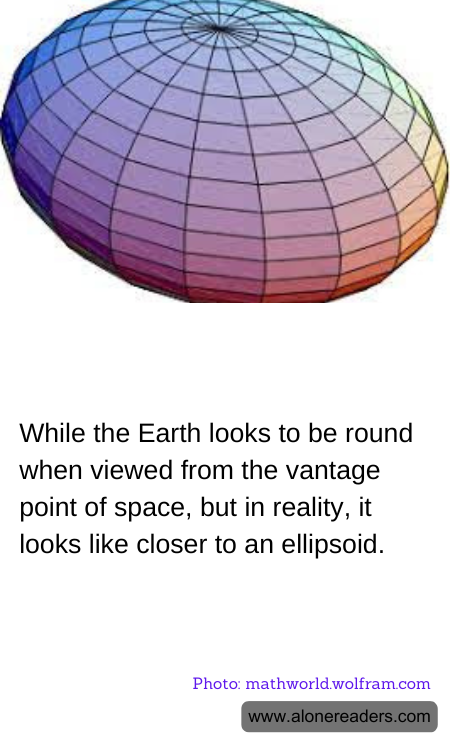
The Earth, often perceived as a perfectly round sphere, especially in many simplified scientific illustrations and popular visuals, deviates from this simplistic shape due to its rotational forces. In reality, the structure of Earth more closely resembles an oblate spheroid, a type of ellipsoid. This particular shape is characterized by its equatorial bulge, where the diameter across the equator is larger than the pole-to-pole diameter. This discrepancy arises because of the centrifugal force generated by the Earth's rotation, which causes the equator to bulge outward.
The equatorial radius of the Earth is about 6,378 kilometers, while the polar radius is slightly shorter, approximately 6,357 kilometers, making the difference in diameters about 21 kilometers. Although this difference is relatively small, it is significant enough to be measured and to have various implications on global phenomena such as climate patterns, ocean currents, and gravitational fields.
This equatorial bulge affects the gravity field of Earth, which is not uniform. The gravitational pull is weaker at the equator than at the poles, not only because of the extra distance due to the bulge but also due to the outward centrifugal force of Earth's rotation. This variation in gravity has several effects, including slight differences in time experienced by satellites orbiting Earth and variations in the weight of objects at different latitudes.
Moreover, the oblate shape of Earth also influences its atmospheric circulation. The rotation leads to the Coriolis effect, which makes storms swirl clockwise in the Southern Hemisphere and counter-clockwise in the Northern Hemisphere, a phenomenon that would not occur if the Earth were a perfect sphere.
Understanding Earth's true form as an oblate spheroid rather than a true sphere is crucial not only for physical geodesy, the study of Earth’s geometric shape, orientation in space, and gravity field, but also for satellite navigation systems, and various astronomical and physics-based applications. This detailed comprehension helps scientists and researchers in accurately modeling and forecasting Earth’s climate systems, oceanic and atmospheric changes, amongst other critical Earth-science-related fields.
