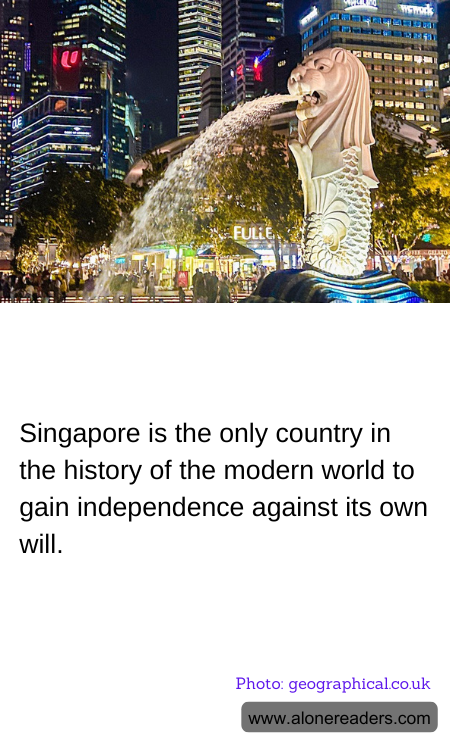
In a unique historical twist, Singapore became the only country to gain independence against its will when it was expelled from Malaysia in 1965. This event was a pivotal moment not just for Singapore but also for Southeast Asia, illustrating a rare instance of involuntary independence in modern international relations.
The roots of this reluctant independence lie in the complex socio-political landscapes of Malaysia and Singapore during the early 1960s. Singapore, then a British colony, was incorporated into the Federation of Malaysia in 1963. However, the merger was fraught with difficulties from the beginning. Major issues included economic disparities, racial tensions between the Chinese-majority Singapore and the Malay-majority areas of the rest of Malaysia, and political ideologies. The People's Action Party (PAP) of Singapore, led by Lee Kuan Yew, promoted a Malaysian Malaysia – a nonracial approach to citizenship that clashed with the affirmative action policies favoring Malays in the rest of Malaysia.
These tensions escalated over the following two years, leading to racial riots in Singapore. The federal government in Kuala Lumpur, led by the United Malays National Organisation (UMNO), found it increasingly difficult to manage the strife and was wary of the threat posed by the PAP’s growing influence among the Malaysian Chinese population. Faced with escalating internal conflict and fearing a potential communist influence within Singapore, the Malaysian Prime Minister, Tunku Abdul Rahman, decided that separation was the best solution to maintain peace and stability in Malaysia.
Thus, on August 9, 1965, Singapore was ousted from Malaysia, becoming an independent nation overnight. The proclamation of independence was a somber moment for Lee Kuan Yew, who famously teared up during a televised press conference, reflecting his deep regret and heavy-heartedness over the separation.
Despite the initial despair, this reluctant independence marks the beginning of Singapore’s transformation. Under the visionary leadership of Lee Kuan Yew and the PAP, Singapore embarked on a rigorous nation-building program, focusing on establishing a robust economy, sound international relations, and a harmonious multi-ethnic society. Today, Singapore's unexpected path to sovereignty is often seen as a blessing in disguise, having spurred decades of unprecedented growth and development, making it one of the world’s most prosperous nations.
Singapore's story of independence underscores the complexities of national and ethnic identity in post-colonial Southeast Asia and highlights the unpredictable course of nation-states in the 20th century. It stands as a testament to the resilience and tenacity of a small nation that turned an unintended separation into a thriving global success story.
