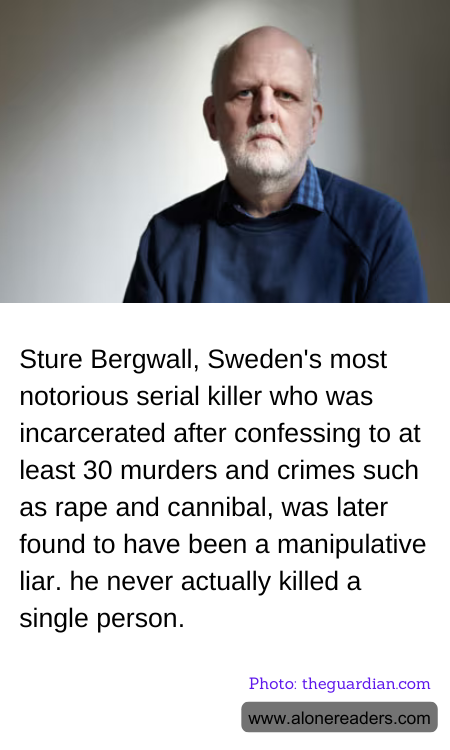
Sture Bergwall, also known by the pseudonym Thomas Quick during the time of his trials, is a Swedish figure whose story is as bewildering as it is tragic, revealing critical flaws in the criminal justice system. In the 1990s, Bergwall was declared Sweden's worst serial killer after he confessed to more than 30 murders, along with numerous other heinous crimes, spanning decades. His confessions included detailed narratives of rape, mutilation, and cannibalism, which sent shockwaves through Sweden and beyond.
Held at a psychiatric facility after a conviction for a separate crime, Bergwall began confessing to unsolved murders, often providing details that seemingly only the murderer could know. This led to his conviction for eight of these murders between 1994 and 2001. The media frenzy around these cases was intense, and Bergwall's own descriptions of his crimes were lurid and chilling, securing his notoriety as a monstrous figure.
However, the truth about Sture Bergwall began to unravel when serious questions were raised about the validity of his confessions and the methods by which they were obtained. It emerged that during the time of his confessions, Bergwall was heavily medicated with benzodiazepines and other psychotropic drugs. He had also undergone suggestive therapy techniques, which, combined with the medications, could have made him susceptible to fabricating stories that he believed were real.
A closer examination of the evidence—or, more pointedly, the lack thereof—began to poke holes in the cases against him. There were no forensic or physical proofs tying him to the scenes of the crimes, and the details he provided could often be traced back to public or police files, accessible to him through media or during interrogations. His confessions, once seen as chillingly precise, were increasingly viewed as unreliable and contaminated by external sources.
The turning point came when Bergwall, who had recanted all his previous confessions by 2008, was granted a retrial. This led to all charges against him being dropped, and by 2013, he was acquitted of all the murders to which he had once confessed. The legal and psychological communities in Sweden and internationally were forced to reflect deeply on how an investigation should be conducted, especially regarding the handling of vulnerable individuals or those with mental health issues in the justice system.
The case of Sture Bergwall is now often cited as a cautionary tale about the dangers of pressuring vulnerable suspects into confessions and the reliance on confessional evidence without corroboration. It also highlights the broader themes of justice and ethics in forensic psychology, pushing for continuous reforms in criminal justice systems around the world to prevent such miscarriages from occurring in the future.
