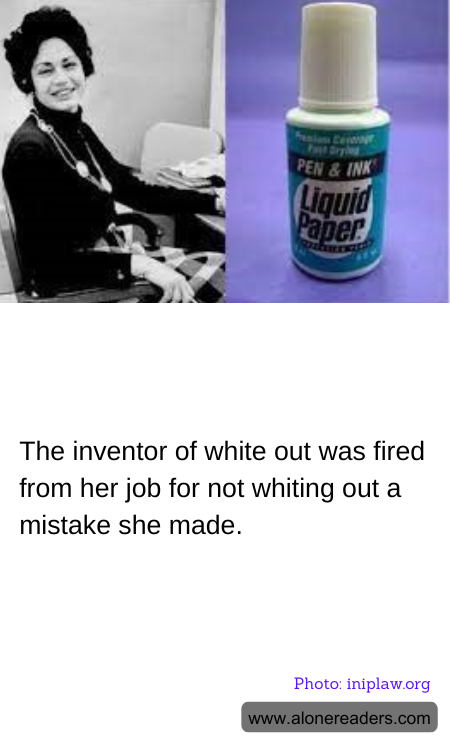
In the annals of invention, the story of Bette Nesmith Graham stands out not only for its ingenuity but also for its irony. Bette, a secretary in the 1950s, was the inventive mind behind Liquid Paper, commonly known as "white out." Her journey from a struggling typist to a successful entrepreneur is a testament to creativity born out of necessity, yet it began with an unexpected twist of fate—being fired for a mistake she couldn't correct.
Bette Nesmith Graham was working as a secretary at a bank in Dallas, Texas, when she faced a common problem of the era: correcting typing errors. In a time when electric typewriters were becoming the norm, mistakes were not easily rectified, often requiring entire pages to be retyped. Bette, a single mother striving to make ends meet, needed a solution that would save time and effort. Drawing inspiration from her background in art, she concocted a white, water-based tempera paint in her kitchen, using it to cover up typing errors. This simple yet effective solution allowed her to correct mistakes quickly and neatly, without having to retype entire documents.
Despite her innovative solution, Bette's journey was not without its challenges. Ironically, she was fired from her secretarial job for failing to correct a typing error—an error she could have easily fixed with her own invention. This setback, however, became a pivotal moment in her life. Rather than being discouraged, Bette saw it as an opportunity to refine and market her product. She began producing her correction fluid in larger quantities, initially selling it to fellow secretaries and eventually to office supply stores.
Bette's determination and entrepreneurial spirit paid off. Her product, initially named "Mistake Out," was later rebranded as "Liquid Paper" and gained widespread popularity. By the 1970s, Liquid Paper had become a staple in offices around the world, and Bette's small kitchen operation had grown into a multimillion-dollar business. In 1979, she sold the company to the Gillette Corporation for $47.5 million, securing her legacy as a pioneering businesswoman.
Bette Nesmith Graham's story is a powerful reminder that innovation often arises from the most unexpected circumstances. Her ability to turn a personal setback into a global success story is an inspiration to aspiring inventors and entrepreneurs everywhere. Her legacy lives on, not just in the ubiquitous bottles of correction fluid found in offices and classrooms, but in the spirit of resilience and creativity she embodied. Her journey underscores the importance of perseverance and the belief that even the simplest ideas can lead to monumental success.
