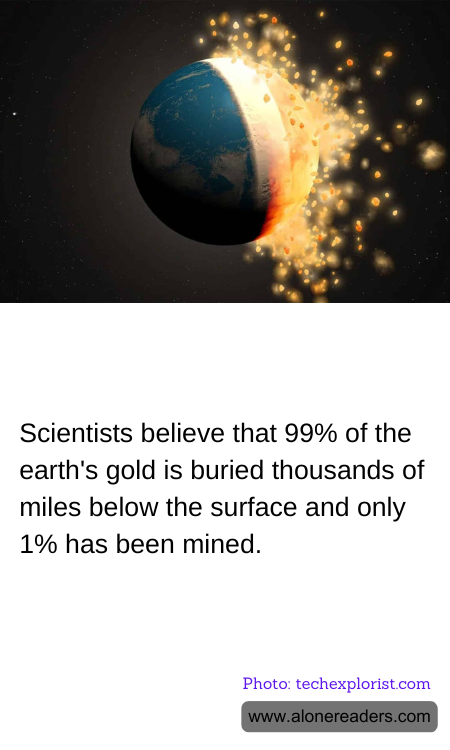
Gold, one of the most coveted and valuable metals on Earth, has fascinated humans for centuries. Its allure is not only due to its lustrous beauty and rarity but also its historical significance as a symbol of wealth and power. However, what many might not realize is that the gold we have mined and used throughout history represents only a tiny fraction of the Earth's total gold reserves. Scientists estimate that a staggering 99% of the planet's gold lies buried deep beneath the Earth's surface, far beyond our current reach.
The Earth's crust, where all known mining activities occur, holds only a small portion of the planet's gold. This is because, during the formation of the Earth, most of the gold, along with other heavy elements, sank towards the core. This process, known as planetary differentiation, occurred billions of years ago when the Earth was still molten. As a result, the majority of the Earth's gold is believed to be located in the core, thousands of miles below the surface, making it inaccessible with current technology.
The gold that we have been able to mine is found in the Earth's crust, often in the form of veins within rocks or as small particles in riverbeds. These deposits are the result of geological processes that brought some of the gold closer to the surface over millions of years. Despite the challenges of mining, humans have extracted approximately 190,000 metric tons of gold throughout history, which is only a fraction of the total gold believed to exist on the planet.
The idea that most of the Earth's gold is out of reach raises intriguing possibilities for the future. Advances in technology could one day make it feasible to access these deep reserves, potentially revolutionizing the gold industry. However, such endeavors would require overcoming significant technical and environmental challenges. The extreme conditions of the Earth's interior, including high temperatures and pressures, present formidable obstacles to any mining efforts.
Moreover, the environmental impact of mining operations is a growing concern. Extracting gold from the Earth's crust already poses significant environmental challenges, including habitat destruction, water pollution, and carbon emissions. Any future attempts to mine gold from deeper layers would need to carefully consider these impacts to ensure sustainable practices.
For now, the vast majority of the Earth's gold remains a tantalizing mystery, hidden away in the depths of our planet. While it may be out of reach, its presence serves as a reminder of the Earth's dynamic history and the incredible processes that have shaped our world. As scientists continue to study the Earth's composition and explore new frontiers in mining technology, the story of gold is far from over. Whether or not we ever access these deep reserves, the quest for gold will undoubtedly continue to captivate and inspire future generations.
