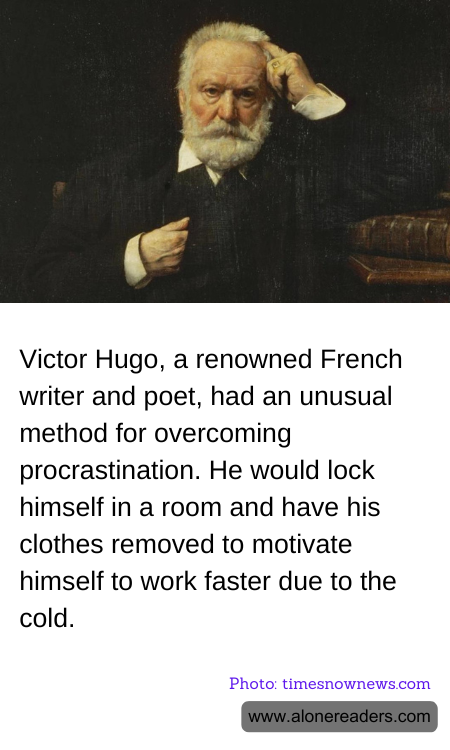
Victor Hugo, the illustrious French writer and poet, is celebrated for his monumental contributions to literature, with works such as "Les Misérables" and "The Hunchback of Notre-Dame" standing as timeless classics. However, beyond his literary genius, Hugo was also known for his unconventional methods of overcoming procrastination, a struggle familiar to many creative minds. One of his most peculiar strategies involved locking himself in a room and having his clothes removed, a tactic designed to spur his productivity through discomfort.
Hugo's approach to battling procrastination was as unique as it was effective. By removing his clothes and isolating himself in a room, he eliminated the possibility of leaving the house, thereby forcing himself to focus solely on his writing. The absence of clothing not only prevented him from succumbing to distractions outside his workspace but also introduced an element of urgency. The cold air served as a constant reminder of the task at hand, compelling him to work more swiftly and efficiently to complete his writing and regain the comfort of warmth.
This method, while extreme, highlights Hugo's dedication to his craft and his willingness to employ any means necessary to overcome the creative blocks that often plague writers. It underscores a broader truth about the nature of creativity and productivity: sometimes, unconventional solutions are required to break through the barriers of procrastination. Hugo's strategy was not merely about discomfort; it was about creating an environment where the only viable option was to write, thereby channeling his focus and energy into his work.
Hugo's peculiar practice also serves as a reminder of the diverse ways individuals can motivate themselves. While his method may not be suitable for everyone, it exemplifies the importance of understanding one's personal triggers and barriers to productivity. For some, a change in environment or routine can be the catalyst needed to ignite creativity and discipline. Hugo's willingness to experiment with his working conditions reflects a broader lesson in adaptability and self-awareness, crucial traits for anyone striving to achieve their goals.
In today's world, where distractions are more prevalent than ever, Hugo's story resonates with those seeking to enhance their productivity. It encourages individuals to explore and embrace unconventional methods that align with their personal needs and circumstances. While locking oneself in a room without clothes may not be the ideal solution for most, the underlying principle of creating a focused, distraction-free environment remains relevant.
Victor Hugo's legacy extends beyond his literary masterpieces; it includes his innovative approach to overcoming the challenges of procrastination. His story is a testament to the power of creativity not only in art but also in the strategies we employ to harness our potential. By understanding and adapting to our unique working styles, we can all find ways to conquer procrastination and achieve our creative ambitions.
