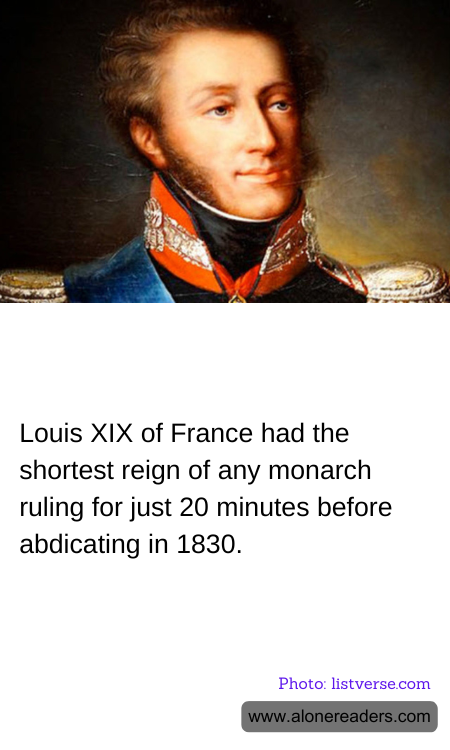
In the annals of history, the reign of Louis XIX of France stands out not for its accomplishments or its grandeur, but for its brevity. Louis Antoine, Duke of Angoulême, known as Louis XIX, holds the record for the shortest reign of any monarch, having ruled for a mere 20 minutes before abdicating in 1830. This fleeting moment on the throne is a fascinating footnote in the complex tapestry of French history, marked by political upheaval and the shifting tides of power.
Louis XIX was born into the House of Bourbon, a dynasty that had long been entwined with the history of France. He was the eldest son of Charles X, who ascended to the throne in 1824. However, Charles X's reign was fraught with challenges, as he faced growing discontent from a populace increasingly enamored with the ideals of the French Revolution. By 1830, tensions had reached a boiling point, culminating in the July Revolution, a three-day uprising that ultimately forced Charles X to abdicate.
In the wake of his father's abdication, Louis Antoine found himself thrust into the role of king. However, his reign was not to be. Recognizing the untenable position of the monarchy and the overwhelming demand for change, Louis XIX chose to abdicate almost immediately in favor of his nephew, the Duke of Bordeaux, who was proclaimed King Henry V. This decision was made in an effort to preserve the Bourbon dynasty and to quell the revolutionary fervor sweeping through France.
The 20-minute reign of Louis XIX is emblematic of a period in French history characterized by rapid political change and the decline of absolute monarchy. It serves as a poignant reminder of the volatility of power and the often unpredictable nature of historical events. Despite his brief tenure as king, Louis XIX's decision to abdicate demonstrated a pragmatic understanding of the political landscape and a willingness to prioritize the stability of the nation over personal ambition.
After his abdication, Louis XIX lived in relative obscurity, spending much of his life in exile. He passed away in 1844, leaving behind a legacy defined not by his actions as a ruler, but by the extraordinary circumstances of his reign. His story is a testament to the complexities of leadership and the ever-changing dynamics of political authority.
For modern readers, the tale of Louis XIX offers a glimpse into a tumultuous era and serves as a reminder of the impermanence of power. It underscores the importance of adaptability and foresight in leadership, qualities that remain relevant in today's world. As history continues to unfold, the brief reign of Louis XIX endures as a unique chapter in the saga of France, illustrating the delicate balance between tradition and progress.
