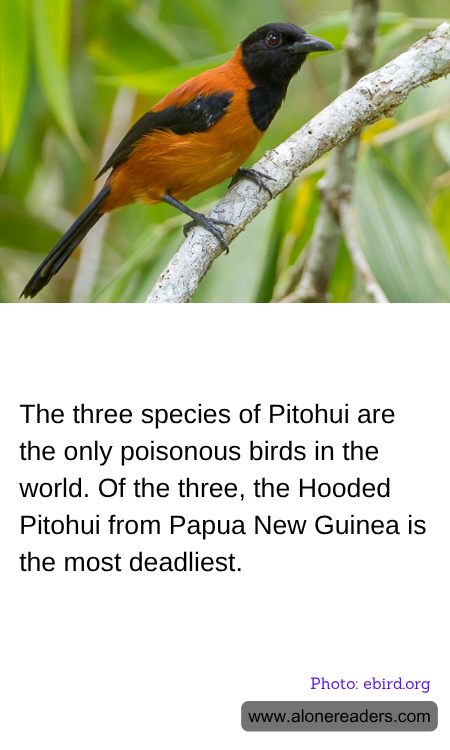
In the lush rainforests of Papua New Guinea, a remarkable avian species thrives, captivating scientists and bird enthusiasts alike with its unique and rare characteristic: toxicity. Among the three known species of Pitohui, the Hooded Pitohui stands out as the most poisonous, earning it the title of the deadliest bird in the world. This fascinating creature, with its striking black and orange plumage, is a testament to the wonders of evolution and the intricate balance of nature.
The Hooded Pitohui, along with its relatives, the Variable Pitohui and the Brown Pitohui, belongs to a small group of birds that possess a natural defense mechanism uncommon in the avian world. These birds harbor a potent neurotoxin known as batrachotoxin, which is also found in certain species of poison dart frogs. This toxin is stored in the birds' skin and feathers, providing an effective deterrent against predators. The presence of batrachotoxin in these birds is believed to be derived from their diet, which includes toxic insects and other arthropods, allowing them to accumulate and store the toxin in their bodies.
The discovery of the Hooded Pitohui's toxicity was a groundbreaking moment in ornithology. It challenged the long-held belief that birds, unlike amphibians and reptiles, did not possess chemical defenses. The realization that these birds could be poisonous was first brought to light by local indigenous communities, who had long known to avoid handling the birds due to their irritating effects. Scientific research later confirmed these observations, revealing the presence of batrachotoxin and its potential dangers to humans and other animals.
Despite its toxic nature, the Hooded Pitohui plays a vital role in its ecosystem. It acts as both a predator and prey, contributing to the delicate balance of the rainforest environment. Its bright coloration serves as a warning to potential predators, signaling its toxicity and deterring attacks. This aposematic coloration is a classic example of nature's way of communicating danger, ensuring the survival of both the bird and its would-be predators.
The study of the Hooded Pitohui and its relatives continues to intrigue scientists, offering insights into the evolutionary pathways that lead to the development of chemical defenses in birds. Understanding how these birds acquire and utilize toxins can provide valuable information about ecological interactions and the adaptive strategies of other species. Furthermore, the Hooded Pitohui serves as a reminder of the incredible biodiversity found in Papua New Guinea, a region that remains one of the most biologically rich and least explored areas on the planet.
In conclusion, the Hooded Pitohui is a remarkable example of nature's ingenuity, showcasing the complex interplay between organisms and their environments. Its status as the most poisonous bird in the world highlights the diversity of life on Earth and the myriad ways in which species have adapted to survive and thrive. As we continue to explore and understand these unique creatures, we gain a deeper appreciation for the natural world and the intricate web of life that sustains it.
