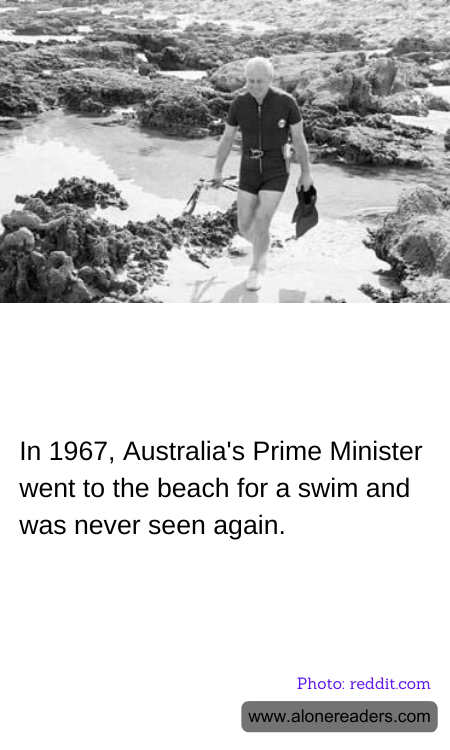
In the annals of Australian history, few events have captured the public's imagination quite like the mysterious disappearance of Prime Minister Harold Holt in 1967. On December 17th of that year, Holt, a seasoned politician and avid swimmer, ventured into the waters off Cheviot Beach near Portsea, Victoria, and was never seen again. This enigmatic event has since become a subject of intrigue and speculation, leaving a lasting legacy in Australian folklore.
Harold Holt, who had been Prime Minister for nearly two years, was known for his love of the ocean and was an experienced swimmer. On that fateful day, he was spending a leisurely weekend at his holiday home with friends. Despite the rough conditions and strong currents, Holt decided to take a swim, a decision that would lead to one of the most perplexing disappearances in political history. Witnesses reported seeing him enter the water, but as the waves grew more tumultuous, Holt vanished from sight, leaving those on the shore in shock and disbelief.
The disappearance prompted an extensive search operation, one of the largest in Australian history, involving the Navy, Air Force, and hundreds of volunteers. Despite the exhaustive efforts, no trace of Holt was ever found, and he was officially presumed dead two days later. The absence of any physical evidence led to a myriad of theories, ranging from accidental drowning to more far-fetched ideas involving espionage and defection. However, the most widely accepted explanation remains that Holt was swept away by the powerful currents, a tragic end to a life dedicated to public service.
Holt's disappearance had significant political and cultural ramifications. It marked the first time in Australian history that a sitting Prime Minister had vanished without a trace, leading to a swift transition of power. John McEwen, the Deputy Prime Minister, was appointed as the interim leader, ensuring stability during a period of national mourning and uncertainty. The incident also sparked discussions about the safety of public figures and the need for better protective measures, although Holt himself had always eschewed personal security, preferring a more relaxed and accessible approach to leadership.
Over the years, Harold Holt's disappearance has become a part of Australia's national identity, often referenced in popular culture and media. It serves as a poignant reminder of the unpredictability of life and the enduring mysteries that can arise even in the most public of lives. While the true fate of Harold Holt may never be known, his legacy as a leader and the circumstances of his disappearance continue to fascinate and mystify Australians and the world alike.
