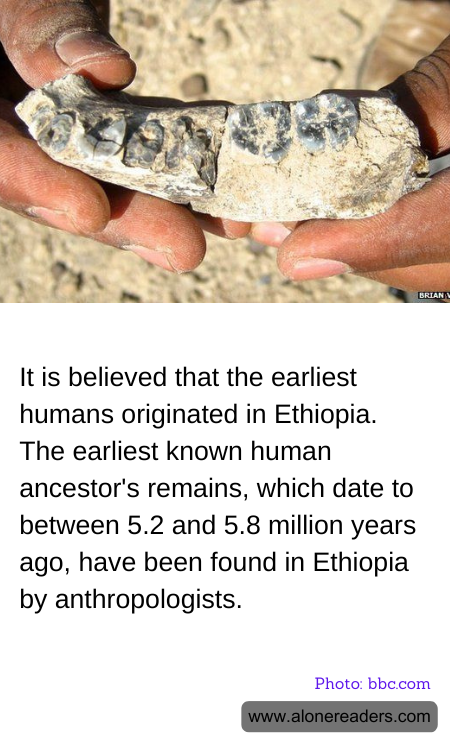
Ethiopia, a country nestled in the Horn of Africa, holds a significant place in the annals of human history. It is widely believed by scientists and anthropologists that the earliest humans originated in this region. This belief is supported by the discovery of ancient human ancestors' remains, which have been unearthed in Ethiopia and date back to between 5.2 and 5.8 million years ago. These findings have provided invaluable insights into the origins and evolution of humankind.
The discovery of these ancient remains has been pivotal in understanding the early stages of human evolution. Among the most notable finds is the fossil known as "Ardipithecus ramidus," which was discovered in the Afar region of Ethiopia. This species is considered one of the earliest known human ancestors, providing a crucial link in the evolutionary chain. The remains of Ardipithecus ramidus offer a glimpse into the physical characteristics and lifestyle of early hominins, shedding light on how they might have lived and adapted to their environment.
Ethiopia's unique geological and climatic conditions have made it a treasure trove for paleontologists and anthropologists. The Great Rift Valley, which runs through the country, has been a particularly rich site for fossil discoveries. This region's sedimentary layers have preserved ancient remains remarkably well, allowing scientists to piece together the story of human evolution over millions of years. The discoveries in Ethiopia have not only deepened our understanding of human ancestry but have also highlighted the country's critical role in the broader narrative of human history.
The significance of these findings extends beyond the scientific community. They have captured the imagination of people worldwide, offering a tangible connection to our distant past. The story of human origins in Ethiopia is a reminder of our shared heritage and the long journey that has led to the diverse tapestry of cultures and societies we see today. It underscores the idea that, despite our differences, we all share a common ancestry that traces back to the heart of Africa.
Ethiopia's contribution to the study of human origins continues to be a source of pride for the nation. The country's rich archaeological sites attract researchers and tourists alike, eager to explore the cradle of humanity. As new discoveries are made, they promise to further unravel the mysteries of our past, offering new perspectives on how early humans lived, adapted, and evolved over millions of years.
In conclusion, the belief that the earliest humans originated in Ethiopia is supported by compelling evidence from fossil discoveries that date back millions of years. These findings have not only advanced our understanding of human evolution but have also highlighted Ethiopia's pivotal role in the story of humankind. As research continues, Ethiopia remains at the forefront of uncovering the secrets of our ancient ancestors, providing a window into the origins of humanity itself.
