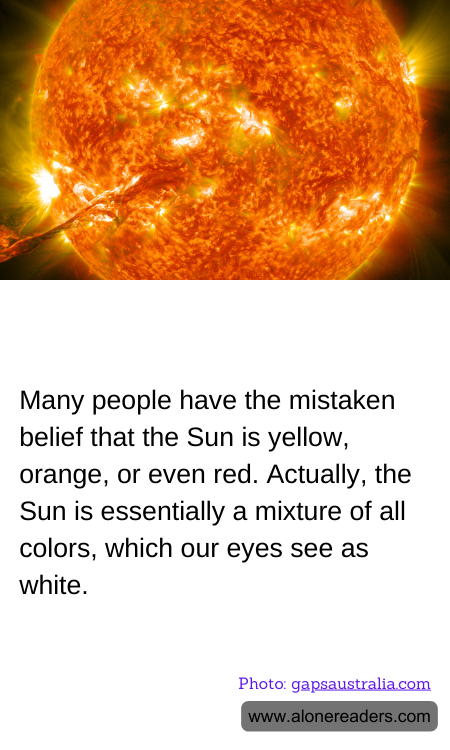
The Sun, the brilliant star at the center of our solar system, has long been a source of fascination and inspiration. Its daily journey across the sky has been depicted in countless works of art and literature, often portrayed in hues of yellow, orange, or red. However, this common perception is a misconception. In reality, the Sun is essentially a mixture of all colors, which our eyes perceive as white.
The misconception about the Sun's color arises from the way sunlight interacts with Earth's atmosphere. When the Sun is high in the sky, its light travels a shorter path through the atmosphere, and we perceive it as white. However, during sunrise and sunset, the Sun's light must pass through a greater thickness of the atmosphere. This longer path scatters shorter wavelengths of light, such as blue and violet, more than the longer wavelengths, like red and orange. As a result, the Sun appears to take on a reddish hue during these times, leading many to believe that the Sun itself is colored.
In truth, the Sun emits light across the entire visible spectrum, from violet to red. When combined, these colors create white light. This is similar to how a prism works; when white light passes through a prism, it is split into its component colors, creating a rainbow. The Sun's light is no different; it is a blend of all the colors of the rainbow, which together appear white to the human eye.
Understanding the true color of the Sun is not just a matter of scientific curiosity; it also has practical implications. For instance, the Sun's white light is crucial for life on Earth, as it provides the energy needed for photosynthesis, the process by which plants produce food. This light also influences our circadian rhythms, affecting our sleep patterns and overall health.
Moreover, recognizing the Sun's true color can enhance our appreciation of the natural world. It reminds us of the complexity and beauty of the universe, where even something as seemingly simple as the color of the Sun is the result of intricate interactions between light and matter.
In conclusion, while the Sun may appear yellow, orange, or red at times, it is, in essence, a brilliant white. This understanding not only corrects a common misconception but also enriches our appreciation of the natural phenomena that shape our world. By recognizing the Sun's true color, we gain a deeper insight into the wonders of our universe and the delicate balance that sustains life on Earth.
