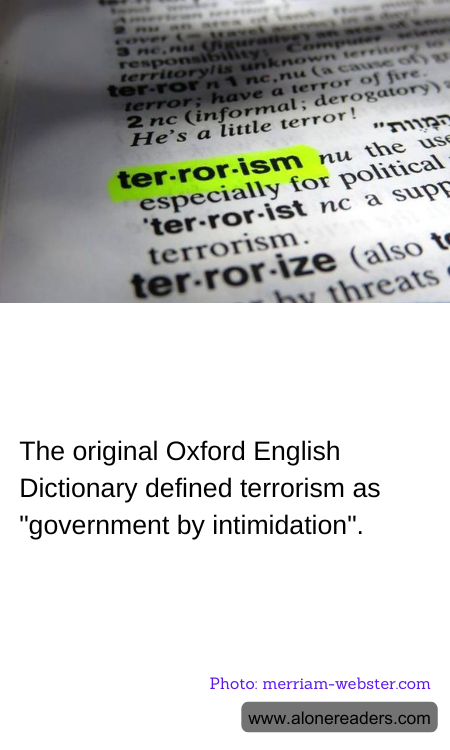
The term "terrorism" is one that has evolved significantly over time, both in its definition and its implications. The original Oxford English Dictionary (OED) defined terrorism as "government by intimidation," a definition that may seem surprising to contemporary readers who associate the term primarily with non-state actors and violent extremism. This historical definition offers a fascinating glimpse into how the concept of terrorism was originally understood and how its meaning has shifted over the years.
In the late 18th and early 19th centuries, when the OED was first compiled, the world was experiencing significant political upheaval. The French Revolution, with its Reign of Terror, was a recent memory, and the term "terrorism" was closely associated with the actions of the revolutionary government. During this period, the government employed fear and intimidation as tools to consolidate power and suppress opposition. Thus, the original definition of terrorism as "government by intimidation" reflected the political realities of the time, where state-sponsored terror was a prominent concern.
As history progressed, the definition of terrorism expanded and transformed. The 20th century saw the rise of various nationalist and ideological movements that employed violence to achieve their goals, often targeting civilians to instill fear and draw attention to their causes. This shift in tactics and actors led to a broader understanding of terrorism, one that included non-state entities and emphasized the use of violence to achieve political ends. The modern definition of terrorism, as found in contemporary dictionaries, typically involves the unlawful use of violence and intimidation, especially against civilians, in pursuit of political aims.
The evolution of the term "terrorism" highlights the dynamic nature of language and how it adapts to reflect societal changes. While the original definition focused on state actions, the modern interpretation encompasses a wider range of actors and methods. This shift underscores the importance of context in understanding language and the need to consider historical perspectives when examining contemporary issues.
Understanding the original definition of terrorism as "government by intimidation" also prompts reflection on the role of power and authority in society. It raises questions about how governments wield power and the ethical implications of using fear as a tool of governance. While the methods and actors associated with terrorism have changed, the underlying themes of power, control, and fear remain relevant in discussions about security and governance today.
In conclusion, the original definition of terrorism as "government by intimidation" serves as a reminder of the historical roots of the term and its evolution over time. It encourages us to consider the broader implications of how we define and respond to terrorism, recognizing that language is not static but rather a reflection of the changing world in which we live. As we continue to confront the challenges posed by terrorism in its various forms, understanding its historical context can provide valuable insights into crafting effective and ethical responses.
