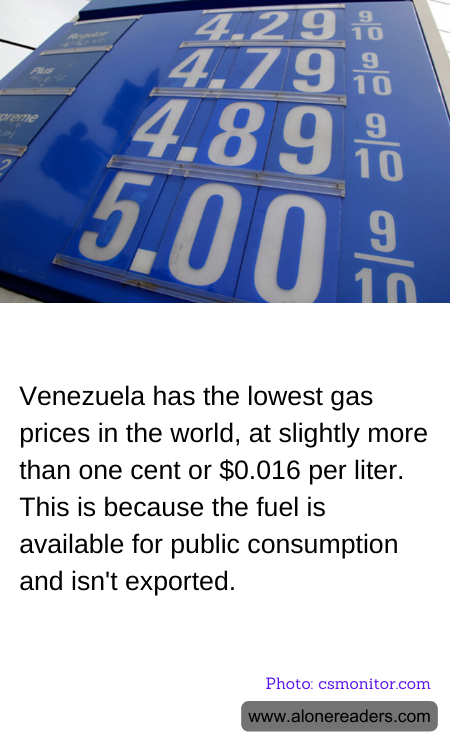
Venezuela, a country rich in natural resources, particularly oil, has long been known for its incredibly low gasoline prices. At slightly more than one cent or $0.016 per liter, Venezuela boasts the cheapest fuel prices in the world. This phenomenon is largely due to the country's policy of making fuel available for public consumption rather than exporting it. This strategy has deep roots in Venezuela's economic and political history, reflecting both its vast oil reserves and the government's approach to resource management.
The abundance of oil in Venezuela is a significant factor in the low cost of gasoline. The country sits atop one of the largest proven oil reserves in the world, which has allowed it to produce fuel at a minimal cost. Historically, the Venezuelan government has subsidized gasoline prices to make it affordable for its citizens, a policy that has been in place for decades. This subsidy is seen as a way to provide economic relief to the population, especially in times of economic hardship. By keeping fuel prices low, the government aims to ease the financial burden on its citizens, allowing them to allocate their limited resources to other essential needs.
However, the decision to prioritize domestic consumption over export has its complexities. While low fuel prices are beneficial for Venezuelans, they also present challenges. The lack of export revenue from gasoline sales means that the country misses out on potential income that could be used to bolster its economy. This is particularly significant given Venezuela's ongoing economic struggles, characterized by hyperinflation and shortages of basic goods. The decision to keep fuel prices low is a double-edged sword, providing immediate relief to citizens but potentially limiting long-term economic growth.
Moreover, the low cost of gasoline has led to unintended consequences, such as fuel smuggling to neighboring countries where prices are significantly higher. This illegal trade undermines the intended benefits of the subsidy and contributes to the country's economic woes. Additionally, the artificially low prices have discouraged investment in the oil sector, leading to infrastructure deterioration and reduced production capacity over time.
Despite these challenges, the policy of maintaining low gasoline prices remains popular among Venezuelans. It is seen as a rare benefit in a country facing numerous economic difficulties. For many, affordable fuel is a crucial aspect of daily life, enabling transportation and access to goods and services. The government's commitment to keeping gasoline prices low is a reflection of its broader strategy to provide for its citizens amidst challenging circumstances.
In conclusion, Venezuela's status as the country with the lowest gasoline prices in the world is a testament to its vast oil resources and the government's policy choices. While this approach offers immediate benefits to the population, it also poses significant challenges that impact the country's economic stability and growth. As Venezuela navigates its complex economic landscape, the issue of fuel pricing remains a critical component of its national discourse, balancing the needs of its citizens with the realities of its economic situation.
