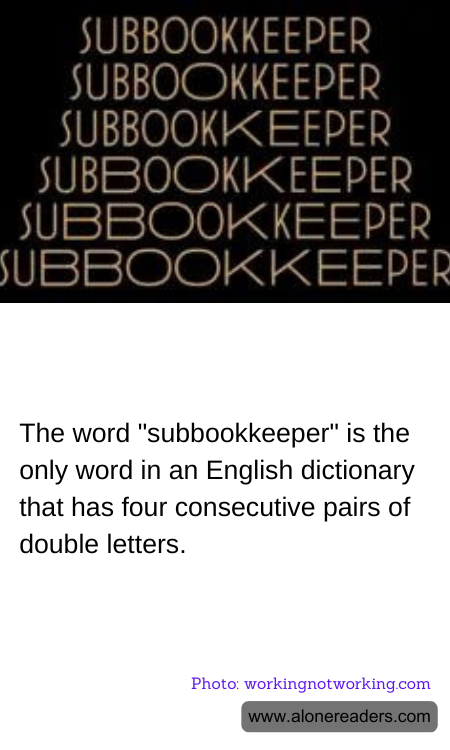
In the vast and intricate tapestry of the English language, certain words stand out not just for their meaning but for their unique structural characteristics. One such word is "subbookkeeper," a term that holds the distinction of being the only word in the English dictionary with four consecutive pairs of double letters. This fascinating feature makes "subbookkeeper" a linguistic curiosity, capturing the interest of language enthusiasts and casual learners alike.
At first glance, "subbookkeeper" might seem like an ordinary term, referring to a subordinate bookkeeper, someone who assists in maintaining financial records. However, its orthographic peculiarity sets it apart. The word contains the pairs "bb," "oo," "kk," and "ee," all in succession. This sequence of double letters is not only rare but also a testament to the playful and sometimes unpredictable nature of English word formation.
The presence of these double letters in "subbookkeeper" can be attributed to the combination of two words: "sub" and "bookkeeper." The prefix "sub-" is commonly used in English to denote a subordinate or secondary level, while "bookkeeper" refers to someone who records the financial transactions of a business. When these two components merge, they create a word that is both functional in its meaning and exceptional in its form.
The uniqueness of "subbookkeeper" highlights the richness and diversity of the English language. English is known for its ability to absorb and adapt words from various languages and cultures, leading to a lexicon that is both vast and varied. This adaptability is one reason why English is filled with words that have unusual spellings and structures, making it a language that is both challenging and rewarding to learn.
For those who enjoy word games and puzzles, "subbookkeeper" offers a delightful challenge. It serves as a reminder of the intricate patterns and rules that govern English spelling, while also illustrating how exceptions to these rules can create words that are both intriguing and memorable. The word's structure can spark curiosity and encourage deeper exploration into the etymology and evolution of language.
In conclusion, "subbookkeeper" is more than just a word; it is a linguistic gem that showcases the complexity and beauty of English. Its four consecutive pairs of double letters make it a standout example of how language can surprise and delight us. Whether you are a seasoned linguist or someone with a casual interest in words, "subbookkeeper" offers a glimpse into the fascinating world of English orthography, inviting us all to appreciate the quirks and wonders of the language we use every day.
