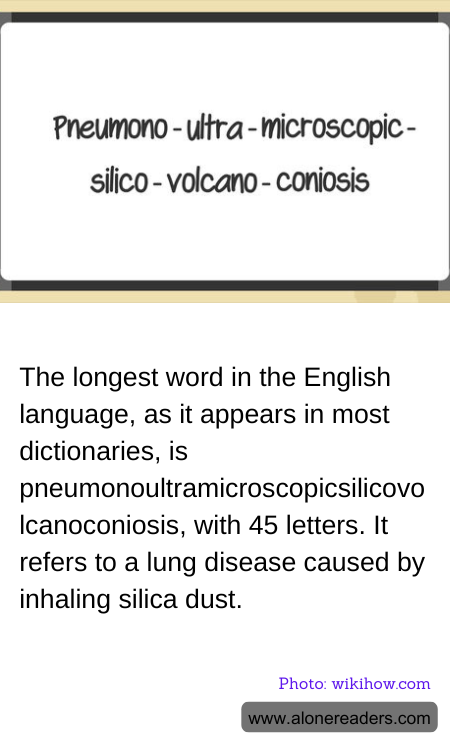
Pneumonoultramicroscopicsilicovolcanoconiosis is a word that often captures the imagination due to its sheer length and complexity. With 45 letters, it holds the distinction of being the longest word in the English language as it appears in most dictionaries. This formidable term refers to a specific type of lung disease caused by the inhalation of very fine silica dust, which can occur in environments such as mines or construction sites where silica particles are prevalent.
The origins of the word are as intriguing as the word itself. It was coined in 1935 by the president of the National Puzzlers' League, Everett M. Smith, during the annual meeting of the league. The intention was to create a new, long word that could serve as a synonym for the more commonly used term "silicosis," a disease that affects the lungs. The word was constructed by combining several Greek and Latin roots that describe the condition: "pneumono" refers to the lungs, "ultra" means beyond, "microscopic" indicates the tiny size of the particles, "silico" relates to silica, "volcano" suggests volcanic dust, and "coniosis" is a suffix used in medical terminology to denote a disease caused by dust.
While the word may seem like a linguistic curiosity, it serves a practical purpose in highlighting the dangers of inhaling fine particulate matter. Silica dust is a common hazard in industries such as mining, construction, and manufacturing. When inhaled, these tiny particles can become lodged in the lungs, leading to inflammation and scarring. Over time, this can result in serious respiratory issues, including pneumonoultramicroscopicsilicovolcanoconiosis. The condition underscores the importance of workplace safety measures, such as wearing protective masks and ensuring proper ventilation, to prevent exposure to harmful dust.
Despite its length, pneumonoultramicroscopicsilicovolcanoconiosis is not frequently used in everyday conversation or even in medical practice. It is often regarded as a novelty word, more likely to be encountered in spelling bees or trivia games than in a doctor's office. Nonetheless, its existence in the dictionary serves as a reminder of the rich and diverse nature of the English language, capable of crafting words that are both descriptive and memorable.
For those who enjoy wordplay and linguistic challenges, pneumonoultramicroscopicsilicovolcanoconiosis offers a fascinating glimpse into the world of constructed language. It exemplifies how words can be formed to convey specific meanings while also capturing the imagination with their complexity. Whether viewed as a medical term or a linguistic marvel, this 45-letter word continues to intrigue and educate people of all ages about the intricacies of language and the importance of occupational health.
