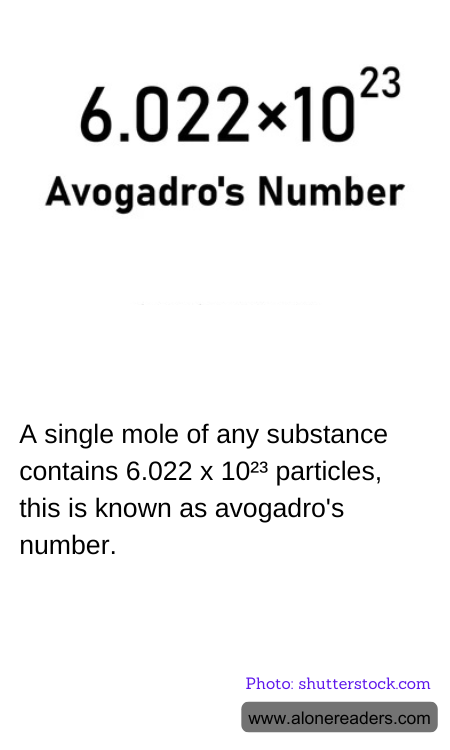
In the fascinating world of chemistry, one of the most fundamental concepts is the mole, a unit that measures the amount of substance. Central to this concept is Avogadro's number, which is 6.022 x 10²³. This number represents the quantity of particles, whether they be atoms, molecules, ions, or electrons, contained in one mole of any substance. Named after the Italian scientist Amedeo Avogadro, this constant is a cornerstone of chemical calculations and understanding.
Avogadro's number is crucial because it provides a bridge between the microscopic world of atoms and molecules and the macroscopic world we can observe and measure. For instance, when chemists talk about a mole of water, they mean 6.022 x 10²³ molecules of H2O. This allows scientists to count and quantify substances in a practical way, despite the incredibly small size of individual atoms and molecules. Without this concept, it would be nearly impossible to perform chemical calculations or to understand the relationships between different substances in a reaction.
The significance of Avogadro's number extends beyond mere counting. It also plays a vital role in determining the molar mass of a substance, which is the mass of one mole of that substance. This is particularly useful when dealing with chemical reactions, as it allows chemists to predict how much of each reactant is needed and how much product will be formed. For example, if you know the molar mass of carbon dioxide is approximately 44 grams per mole, you can calculate how much carbon dioxide will be produced from a given amount of carbon and oxygen.
Understanding Avogadro's number also helps in grasping the concept of the ideal gas law, which relates the pressure, volume, and temperature of a gas to the number of moles present. This relationship is crucial in fields ranging from environmental science to engineering, where gases play a significant role. By using Avogadro's number, scientists can predict how gases will behave under different conditions, which is essential for everything from designing engines to understanding atmospheric phenomena.
In educational settings, Avogadro's number serves as a gateway to deeper chemical understanding. It helps students appreciate the scale and scope of chemical reactions and the vast number of particles involved in even the simplest processes. This understanding is not only fundamental to chemistry but also enriches our comprehension of the natural world, highlighting the intricate and interconnected nature of all matter.
In conclusion, Avogadro's number is more than just a figure; it is a key that unlocks the mysteries of the molecular world. By providing a tangible way to measure and understand the invisible, it allows scientists and students alike to explore the complexities of chemistry with precision and clarity. Whether in the laboratory, the classroom, or the broader world, Avogadro's number remains an essential tool in the ongoing quest to understand the universe at its most fundamental level.
