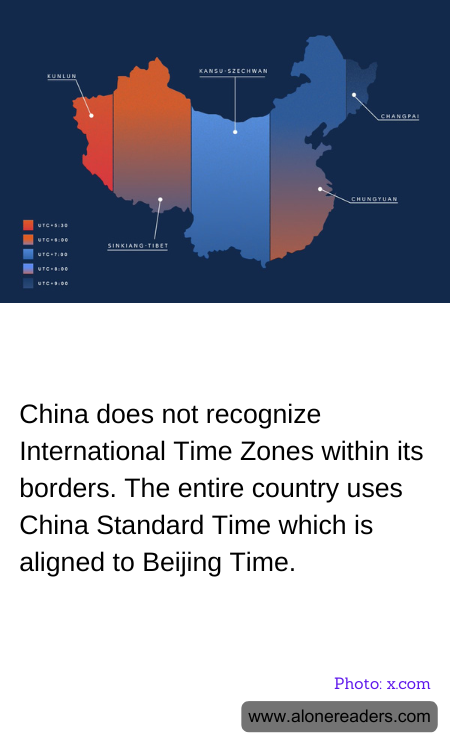
China, a vast nation with a landmass stretching over 9.6 million square kilometers, presents a unique approach to timekeeping that sets it apart from most other countries. Despite spanning five geographical time zones, China operates under a single time zone known as China Standard Time (CST), which is aligned with Beijing Time. This decision, rooted in historical and political considerations, has both practical implications and cultural significance.
The adoption of a unified time zone across China dates back to 1949, following the establishment of the People's Republic of China. The government, under the leadership of the Communist Party, sought to promote national unity and cohesion. By aligning the entire country to Beijing Time, the central government aimed to reinforce Beijing's role as the political and cultural heart of the nation. This decision was also a practical one, simplifying administrative processes and communication across the vast country.
For residents in the western regions of China, such as Xinjiang and Tibet, the use of Beijing Time can present challenges. These areas experience significant discrepancies between the official time and the natural solar time. For instance, in Urumqi, the capital of Xinjiang, the sun can rise as late as 10 a.m. during winter months. To adapt, local residents often follow an unofficial time, known as Xinjiang Time, which is two hours behind Beijing Time. This unofficial time helps align daily activities more closely with daylight hours, although it is not officially recognized by the government.
The use of a single time zone in China also has implications for business and international relations. For companies operating across different regions of China, the uniform time zone simplifies scheduling and coordination. However, it can pose challenges for international businesses and travelers who must adjust to the time difference when conducting activities in China. Despite these challenges, the system remains largely accepted within the country, reflecting a broader cultural emphasis on unity and collective identity.
China's approach to timekeeping is a fascinating example of how a nation can prioritize national unity and administrative efficiency over geographical considerations. While it may seem unconventional to those accustomed to multiple time zones, it underscores the importance of centralized governance and cultural cohesion in China's national identity. As the country continues to grow and evolve, its unique approach to time remains a testament to its distinctive blend of tradition and modernity.
