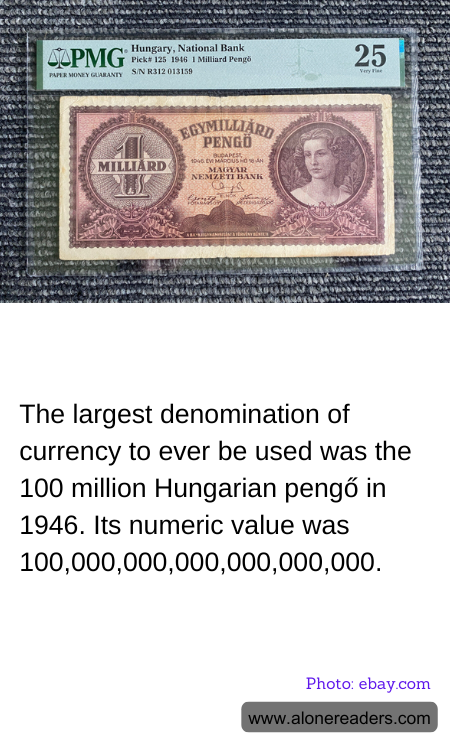
In the annals of economic history, few events are as striking as the hyperinflation that gripped Hungary in the mid-20th century. This period of financial turmoil reached its zenith in 1946 when the Hungarian government issued the largest denomination of currency ever used: the 100 million pengo note. This staggering figure, represented numerically as 100,000,000,000,000,000,000, stands as a testament to the extreme economic conditions of the time.
The story of the 100 million pengo is rooted in the aftermath of World War II. Hungary, like many European nations, was left in ruins, grappling with the economic devastation wrought by years of conflict. The country faced severe shortages of goods and services, and the government resorted to printing money in an attempt to stabilize the economy. However, this approach only exacerbated the situation, leading to hyperinflation of unprecedented proportions.
By mid-1946, inflation in Hungary had reached astronomical levels, with prices doubling every 15 hours. The pengo, once a stable currency, became virtually worthless. In an effort to keep up with the rapidly devaluing currency, the government issued increasingly larger denominations. The 100 million pengo note, despite its seemingly astronomical value, could barely purchase a loaf of bread. This note, along with others of similarly large denominations, was printed in a desperate bid to maintain some semblance of economic order.
The issuance of the 100 million pengo note was not just a financial maneuver but also a reflection of the social and political chaos of the time. The Hungarian people, already suffering from the ravages of war, faced the additional burden of economic uncertainty. Daily life became a struggle as citizens were forced to carry bags of money just to buy basic necessities. The psychological impact of such extreme inflation was profound, eroding trust in the government and the financial system.
In August 1946, the Hungarian government introduced a new currency, the forint, in an attempt to stabilize the economy and restore confidence. The forint replaced the pengo at an exchange rate of 400 octillion pengo to one forint, effectively rendering the old currency obsolete. This move marked the end of one of the most severe episodes of hyperinflation in history.
The legacy of the 100 million pengo note serves as a cautionary tale about the dangers of unchecked inflation and the importance of sound economic policies. It highlights the fragility of financial systems and the need for careful management to prevent similar crises in the future. For historians and economists alike, the story of the Hungarian pengo remains a powerful reminder of the complex interplay between politics, economics, and human resilience in the face of adversity.
