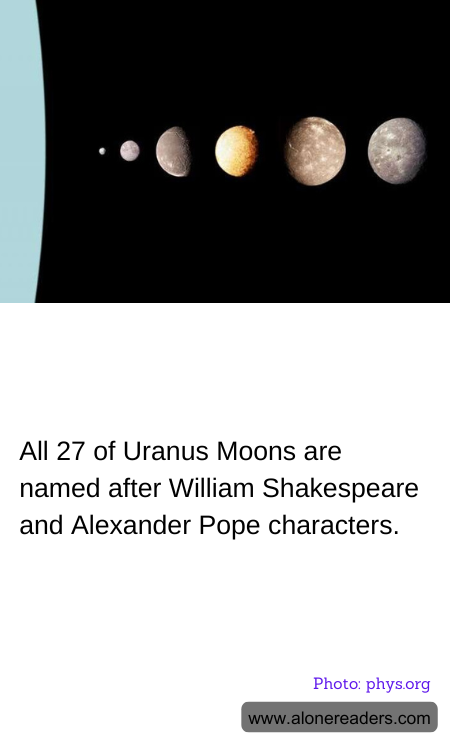
Uranus, the seventh planet from the Sun, is not only known for its unique tilt and icy composition but also for its intriguing collection of moons. Unlike the moons of other planets, which are often named after mythological figures, all 27 of Uranus's moons are named after characters from the works of William Shakespeare and Alexander Pope. This distinctive naming convention adds a literary flair to the celestial bodies orbiting this distant planet.
The tradition began in 1787 when Sir William Herschel, the discoverer of Uranus, identified its first two moons, Titania and Oberon. These names were inspired by characters from Shakespeare's "A Midsummer Night's Dream," setting a precedent for future discoveries. As more moons were identified, astronomers continued to draw from the rich tapestry of Shakespeare's plays and the works of Alexander Pope, a celebrated English poet known for his satirical verse and translation of Homer.
Among the Shakespearean names, we find Ariel and Miranda from "The Tempest," Puck from "A Midsummer Night's Dream," and Juliet from "Romeo and Juliet." Each name evokes the drama, romance, and whimsy of the plays, providing a cultural connection to these distant celestial bodies. The choice of names not only honors the literary giants but also reflects the imaginative spirit of exploration and discovery.
Alexander Pope's influence is seen in the naming of Belinda, a character from his mock-epic poem "The Rape of the Lock." This inclusion highlights the blend of high drama and satirical wit that characterizes Pope's work, offering a nod to the diversity of English literature. The decision to incorporate Pope's characters alongside Shakespeare's underscores the importance of both authors in the canon of English literature.
The moons of Uranus, with their literary namesakes, serve as a reminder of the enduring impact of Shakespeare and Pope on our culture. They also highlight the creativity and thoughtfulness of the scientific community in choosing names that resonate with both the scientific and literary worlds. This unique naming convention not only enriches our understanding of Uranus but also invites us to explore the connections between science and the arts.
In a universe filled with countless celestial bodies, the moons of Uranus stand out for their literary connections. As we continue to explore the cosmos, the names of these moons remind us of the stories and characters that have shaped our cultural heritage. They serve as a testament to the power of literature to inspire and inform our understanding of the universe, bridging the gap between the arts and sciences in a way that is both meaningful and enduring.
