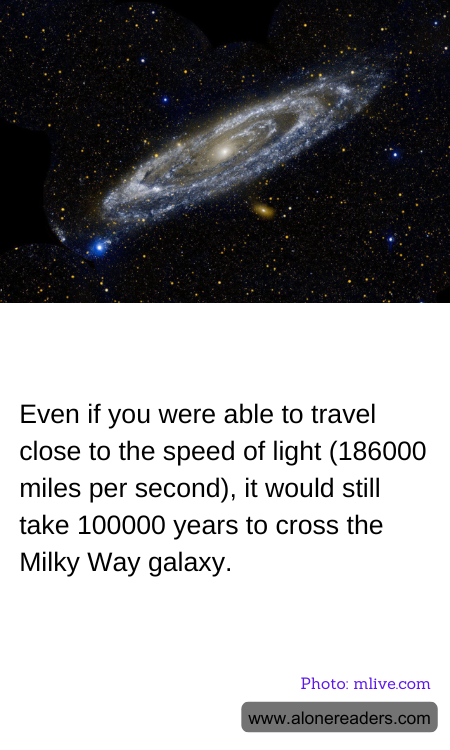
The vastness of the universe is a concept that has fascinated humans for centuries. Our home galaxy, the Milky Way, is a sprawling collection of stars, planets, and cosmic phenomena that stretches across an unimaginable expanse of space. Even with the most advanced technology and theoretical capabilities, traversing this celestial giant remains a daunting challenge. To put this into perspective, consider the speed of light, which is the fastest speed known to science. Light travels at an astonishing 186,000 miles per second, a speed that allows it to circle the Earth more than seven times in just one second. Yet, even at this incredible velocity, it would take approximately 100,000 years to cross the Milky Way from one end to the other.
This staggering fact highlights the sheer scale of our galaxy. The Milky Way is estimated to be about 100,000 light-years in diameter. A light-year, the distance light travels in one year, is about 5.88 trillion miles. Therefore, the Milky Way spans roughly 588 quadrillion miles. These numbers are so large that they can be difficult to comprehend. To put it in simpler terms, if you were to embark on a journey across the Milky Way at the speed of light, you would need to travel continuously for 100,000 years, a time span that far exceeds the entirety of human civilization.
The enormity of the Milky Way is not just a testament to the vastness of space but also a reminder of the limitations of our current technology and understanding. While science fiction often imagines faster-than-light travel, such as warp drives or hyperspace jumps, these concepts remain speculative and beyond our current scientific capabilities. The laws of physics, as we understand them, impose strict limits on how fast we can travel. Even if we could achieve near-light speeds, the journey across our galaxy would still be a multi-generational endeavor.
This realization invites us to appreciate the incredible complexity and beauty of the universe. The Milky Way is home to hundreds of billions of stars, each potentially hosting its own system of planets. Among these countless celestial bodies, there may be other worlds with conditions suitable for life, waiting to be discovered. The vast distances involved in space travel challenge us to think creatively and push the boundaries of our scientific knowledge.
In the meantime, our exploration of the galaxy continues through telescopes and robotic spacecraft, which provide glimpses into the wonders of the cosmos. These tools allow us to study distant stars, nebulae, and galaxies, expanding our understanding of the universe and our place within it. As we gaze up at the night sky, we are reminded of the incredible journey that lies ahead and the endless possibilities that await us in the vast expanse of space.
