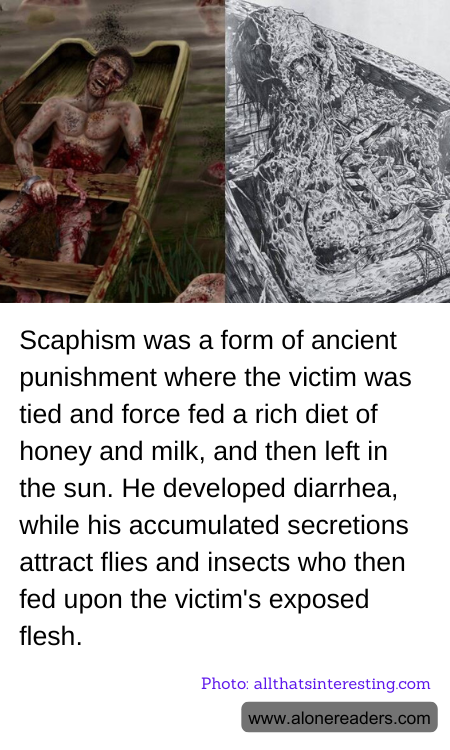
In the annals of history, there exist numerous accounts of ancient punishments that reflect the darker aspects of human creativity and cruelty. Among these, scaphism stands out as one of the most harrowing and grotesque methods of execution. Originating from ancient Persia, scaphism was designed not only to end a life but to do so in a manner that inflicted maximum suffering and humiliation.
The process of scaphism began with the victim being securely fastened between two boats or hollowed-out tree trunks, leaving only the head, hands, and feet exposed. This confinement was the prelude to a torturous ordeal that would unfold over several days. The victim was then force-fed a diet rich in milk and honey, a seemingly benign concoction that would soon become a source of agony. This diet was not intended to nourish but to induce severe diarrhea, which would leave the victim in a state of perpetual filth and vulnerability.
As the victim lay exposed under the relentless sun, the mixture of sweat, excrement, and the sticky residue of honey created an irresistible attraction for insects. Flies, ants, and other pests would swarm to the scene, drawn by the scent of decay and sweetness. These insects would begin to feast on the victim's exposed flesh, laying eggs that would hatch into larvae, further exacerbating the torment. The combination of dehydration, infection, and the relentless assault of insects would eventually lead to a slow and agonizing death.
Scaphism was not merely a method of execution; it was a spectacle of suffering intended to serve as a deterrent to others. The public nature of the punishment, coupled with its prolonged duration, ensured that the victim's agony was witnessed by many, reinforcing the power and authority of those who wielded it. This method of punishment underscores the lengths to which ancient societies would go to maintain control and instill fear.
While scaphism is a testament to the extremes of human cruelty, it also serves as a reminder of the progress humanity has made in terms of justice and human rights. Today, such barbaric practices are universally condemned, and the focus has shifted towards more humane and rehabilitative approaches to justice. The story of scaphism, though grim, highlights the importance of remembering the past to ensure that such atrocities are never repeated.
In reflecting on scaphism, we are reminded of the capacity for both cruelty and compassion within human nature. It is a stark illustration of the potential for darkness in the human soul, but also a call to continue striving for a more just and humane world.
