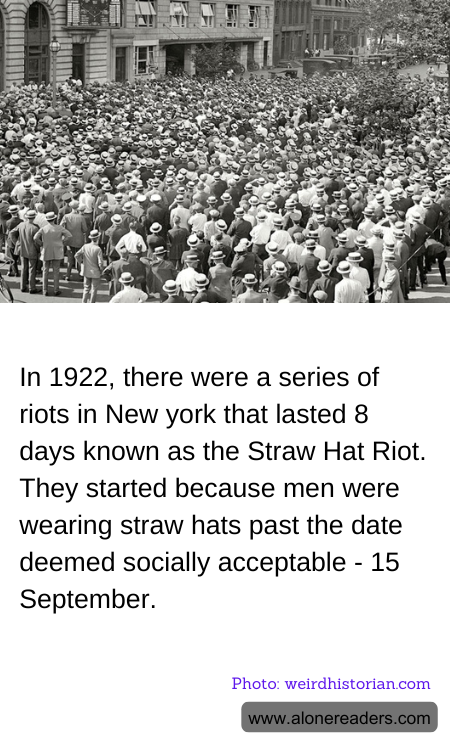
In the bustling streets of New York City in 1922, an unexpected series of events unfolded that would later be remembered as the Straw Hat Riot. This peculiar episode in history was sparked by a seemingly trivial fashion faux pas: men wearing straw hats past the socially accepted date of September 15. What began as a lighthearted tradition quickly escalated into a week-long frenzy that captured the attention of the city and left a lasting mark on its cultural history.
The origins of the Straw Hat Riot can be traced back to a long-standing custom that dictated the appropriate time for wearing straw hats. Traditionally, these lightweight hats were considered suitable for the summer months, providing relief from the heat. However, come mid-September, the fashion-conscious were expected to switch to felt hats, marking the transition to cooler weather. This unwritten rule was so ingrained in society that it became a point of contention and even ridicule for those who dared to defy it.
On September 13, 1922, a group of rowdy youths in Manhattan decided to take matters into their own hands. Armed with sticks, they began knocking straw hats off the heads of unsuspecting passersby, sparking a chain reaction of chaos. What started as a prank quickly spiraled out of control, as more people joined in the hat-smashing frenzy. The situation escalated over the next few days, with mobs forming in various parts of the city, targeting anyone who dared to wear a straw hat.
The police were soon called in to quell the disturbances, but their efforts were met with limited success. The riot continued for eight days, with reports of violence and arrests making headlines. The New York Times documented the events, noting that the riots were not just confined to Manhattan but had spread to other boroughs as well. The chaos was a testament to the power of social norms and the lengths to which people would go to enforce them.
While the Straw Hat Riot may seem absurd by today's standards, it serves as a fascinating glimpse into the social dynamics of the early 20th century. It highlights the importance placed on fashion and conformity, as well as the potential for seemingly minor issues to ignite widespread unrest. The riot also underscores the role of youth culture in challenging societal norms, a theme that continues to resonate in various forms throughout history.
In the aftermath of the riot, the city gradually returned to normalcy, and the straw hat rule eventually faded into obscurity. However, the events of 1922 remain a curious chapter in New York's history, a reminder of a time when fashion faux pas could lead to citywide upheaval. Today, the Straw Hat Riot stands as a quirky anecdote, illustrating the ever-evolving nature of social customs and the unpredictable ways in which they can manifest.
