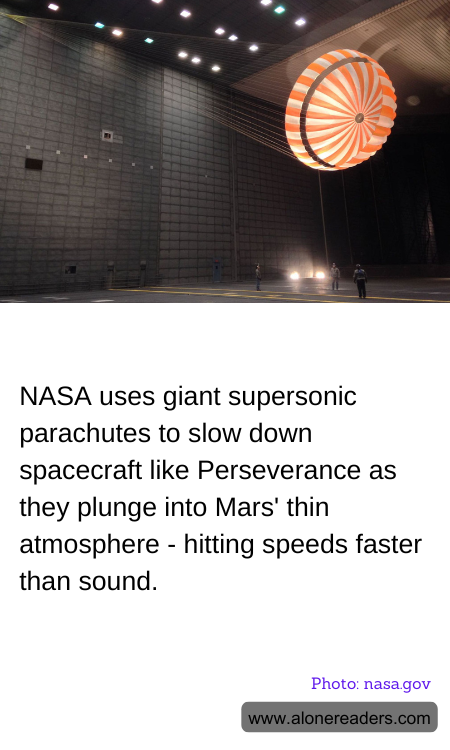
In the vast expanse of space exploration, landing a spacecraft on Mars presents one of the most formidable challenges. The thin Martian atmosphere, which is less than 1% the density of Earth's, offers little resistance to incoming spacecraft, making the task of slowing them down from supersonic speeds a monumental feat of engineering. To address this challenge, NASA has developed giant supersonic parachutes, a critical component in the successful landing of missions like the Perseverance rover.
When a spacecraft approaches Mars, it is traveling at speeds exceeding 12,000 miles per hour. At such velocities, the thin atmosphere does little to slow it down. Enter the supersonic parachute, a marvel of modern engineering designed to deploy at speeds faster than sound. These parachutes are not only enormous, with diameters reaching up to 70 feet, but they are also incredibly strong, capable of withstanding the intense forces exerted during deployment.
The deployment of a supersonic parachute is a precisely timed event. As the spacecraft enters the Martian atmosphere, it first relies on a heat shield to protect it from the intense heat generated by atmospheric entry. Once the spacecraft has slowed to a manageable speed, the parachute is deployed, rapidly inflating to create drag and further reduce the spacecraft's speed. This process is crucial for ensuring that the spacecraft can safely descend to the Martian surface.
The design and testing of these parachutes are feats of engineering in their own right. NASA conducts rigorous testing on Earth, using wind tunnels and high-altitude balloon drops to simulate the conditions of Mars. These tests ensure that the parachutes can deploy reliably and withstand the harsh conditions of space travel. The success of these tests is evident in the flawless landing of the Perseverance rover in February 2021, which relied on a supersonic parachute to safely reach the Martian surface.
The use of supersonic parachutes is a testament to human ingenuity and the relentless pursuit of knowledge. By overcoming the challenges posed by Mars' thin atmosphere, NASA continues to push the boundaries of what is possible in space exploration. These parachutes not only enable the safe landing of scientific instruments and rovers but also pave the way for future missions, including those that may one day carry humans to the Red Planet.
As we look to the future, the lessons learned from the development and deployment of supersonic parachutes will undoubtedly inform the next generation of space exploration technologies. With each successful mission, we move closer to unlocking the mysteries of Mars and expanding our understanding of the universe.
