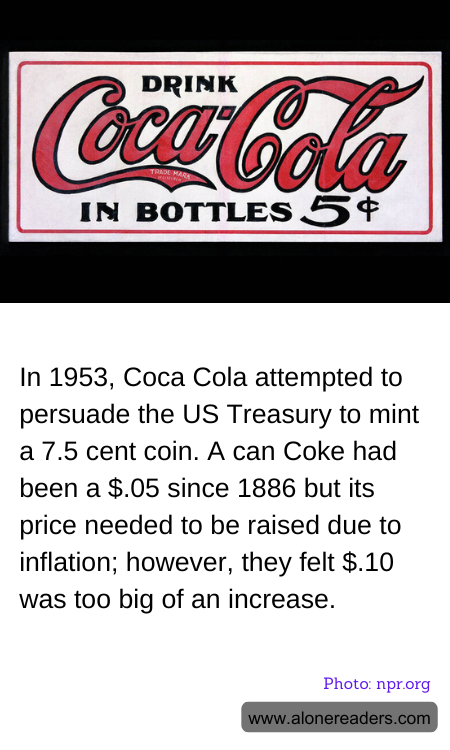
In the early 1950s, Coca-Cola found itself in a unique predicament that highlighted the intersection of business strategy and economic realities. Since its inception in 1886, Coca-Cola had been a staple of American life, with its price steadfastly set at five cents for over six decades. However, by 1953, the economic landscape had shifted significantly due to inflation, and the company faced the challenge of adjusting its pricing strategy without alienating its loyal customer base.
The dilemma was clear: maintaining the five-cent price point was no longer financially viable, yet doubling the price to ten cents seemed too drastic a leap for consumers accustomed to the traditional nickel price. In a creative attempt to bridge this gap, Coca-Cola proposed an unusual solution to the U.S. Treasury: the introduction of a 7.5-cent coin. This new denomination would allow the company to raise prices incrementally, reflecting the economic pressures of the time while minimizing the shock to consumers.
Coca-Cola's request was not merely a whimsical idea but a calculated move to maintain its market position. The company understood that consumer perception was crucial, and a sudden price increase could potentially disrupt its brand loyalty. By advocating for a 7.5-cent coin, Coca-Cola aimed to ease consumers into the new pricing structure, preserving its reputation as an affordable luxury.
Despite the ingenuity of the proposal, the U.S. Treasury did not adopt the idea. The introduction of a new coin denomination posed logistical challenges and complexities that outweighed the potential benefits. The Treasury's decision left Coca-Cola to navigate the pricing conundrum through other means. Eventually, the company had to increase the price of its iconic beverage to ten cents, a move that marked the end of an era but also underscored the inevitability of economic change.
This episode in Coca-Cola's history is a fascinating example of how businesses must adapt to external economic forces while striving to maintain consumer trust and satisfaction. It also serves as a reminder of the innovative thinking that companies often employ to address challenges, even when those ideas do not come to fruition. The story of the 7.5-cent coin proposal remains a curious footnote in the annals of American business history, illustrating the delicate balance between tradition and progress.
