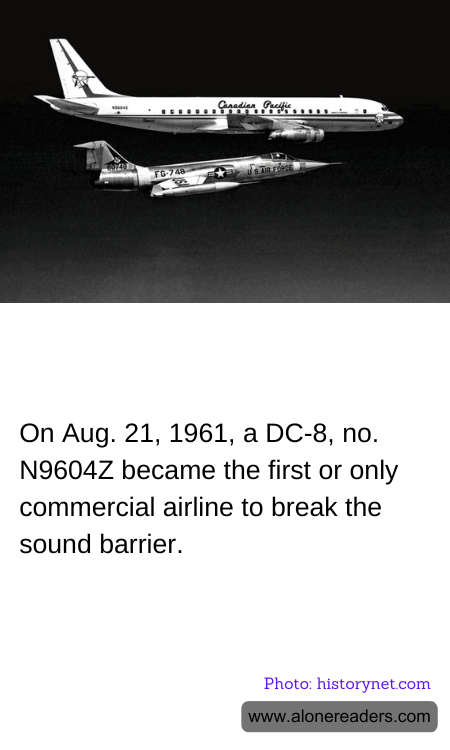
On August 21, 1961, a remarkable event unfolded in the skies that would etch its place in aviation history. A Douglas DC-8, bearing the registration number N9604Z, achieved what no other commercial airliner had done before—it broke the sound barrier. This extraordinary feat was not only a testament to the engineering prowess of the time but also a significant milestone in the evolution of commercial aviation.
The DC-8, a jet airliner developed by the Douglas Aircraft Company, was primarily designed for subsonic travel. However, during a series of test flights aimed at exploring the aircraft's performance limits, the team behind the DC-8 decided to push the boundaries. The flight took place over Edwards Air Force Base in California, a location synonymous with aviation testing and innovation. As the aircraft soared through the sky, it reached a speed of Mach 1.012, momentarily surpassing the speed of sound.
Breaking the sound barrier was a significant achievement, especially for a commercial airliner. At the time, supersonic travel was largely the domain of military aircraft, with the Concorde and the Soviet Tu-144 still years away from their first flights. The DC-8's accomplishment demonstrated the potential for commercial aircraft to achieve speeds previously thought unattainable for passenger travel. It also underscored the robust design and engineering capabilities of the Douglas Aircraft Company, which had been a major player in the aviation industry.
The flight of N9604Z was not a commercial operation but rather a test flight, and it did not carry passengers. Nevertheless, it captured the imagination of the public and the aviation community alike. The achievement was widely reported and celebrated, highlighting the possibilities of future advancements in air travel. It also served as a precursor to the development of supersonic passenger jets, which would later become a reality with the introduction of the Concorde in the 1970s.
While the DC-8's supersonic flight was a one-time event, it remains a fascinating chapter in the history of aviation. It serves as a reminder of the relentless pursuit of progress and the spirit of innovation that drives the industry forward. Today, as the aviation sector continues to explore new frontiers with advancements in technology and sustainability, the legacy of the DC-8's supersonic achievement continues to inspire engineers and aviation enthusiasts around the world.
