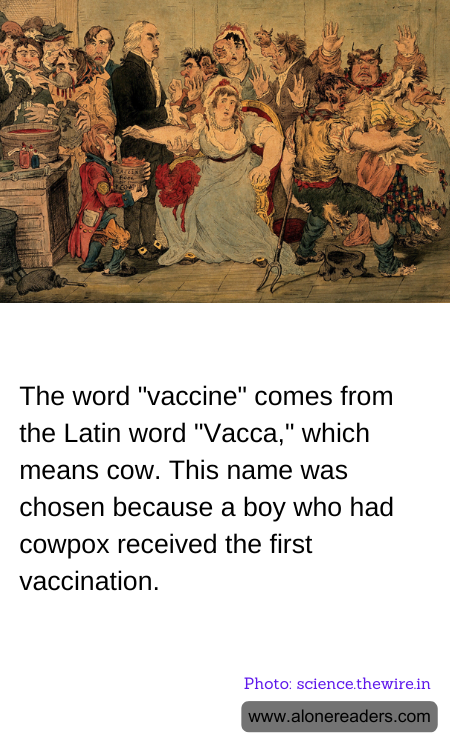
The word "vaccine" has an intriguing origin that traces back to the Latin word "vacca," meaning cow. This connection to cows is not merely linguistic but deeply rooted in the history of medicine and the development of vaccines. The story begins in the late 18th century with a remarkable discovery by an English physician named Edward Jenner, whose work laid the foundation for modern immunology.
In the 1700s, smallpox was a devastating disease, causing severe illness and death across the globe. However, it was observed that milkmaids who contracted cowpox, a much milder disease, seemed to be immune to smallpox. Cowpox, which affected cows, could be transmitted to humans through direct contact, but it was not life-threatening. This observation led Jenner to hypothesize that exposure to cowpox could protect against smallpox.
In 1796, Jenner conducted a groundbreaking experiment that would change the course of medical history. He took material from a cowpox sore on the hand of a milkmaid named Sarah Nelmes and inoculated it into the arm of a young boy named James Phipps. After a few days, the boy developed mild symptoms of cowpox but soon recovered. Jenner then exposed James to smallpox, and remarkably, the boy did not contract the disease. This experiment demonstrated that cowpox could indeed provide immunity to smallpox, and thus, the concept of vaccination was born.
The term "vaccine" was derived from "vacca" to honor the role of the cow in this medical breakthrough. Jenner's work was met with both skepticism and acclaim, but over time, the practice of vaccination gained acceptance and became a crucial tool in the fight against infectious diseases. The success of the smallpox vaccine eventually led to the eradication of the disease in 1980, a testament to the power of vaccination.
Today, vaccines continue to play a vital role in public health, protecting millions from diseases such as measles, polio, and influenza. The principles established by Jenner's early work have been expanded upon, leading to the development of vaccines for a wide range of illnesses. The story of the word "vaccine" serves as a reminder of the humble beginnings of this life-saving technology and the importance of scientific curiosity and innovation.
Understanding the origin of the word "vaccine" provides insight into the history of medicine and the enduring impact of Jenner's discovery. It highlights the interconnectedness of language, science, and history, showing how a simple observation involving cows led to one of the most significant advancements in human health. As we continue to face new challenges in the realm of infectious diseases, the legacy of the cow and the pioneering spirit of Edward Jenner remain as relevant as ever.
