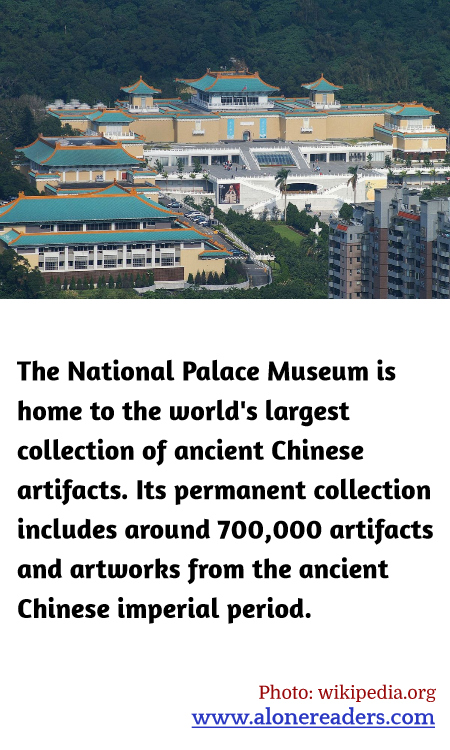
The National Palace Museum, located in Taipei, Taiwan, stands as a monumental repository of Chinese cultural history, housing the world's largest collection of ancient Chinese artifacts. The impressive assemblage boasts approximately 700,000 items that span millennia of China's history. This vast collection includes exquisite paintings, rare manuscripts, important documents, and artifacts that were once treasures of China’s imperial families.
Originally established as the Palace Museum in Beijing's Forbidden City in 1925, the institution was moved to Taiwan during the Chinese Civil War in the late 1940s. This relocation was part of an effort to protect the artifacts from potential damage during the conflicts. Since then, it has become a cornerstone in preserving Chinese cultural heritage and promoting the study of ancient Chinese art.
The museum’s collection is rich and diverse, including artworks made from ceramics, bronze, wood, and precious stones. Notably, it houses many pieces from the Song, Yuan, Ming, and Qing dynasties, providing insight into the skilled craftsmanship and artistic evolution through different imperial eras. One of the most prized pieces in the museum’s collection is the Jadeite Cabbage, a small but intricately detailed sculpture that mimics the form of a cabbage head, complete with insects camouflaged in its leaves. Another significant artifact is the Meat-shaped Stone, a piece of jasper carved to resemble a piece of braised pork belly, which is a testament to the meticulous attention to detail and artistic sophistication during the Qing dynasty.
The presentation of these artifacts is carefully curated to educate visitors about the historical, cultural, and technological contexts in which these items were created. The museum not only acts as a custodian of history but also as an educational institution, with resources such as guided tours, lectures, and interactive displays to engage a wide range of audiences.
Moreover, the National Palace Museum has embraced modern technology to reach a global audience. Through virtual tours and digital archives, online visitors can explore its vast collections, bridging geographical and cultural distances and making Chinese history accessible to people around the world.
Thus, the National Palace Museum serves as a window into the ancient Chinese past, fostering an appreciation for its rich cultural heritage and influencing the study and preservation of Chinese artifacts worldwide. Its invaluable collections continue to attract scholars, historians, and tourists, making it a pivotal institution for cultural exchange and educational enrichment.
