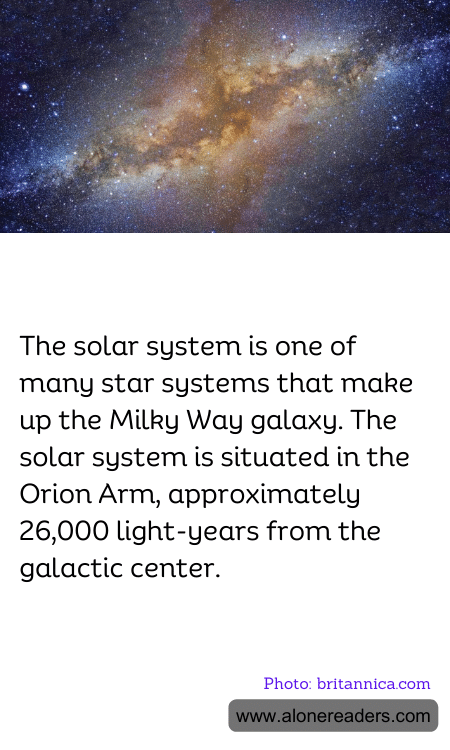
Our solar system, a mesmerizing collection of planets, moons, asteroids, and comets, orbits a single star—our Sun—and is one of the billions of star systems that make up the Milky Way galaxy. Situated in the Orion Arm, a spiral arm of the Milky Way that is approximately 26,000 light-years from the galactic center, the solar system is about 4.5 billion years old, a relatively young age in the cosmic timeline.
The solar system is dynamically laid out with the Sun at the center, holding everything in its gravitational grip. Surrounding the Sun are the planets, divided into the inner rocky planets (Mercury, Venus, Earth, and Mars) and the outer gas giants (Jupiter and Saturn) and ice giants (Uranus and Neptune). The planets orbit the Sun in elliptical paths, with the inner planets having shorter and faster orbits compared to their distant gas and ice giant cousins.
Beyond the planets, the solar system extends into the Kuiper Belt and the scattered disk, which are home to many small icy bodies, including dwarf planets like Pluto. Far beyond even these distant regions, the hypothesized Oort Cloud forms a distant shell of icy objects believed to be the source of long-period comets, marking the edge of the Sun’s gravitational influence and the end of the solar system.
Understanding the layout and dynamics of our solar system helps scientists comprehend the fundamental processes that govern other star systems in our galaxy and beyond. Despite a vast distance separating these systems, the underlying physics binding the cosmos is universal from the Sun’s nuclear fusion, which lights up our days, to the orbits of the outermost reaches of the Milky Way. In exploring our own solar system, we unlock clues about the broader universe—its past, its future, and the potential for other life-bearing worlds.
