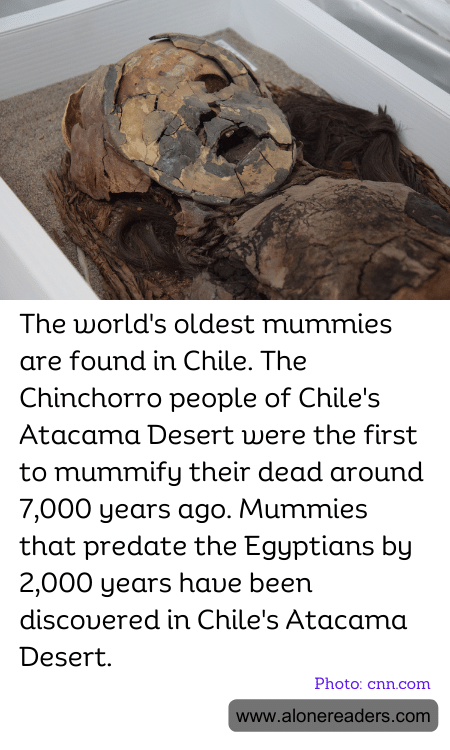
In the arid stretches of Chile's Atacama Desert, the world's earliest known mummies have emerged, reshaping our understanding of ancient burial practices. These mummies, created by the Chinchorro people, date back to around 7,000 years ago, a timeline that precedes the Egyptian mummification by at least two millennia. The Chinchorro were a coastal people, subsisting mainly on fishing, who developed a unique method of preserving their dead.
Unlike the ornate and hierarchical mummification techniques seen in ancient Egypt, the Chinchorro mummification process was remarkably democratic, applied to all members of their society regardless of age or status. This inclusive approach suggests a deep cultural reverence for the community and the deceased. The mummification involved removing the internal organs and reinforcing the body with sticks and reeds to maintain the original shape and structure. The skin was often removed, treated, and then reattached to the body, and in some cases, the skin of sea lions was used as a cover. Facial features were reconstructed with clay, and the mummies were often painted with a red or black pigment, giving them a distinctive appearance that has been remarkably preserved through the millennia.
The extreme dryness of the Atacama Desert played a key role in the natural preservation of the mummies, but the meticulous care taken by the Chinchorro in preparing their dead indicates a complex understanding of bodily preservation. The reasons behind the Chinchorro's mummification practices remain a topic of research and speculation. Some scholars suggest that the practice might have originated as a way to cope with the psychological impact of environmental hardships or as part of ritualistic beliefs connected to life after death.
The discovery of the Chinchorro mummies offers invaluable insights into the early development of human cultural practices related to death and the afterlife. It also highlights the diversity and ingenuity of prehistoric civilizations, reminding us that ancient peoples around the world had complex belief systems and sophisticated traditions long before many of the more commonly recognized ancient cultures. As research continues, these ancient mummies help piece together the vast and varied tapestry of human history tucked away in one of the world's driest deserts.
