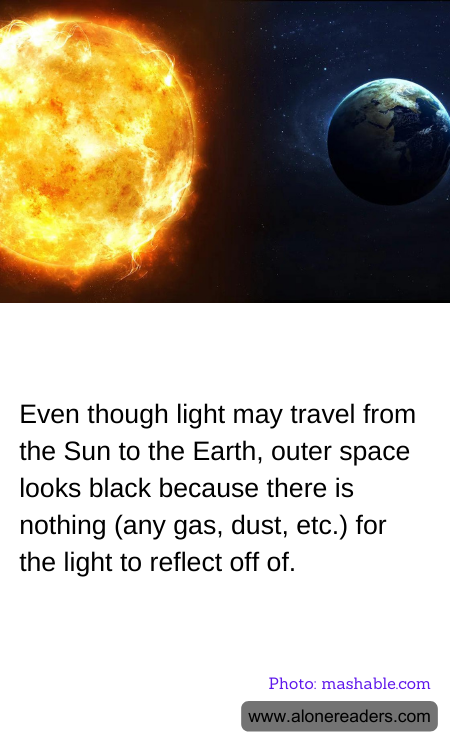
When we look up at the sky during the day, the Sun's light illuminates our atmosphere, scattering blue wavelengths and giving the sky its blue color. However, when we gaze into outer space, even though it is filled with countless stars including our own Sun, space appears pitch black. This stark contrast puzzles many, yet the explanation lies in the nature of light and the environment through which it travels.
Light travels through space in a straight line until it interacts with some form of matter. It can be absorbed, reflected, or bent. In the vast stretches of outer space, there are large expanses where very little matter—such as gas, dust, or other particles—exists. Without these particles to scatter light, there is nothing to illuminate and thus no light reaches our eyes. This means that while light from stars continues to travel through space, it only becomes visible when it has something to interact with that can reflect or scatter it toward us.
In the context of our Sun, it illuminates planets, asteroids, and comets within our solar system. However, beyond this, its light travels unimpeded through empty space, failing to interact with enough matter to be visible. As a result, vast regions of space appear devoid of light, creating the visual perception of darkness despite the presence of billions of lights shining across the universe.
Furthermore, the sensitivity of human eyes also plays a role in how we perceive light and darkness in space. Our eyes are not sensitive enough to detect the dim light of distant stars in the same way they detect sunlight. Additionally, the further away a light source is, the fainter it appears, explaining why faraway stars seem less bright, contributing less to the lighting of space on a grand scale.
In essence, the phenomenon of space appearing black, despite being filled with sunlight and light from other stars, can be attributed to the absence of enough matter to scatter the light to our vision, and the limitations of human eyes in detecting extremely dim light at great distances, resulting in the deep darkness that characterizes our view of space from Earth.
