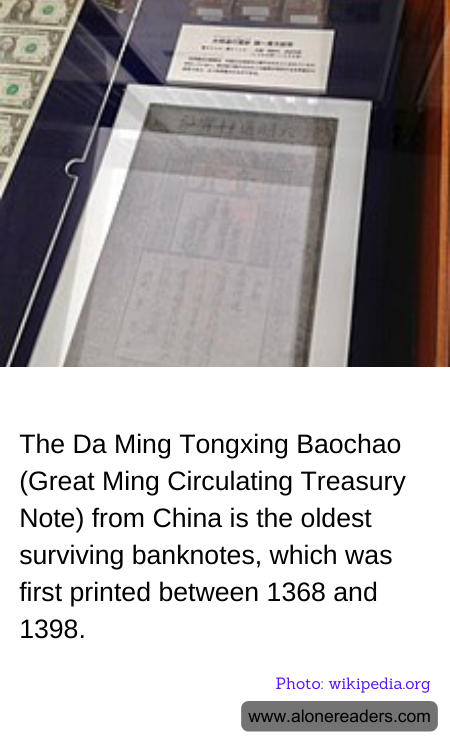
The Da Ming Tongxing Baochao, translating to the Great Ming Circulating Treasury Note, holds the distinction of being among the earliest surviving banknotes in the world. Issued during the Ming Dynasty (1368–1644) under the reign of the Hongwu Emperor, these notes were first printed between 1368 and 1398, marking a significant development in the history of money.
The issuance of this currency was part of a broader attempt to stabilize and streamline the economic system of the vast and populous empire. At the time, China was already advanced in terms of monetary innovations, having been one of the first cultures to use paper money. The Ming notes were intricately designed, featuring complex patterns and textual information aimed at preventing counterfeiting, a persistent issue even in ancient times.
The production of these notes was authorized by the government and came with strict regulations. The paper used was of high quality, and specific offices were established to control the printing and circulation of the currency. This was an early example of state-controlled monetary policy, a concept that has evolved but remains in practice in modern economic systems around the world.
The importance of the Da Ming Tongxing Baochao goes beyond its functionality as a tool of trade and commerce. It is a cultural artifact that offers insights into the technological, artistic, and administrative capabilities of the Ming Dynasty era. The banknotes illustrate the sophistication of early Chinese printing technology, including woodblock printing, which would later spread to other parts of the world and revolutionize the production of books and other printed materials.
Despite their historical significance, the use of these notes eventually declined. The inability to control mass issuing led to inflation and a subsequent loss of faith in paper money, prompting a return to coinage. Today, examples of Da Ming Tongxing Baochao are prized by collectors and historians alike, not only for their rarity and age but as a testament to China’s long-standing role as a pioneer in financial innovation. They are preserved and displayed in museums around the world, where they continue to educate and fascinate those interested in the rich tapestry of human economic history.
