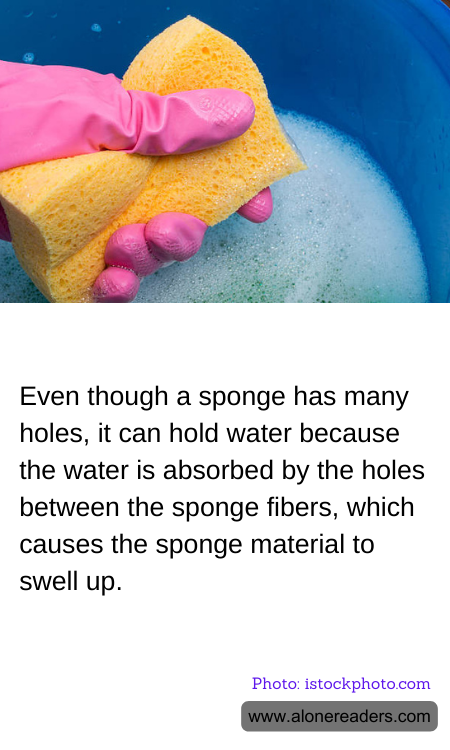
Sponges are fascinating objects, both in their natural form in the ocean and as a synthetic product commonly used in households. The reason a sponge can hold water despite being full of holes lies in its physical structure and the properties of water itself.
The body of a sponge, whether natural or synthetic, consists of a network of porous fibers. In the case of natural spones, these fibers are made of a substance called spongin; synthetic sponges, on the other hand, are usually made from foamed plastic polymers. The spaces between these fibers create a matrix of tiny pores and canals. When a sponge is immersed in water, these pores fill up due to a physical phenomenon known as capillary action.
Capillary action occurs when the adhesion of water molecules to the walls of the sponge's fibers is stronger than the cohesion forces among the water molecules themselves. This adhesion pulls water into the tiny spaces between the fibers, and cohesion helps more water to follow along, filling the pores efficiently. As the sponge absorbs water, it expands slightly, which allows it to retain even more water within its structure.
Moreover, the surface tension of water—a measure of the elastic tendency of its surface—plays a critical role. It acts as a sort of seal at the openings of the pores, preventing the water from easily flowing out unless the sponge is squeezed. When pressure is applied to the sponge, the structure compresses, reducing the size of the pores and forcing the water out.
Thus, the holes in a sponge are not a detriment to its ability to hold water; rather, they are crucial to its function. The design of a sponge showcases a perfect balance between form and functionality - with its porosity being the key to its ability to absorb and hold liquids. This simple yet effective mechanism has made the sponge an indispensable tool in cleaning and other applications around the world.
