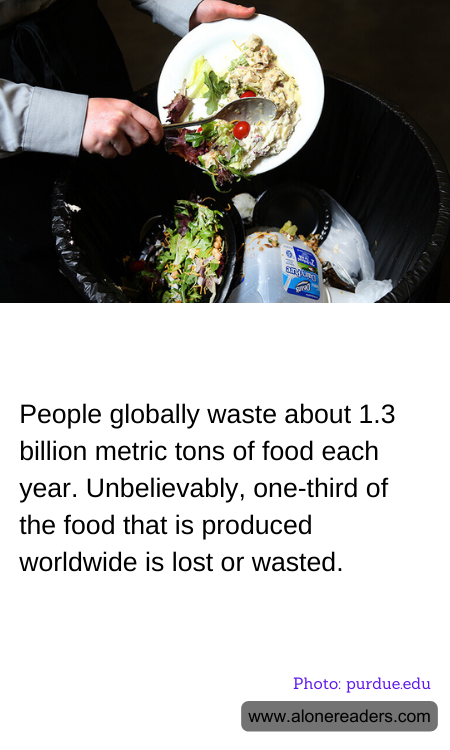
Each year, approximately 1.3 billion metric tons of food are wasted globally—a staggering figure that represents about one-third of the food produced for human consumption. This immense waste has far-reaching implications, not only for global food security but also for the environment, economy, and society at large.
Food waste occurs at various stages of the food supply chain—from initial agricultural production through household consumption. In developing countries, food loss often happens earlier in the supply chain, during production, handling, and storage. Factors such as inadequate harvesting techniques, climatic conditions, and logistical challenges contribute to this early-stage waste. In contrast, in more developed countries, the majority of food waste occurs at the retail and consumer levels. This can be attributed to stringent quality standards that lead to the rejection of perfectly edible food, inefficient purchasing practices, and poor planning by consumers.
The environmental impact of food waste is profound. When food is discarded, it ends up in landfills where it decomposes and releases methane, a potent greenhouse gas. Moreover, the water, energy, and labor utilized in growing, processing, transporting, and cooking this wasted food are also squandered. To put it into perspective, if food waste were a country, it would be the third-largest emitter of greenhouse gases after the USA and China.
Economically, the cost of food waste is equally alarming. It is estimated that the global economy loses hundreds of billions of dollars each year as a result of wasted food. For households, this translates to a substantial portion of their food budget vanishing into thin air. At a time when global food prices are steadily climbing, reducing food waste could have a significant impact on reducing the overall economic strain experienced by millions of consumers worldwide.
Addressing this issue requires a multifaceted approach. Governments, businesses, and individuals all have roles to play. Policies aimed at improving food storage, processing facilities, and transportation to reduce spoilage, particularly in developing countries, are crucial. Retailers can revise quality standards and donate surplus food to charities instead of discarding it. There is also a strong case for consumer education campaigns to help change public attitudes and behaviors regarding food purchasing, storage, and consumption.
Innovative solutions like app-based platforms that connect consumers with food outlets that have surplus food, or the use of biogas facilities to turn food waste into energy, are being tested and implemented around the world. Each step taken towards reducing food waste not only brings us closer to achieving global food security but also lessens the environmental impact, presenting a win-win scenario for both humanity and the planet. As awareness grows and more strategies are put into place, there is hope that this persistent problem can be significantly mitigated.
