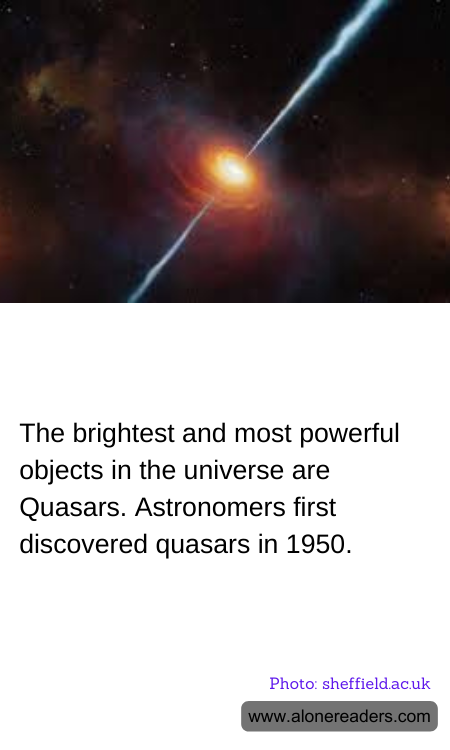
Quasars, or quasi-stellar objects, are the brightest and most powerful objects in the universe, outshining even the brightest galaxies by hundreds of times. The first quasars were discovered in the late 1950s and early 1960s, initially detected as sources of radio waves. It was a mystery that puzzled astronomers, as these objects resembled stars in optical telescopes but behaved entirely differently.
The true nature of quasars began to unfold through the work of astronomers like Maarten Schmidt, who in 1963 identified the redshift in the spectrum of 3C 273, one of the first quasars discovered. This redshift indicated that the quasar was moving away from Earth at a significant fraction of the speed of light, an observation that placed 3C 273 at a vast distance from Earth, much further than any known star, and suggesting a remarkably high intrinsic brightness.
Quasars are powered by supermassive black holes at the center of galaxies. As matter spirals into these black holes, it heats up to incredible temperatures, emitting vast amounts of energy across the electromagnetic spectrum, including visible light, radio waves, and even X-rays. This process occurs in the accretion disk, a structure of dust and gas that forms around the black hole. The immense gravitational pull of the black hole and the speed at which material is compressed and heated in the accretion disk account for the tremendous energy output of quasars.
Despite their luminosity, quasars are not visible to the naked eye due to their extreme distances from Earth. They reside in the centers of galaxies far across the universe, with light from the closest quasars taking billions of years to reach our planet. Their brightness allows them to be used as cosmic beacons that help astronomers probe the distant universe, understanding both the large-scale structure of the cosmos and the evolution of galaxies through time.
The study of quasars continues to be a vibrant field in astronomy, contributing crucial insights into the behavior of matter under the most extreme conditions, the growth and evolution of supermassive black holes, and the expansion of the universe itself. As observational tools improve and new quasars are discovered, our understanding of these fascinating objects continues to evolve, offering glimpses into the very early universe, a time when quasars were more common and played a significant role in the way the universe looks today.
