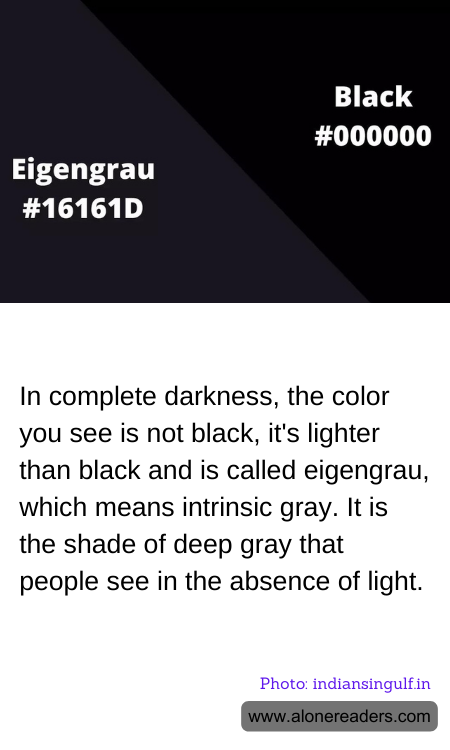
When we close our eyes or find ourselves in a pitch-dark environment, the color we perceive is often assumed to be pure black. However, this is not the case. The color seen in complete darkness is actually a dark gray tone, known as eigengrau, which translates to "intrinsic gray" in German. This phenomenon occurs because the cells in our eyes—specifically the rods, which are responsible for vision in low light—constantly send information to the brain, even in the absence of light.
Eigengrau is not just a random perception but rather an interesting demonstration of our visual system's baseline output in complete darkness. It serves as a reminder of the brain's complex processing capabilities, constantly interpreting signals even when external visual input is minimal or nonexistent. This intrinsic gray is perceived as lighter than black due to the contrast between the complete absence of light and the minimal but constant neuronal activity.
The color eigengrau is said to be more noticeable in situations where a person transitions from a brightly lit environment to a dark one. During this transition, the eyes adjust, and individuals may become more aware of eigengrau as their vision adapts to the new level of light, or rather, the lack of it. This gray perception highlights the inherent activity in our visual system, emphasizing that even in darkness, our sensory perception is not completely turned off.
Understanding eigengrau not only deepens our understanding of human sensory perception but also underscores the subtleties of how we interpret and understand the world around us, even under conditions that seem devoid of any visual stimulus. This intrinsic gray paints a fascinating picture of the ever-active nature of brain function, illustrating how our perception of reality is a complex and dynamic interplay between the environment and our neural processes.
