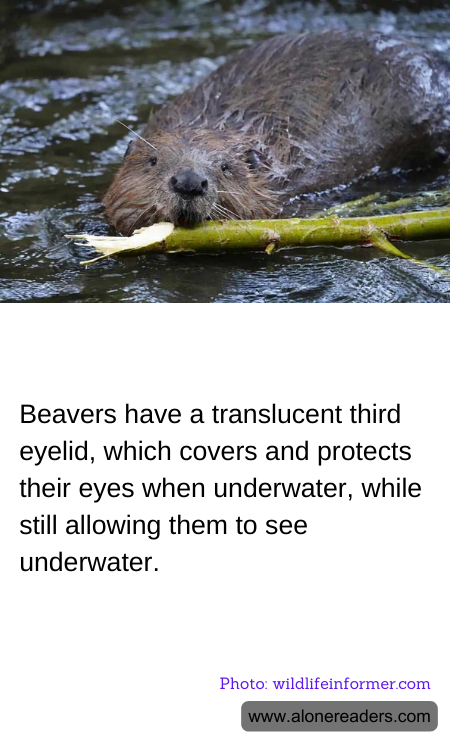
Beavers are remarkable creatures not only due to their impressive engineering skills but also because of their specialized physical adaptations that make them highly effective aquatic animals. One of the lesser-known yet fascinating adaptations is their translucent third eyelid. This feature allows beavers to see underwater while protecting their eyes, a vital adaptation for an animal that spends a significant amount of time submerged.
Often referred to as a "nictitating membrane," this third eyelid sweeps horizontally across the beaver's eye from the inside to the outside corner, acting as a form of biological goggles. While the beaver dives, chews on underwater vegetation, or carries out construction work on dams and lodges, its eyes are shielded from potential hazards such as floating debris, abrasive sand, and even the water itself, which can be murky and filled with particulate matter.
This eyelid is transparent enough to allow beavers to see, albeit less clearly than they would on land. This sight capability is essential for navigating underwater, avoiding predators, and locating the stems, branches, and leaves they favor. The membrane functions similarly to how humans might use swim goggles, permitting beavers to keep their eyes open underwater to gather construction materials or food with precise vision. Moreover, this feature is moistened by tears to ensure it doesn't dry out and to provide additional lubrication, which increases the comfort and vision clarity of the beaver while submerged.
In addition to the nictitating membrane, beavers possess other adaptations that aid their aquatic life. Their large, flat tails serve as rudders, helping them steer in the water, and their webbed hind-feet act like natural paddles, greatly enhancing their swimming ability. Moreover, their fur releases oil that adds a waterproof layer, adding another level of protection and thermal insulation.
These combined adaptations—suited both for water and land—underscore the evolutionary success of the beaver. As ecosystem engineers, beavers play a crucial role in enhancing their habitats, affecting everything from local water levels to wildlife diversity. Their ability to modify landscapes is unparalleled among North American mammals, demonstrating the importance of their survival and the conservation of their wetland environments. The nictitating membrane is just one piece of the anatomical puzzle that makes beavers such adept and resilient animals in their watery worlds.
