The Babylonians, an ancient civilization originating from the region of Mesopotamia, present-day Iraq, were pioneers in various fields including mathematics, astronomy, and engineering. One of their most enduring contributions to the world was the development of the sexagesimal, or base-60, numerical system. This system, which dates back to around 2000 BCE, is particularly notable for its influence on the way we measure time today.
Unlike the decimal system, which is based on the number 10, the Babylonian system was based on the number 60. This choice might seem arbitrary today, but it offered many practical advantages. Sixty can be evenly divided by a number of divisors (2, 3, 4, 5, 6, 10, 12, 15, 20, 30), making calculations easier and more flexible. This flexibility was useful both in abstract mathematics and in applied fields like astronomy, which was a major area of Babylonian scholarship.
The use of the sexagesimal system led to the division of the circle into 360 degrees (6 x 60), reflecting the Babylonian year's 360 days. This integration of timekeeping and geometry was critical to the development of both astronomy and navigation. The division of each hour into 60 minutes and of each minute into 60 seconds derives directly from this system. This method of time measurement has persisted through the centuries, long outliving the Babylonian civilization itself, and remains the standard today.
The legacy of the Babylonians in the field of time measurement is profound. Their mathematical innovations laid the groundwork for future civilizations, particularly the Greeks, who built on and expanded Babylonian astronomical calculations. Through these channels, Babylonian innovations were eventually absorbed into the broader scientific canon and still impact the way we conceptualize and measure time today.
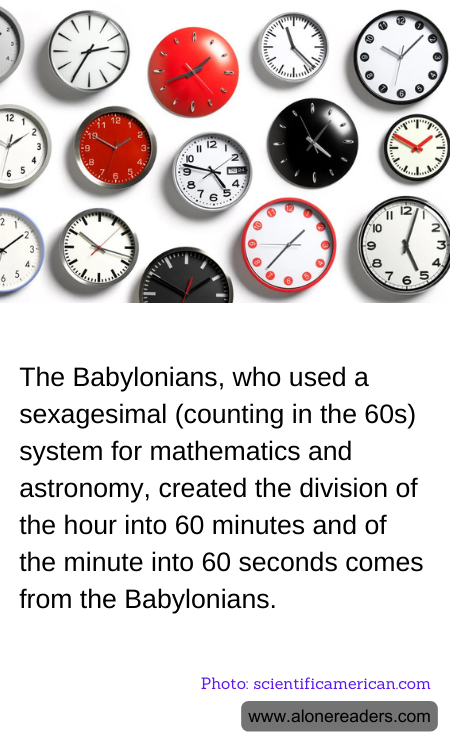
In essence, every glance at a clock or watch is a moment that connects us with the ancient Babylonians, reminding us how civilizations thousands of years apart can influence and enrich one another through shared knowledge and ingenuity.
